column (e.g. in newspaper)
2025.07.24
I keep hearing about light therapy (IPL), but what is it?

As an Assistant Professor, Associate Ward Director, and Chief of Dermatopathology at the university hospital dermatology department, I deepened my expertise through academic presentations and paper publications both domestically and internationally. I have handled a wide range of treatments, from birthmark therapy in children to adult pigmentation concerns, utilizing various lasers and injection therapies, while also contributing to community healthcare. Through encountering numerous cases, I strongly felt the potential and necessity of aesthetic medicine, resolving to pursue further expertise. Building upon my solid dermatological knowledge and meticulous diagnostic skills, I value treatments that gently support each individual's skin while bringing out its inherent beauty.
Have you ever heard of light therapy (IPL)?
I am Dr. Aya Hayama, a board-certified dermatologist.

Actually, this light therapy (IPL) is, roughly speaking, a triple-threat treatment with minimal downtime that effectively addresses dark spots, redness, and improves skin firmness.💓
When referring to light therapy in a broad sense, it is sometimes called IPL, which is IIntense Pused LA word formed by stringing together the initial letters of "light," it refers to a machine that generates high-power short pulses (hereinafter).
※Luminous Corporation was the first in the world to createHigh-power short-pulse light generatorAnd since IPL is essentially a trademarked name, other light therapies should not use it; however, such devices are collectively referred to as IPL.とThere are also other options. Photo facials are the same.
Light sources available for SP
Selective Photothermolysis (SP) utilizes pulsed light with high energy density to selectively destroy colored cells or tissues. Therefore, laser beams can deliver pulsed light with extremely high energy density. However, the light source used for SP does not necessarily need to be a laser; any conventional light source capable of emitting pulsed light with very high energy density can be used for SP.
The Difference Between Laser Light and Ordinary Light
We can now artificially generate coherent light with a uniform phase and wavelength for use in lasers. While such lasers are often limited to emitting light of a uniform wavelength, high-power short-pulse devices (such as IPL for phototherapy)Light typically ranging from 500 to 1200 nmIn other words, it can simultaneously emit light across wavelengths from visible light to near-infrared. This means a single device can simultaneously emit light absorbed by melanin, hemoglobin, and water. Consequently, a single unit can be used to treat pigmented lesions and vascular lesions, as well as for hair removal purposes.
The Truth About Laser Therapy and Cosmetic Dermatology Treatments: What No One Told You By Watanabe Fumiichi, Professor Emeritus, Teikyo University See
Rumekka.
Lumecca, a type of light therapy (IPL), is applied to the entire face. While it doesn't deliver the same results as laser treatments, its lower energy output means less downtime. This makes it ideal for year-round maintenance.
Intense Pulsed Light (IPL) therapy utilizes a broad spectrum of wavelengths to effectively address concerns such as dark spots, dullness, freckles, and redness. By inducing thermal denaturation around blood vessels and stimulating the regeneration of collagen fibers in the surrounding tissue, it also improves skin texture and reduces wrinkles. A single session can deliver noticeable improvements in skin radiance and dullness. An added benefit is its mild hair reduction effect, resulting in a smooth, silky skin texture.
It is also suitable for treating particularly faint spots and fine freckles, as well as improving redness in the face.
Now, take a look at the case!!
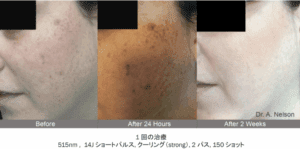
When the reaction is good, the affected area may respond by forming scabs, but in most cases, the scabs fall off without leaving any pigmentation.
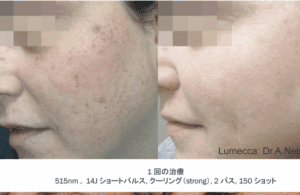
This treatment also targets雀卵斑 and dark spots with its short wavelength, so it's quite effective.
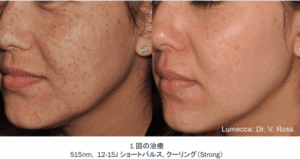
This treatment also uses short wavelengths to remove spots, but it also reduces redness and evens out the skin tone, resulting in a beautiful appearance.
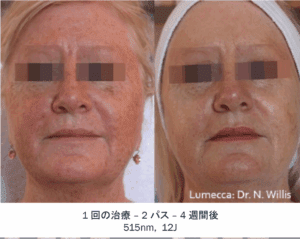
Perhaps because he's Caucasian, the redness has subsided despite the short wavelength irradiation.
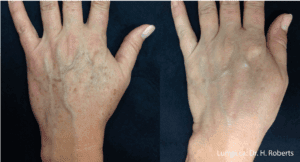
Hand spots are actually quite difficult to treat, but with Lumecca, look at this result!
As you can see, other benefits include skin tone brightening and improved firmness through enhanced cell turnover.
It is effective not only for the face but also for age spots that appear on the back of the hands with age.
(However, pigmentation tends to appear more easily than on the face, and because metabolism is slower than in facial skin, it may take longer to fade.)
Downtime is minimal, and the discomfort is comparable to being flicked with a rubber band, making it a good choice even for those sensitive to pain.
For those with both melasma and sunspots, since sudden worsening is unlikely, I believe it's worth trying. Please consider this point and feel free to consult with us.
https://biancaclinic.jp/medical-spa/skincare/lumecca/
Here's a personal musing from me, a dermatologist...
I also love that light therapy (IPL) allows for more customized treatments by adjusting wavelengths: 515nm for faint spots, 560nm for overall treatment, 580-590nm for redness, and wavelengths like 755nm or 1000nm for hair removal.
I secretly like how it feels like a chance for dermatologists to show off their skills!