column (e.g. in newspaper)
2025.11.08
What method of implantation is best in the end? Comparison of Fixation Methods, Front Clamping / Back Clamping
As a plastic surgeon certified by the Japanese Society of Plastic and Reconstructive Surgery, I have been involved in many cases of trauma, reconstruction, and congenital diseases, and have cultivated precise techniques and a deep understanding of anatomy. He entered the field of cosmetic surgery out of a desire to bring the power of cosmetics to his patients, as a change in one's appearance can also make one's mind more positive. Her specialties include general treatment of the eye area, injections, and sagging skin. I provide treatments that focus on beauty with the medical stance of "sincerely addressing the ideals of the patient.
Hello!
Designing natural beauty with trust.
I am Masataka Fujihashi, a board-certified plastic surgeon.

Is two points okay for the burial? How many points are best?
"What's the difference between the tarsal plate method and the levator muscle method?"
"Is back fastening better than front fastening?"
I really do get this question a lot in counseling.
However, to get straight to the point,
“There is no universal solution for buried objects.”
And then,The most important thing is whether it suits your eyelids. is.
The buried suture method goes by various names at different clinics, so you might be wondering which one to choose.
The only four points that actually influence the outcome of the procedure are as follows:
① Where to fix it (tarsal plate method / levator muscle method)
② How many points to fasten (2 points, 3 points, 4 points...)
③ Tie the thread on the front side or tie it on the back side
④ Eyelid condition (thickness, excess skin, fat, levator muscle strength)
Once you understand this, you won't be misled by names, and you'll see the method that suits you.
With this in mind, I will now explain the representative surgical methods in order.
⸻
■ Mounting Method
① Tarsal Plate Method (Natural, Minimal Downtime / Suitable for Those Preferring a Subtle Width)
This method involves attaching the suture to the hard supporting tissue called the tarsal plate located behind the eyelid, making it technically simple.
• BenefitsLess swelling, natural-looking results
• DisadvantagesIncreasing the width makes it looser and more prone to springing back.
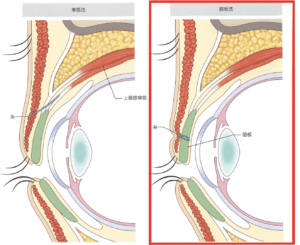
Source: 'Facial Plastic Surgery, 1st Edition' (Nihon Iji Shinposha, 2021) p.5, Figure 3, reproduced with modifications
Suitable for
・Originally prone to creasing monolid
・Someone who's okay with deep-set eyes
・For those who want a subtle, natural double eyelid
Not suitable for
・Severe skin laxity
・Excess fat in the eyelids
・People who prefer a wide design
In the above type,difficult to achieve width・prone to revert There is a tendency.
✅ Suitable for narrower designs
❌ Not suitable for those who want a wide look / have thick eyelids / or significant drooping
→ The tarsal plate method is highly compatible with individuals who have thin eyelids and a narrow eye shape.
② Elevator Method (Stable and effective for wide ranges / Technical proficiency makes a difference)
A method that directly creates the double eyelid structure by attaching threads to the muscle that lifts the eyelid (levator muscle).It reproduces a structure that closely resembles the principle of natural double eyelids.
• Benefits: Resistant to slipping back / Capable of accommodating a wide range / Provides a firm grip
• DisadvantagesSignificant Variation in Physician Technique / Risk of Iatrogenic Ptosis
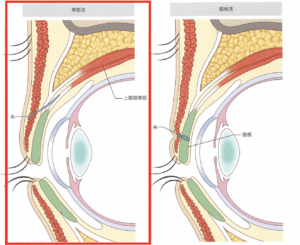
Source: 'Facial Plastic Surgery, 1st Edition' (Nihon Iji Shinposha, 2021) p.5, Figure 3, reproduced with modifications
Suitable for
・Strong single eyelids
・Thick eyelids / Excess skin
・I want to make sure the width is substantial
Especially those who aren't suited for itNoneHowever, the downside is thatRisk of iatrogenic ptosisand there is,Technical differences arise in how the thread is applied and the tightness of the knot,The doctor's experience is crucial.will come to be.
Compared to the tarsal plate method, the downtime honestly doesn't change at all once you get used to it.
✅ Easy to accommodate even wide items
✅ Natural and hard to detect
✅ Long-lasting
❗ Choosing a physician with solid experience is a prerequisite.
→ For those seeking to address drooping eyelids or achieve wider double eyelids, the levator muscle procedure is the only viable option.
③ Natural Adhesion Method
This method involves intricately embedding a single thread to promote natural adhesion between the eyelid skin and the levator muscle, thereby creating a double eyelid line.
• BenefitsTheoretically difficult to achieve, a double line forming a natural arch
• Disadvantages:Prone to swelling and bruising, with a long recovery period
“It is not a ”magical method that is particularly hard to break."
Structurally, it is ultimately a type of burialis.
By devising a method for threading the needle to "support the line more broadly,"Often advertised as "smooth engagement" and "hard to disengage,"Structurally identical to burial.
People who fall out just fall out.
⸻
■ Front Fastening / Back Fastening Differences
Front fastening
The knot in the thread skin side How to get here.
• People often say it produces a ball of thread, butIf handled carefully, it's hardly noticeable.。
• Wounds Tiny holes at the base of the eyelashes so,Most people can't tell even if they see it.。
• When changing lines in the future,Easy to remove stitchesThis also offers significant advantages.
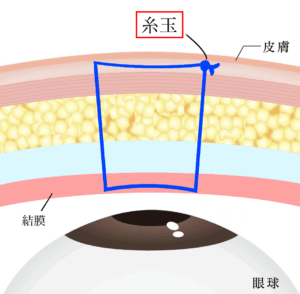
Back fastening
the knot in the thread The inner surface of the eyelid (conjunctival side) How to embed it.
• Since no scratches appear on the surface,“For those who are concerned about tangled yarn。
• However,Removing stitches is somewhat difficult.(Experienced physicians can handle it).
• When performing a double eyelid incision,The thread used for the backstitch may remain.Please be careful.
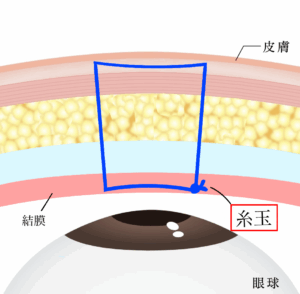
Conclusion:
Surface fastening is the basic method with minimal risk during finishing and adjustments.
Back fastening is for those who absolutely don't want any marks. However, it's not a universal solution, nor is it necessarily better than front fastening.
⸻
■ Summary
Burial is not about "which one is best,"Choosing the right method for your eyelids is important. is.
• Tarsal plate method → For those with thin eyelids / prefer a subtle width and natural look
• Elevator Method → For those with thick eyelids / wanting wider eyelids / seeking stability
• Spontaneous adhesion → Not as special as the name suggests, merely a form of obscurity
• Even with a surface mount,If handled carefully, scratches and thread balls will be barely noticeable.。
• The back fastening is,For those who don't want to get hurtHowever, caution is required during suture removal and future incisions.
This timeFixed Method and Surface Fastening/Back FasteningI explained.
Next time,
・What is the best number of points to use? (The difference between 2 points, 3 points, and 4 points)
・Thread placement methods (dot stitch / triangle / square)
・Is “special thread” really different?
I'll summarize this for clarity, so stay tuned.
⸻
Reservations can be made here.
Complete your reservation in 60 seconds ▶︎
https://reservation.medical-force.com/b/d7bb811e-ebd5-4b93-93f8-588864b24f15
⸻
【Profile】
Masataka Fujihashi, MD, Plastic Surgeon
Leveraging expertise as a board-certified plastic surgeon, I offer comprehensive facial cosmetic procedures including eyelid and nose surgery, facial liposuction, thread lifts, and hyaluronic acid injections. From incisional surgeries and revision procedures requiring delicate design to minimally invasive injections and lifts with minimal downtime, I strive to provide treatments tailored to each patient's ideal outcome.
We are dedicated to achieving natural results and minimizing downtime, pursuing medical care that leaves you feeling confident in your choice through sincere consultations.
Designing natural beauty with trust.
We cherish that sentiment and apply it to our daily practice.
Read other blog posts ▼
https://biancaclinic.jp/author_cat/fujihashi/
【SNS】
Instagram ▶︎ https://www.instagram.com/dr_fujihashi?igsh=MTEzOW1sc3p3bGFibA%3D%3D&utm_source=qr
X ▶︎ https://x.com/dr_fujihashi?s=21
【Career】
March 2015: Graduated from the School of Medicine, Showa University
April 2015 Showa University Yokohama Northern Hospital Initial Clinical Training
April 2017 Showa University Hospital Department of Plastic Surgery
October 2017 Maebashi Red Cross Hospital Plastic Surgery / Cosmetic Surgery
April 2019 Nishio Municipal Hospital Plastic Surgery Department
April 2020 Showa University Fujigaoka Hospital Plastic Surgery Department
November 2020 Ota Nishinouchi Hospital Plastic Surgery / Cosmetic Surgery
July 2022 Tokyo Rosai Hospital Plastic Surgery / Cosmetic Surgery Department Head
July 2022: R.O.clinic (Part-time), Kusano Taro Clinic (Part-time)
April 2024 Deputy Director, Ginza TA Clinic
November 2025 BIANCA CLINIC
【Professional Affiliations and Qualifications】
Japanese Society of Plastic and Reconstructive Surgery Board-Certified Plastic Surgeon
Member of the Japanese Society of Aesthetic Plastic Surgery (JSAPS)
Member of the Japanese Society of Aesthetic Surgery (JSAS)