column (e.g. in newspaper)
2025.11.09
What method of implantation is best in the end? (2) Comparison of the number of fixation points, threading methods, and thread types.
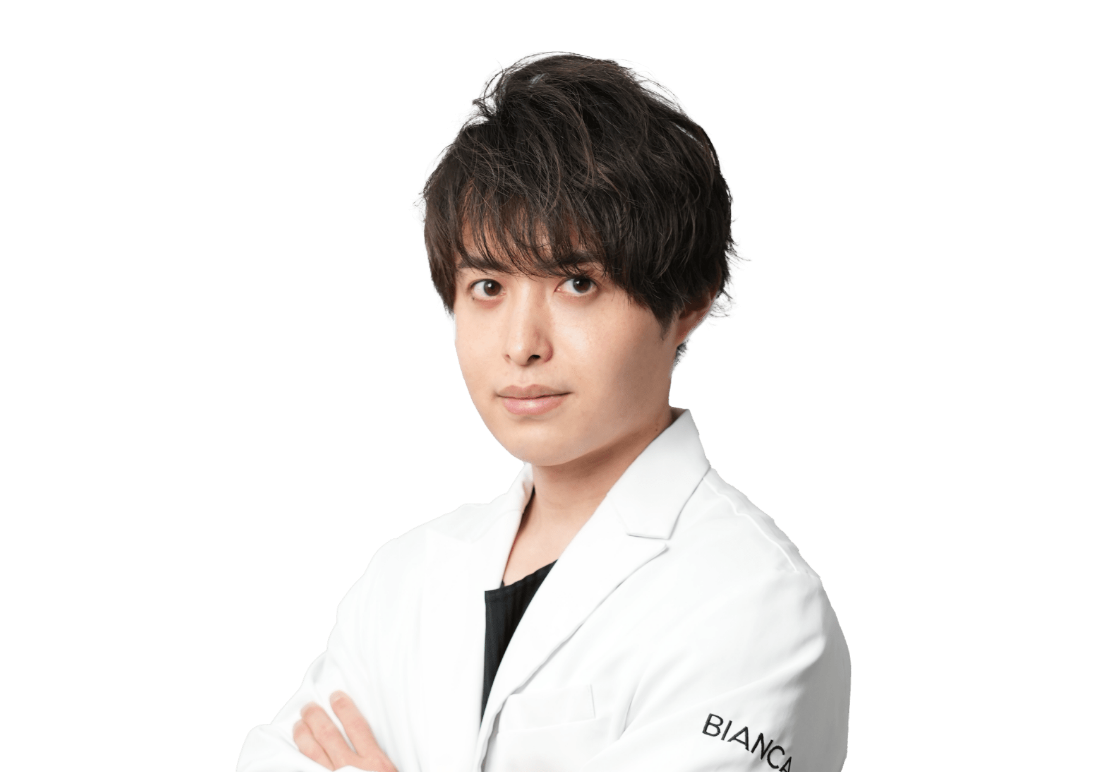
As a plastic surgeon certified by the Japanese Society of Plastic and Reconstructive Surgery, I have been involved in many cases of trauma, reconstruction, and congenital diseases, and have cultivated precise techniques and a deep understanding of anatomy. He entered the field of cosmetic surgery out of a desire to bring the power of cosmetics to his patients, as a change in one's appearance can also make one's mind more positive. Her specialties include general treatment of the eye area, injections, and sagging skin. I provide treatments that focus on beauty with the medical stance of "sincerely addressing the ideals of the patient.
Hello!
Designing natural beauty with trust.
I am Masataka Fujihashi, a board-certified plastic surgeon.
In the previous article,
・Where to fix it (tarsal plate method / levator muscle method / natural adhesion)
・Front fastening / Back fastening
We have explained about.
This time, the following three factors that affect the finish and longevity of buried work:
① Score (2 points / 3 points / 4 points)
② Threading Methods (Stitching / Triangle / Square)
③ Thread Types (So They're Different After All? The Issue)
Let me break this down clearly.
⸻
■ Differences in Scoring (2 points / 3 points / 4 points)
Number of anchors = Number of "pillars" supporting the double structureis.
Fewer pillars mean weaker support; the more pillars there are, the more stable it becomes.
In other words,
• 2 points → It can produce changes, but its stability is weak.
• The score increases → Increased support along the line makes it harder to return.
There is a relationship.
Additionally, as the number of columns increases, the double line becomes ""A sharp, angular fold" → "A smooth, arched curve"approaches.
However,It's not necessarily true that the more points you earn, the better.
However, there is also the disadvantage that the more suture material used, the more likely it is to result in stronger scar tissue formation.
✅ Conclusion
• 2 points → Changes are minimal / Minimal support
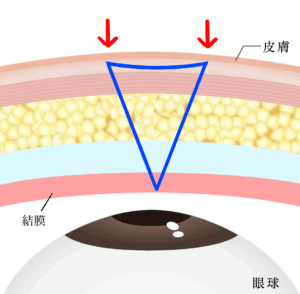
• 3 points →More stable than two points; the minimum score I want
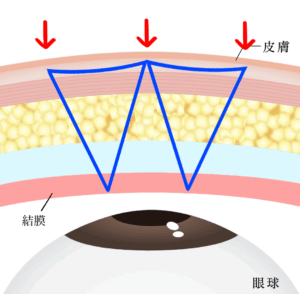
• 4 points → Offers the best balance of stability, clean lines, and minimal burden (particularly suitable for those with thick eyelids / desiring a wide crease / who want to avoid crease loss)
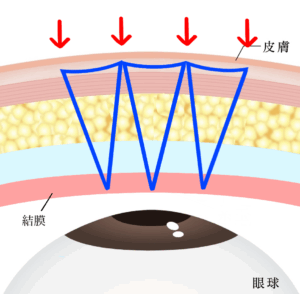
Putting in too much is also a burden, so “four points is just right.”That approach is perfectly fine.
⸻
■ Differences in Threading Methods (Stitching / Triangle / Square)
The buried suture method is not just about "how many points to secure,"How to run the threadBut stability changes.
However, in conclusion,Rather than which method is of higher quality, “whether the practitioner is familiar with that method” is also an important factor.。
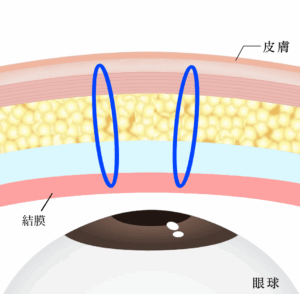
① Dot stop (simplest)
This is a method for securing the thread as a “dot” along the double line.
Benefits
• Simple procedures that are easy to keep costs down
Disadvantages
• Because force is concentrated at a single point,easy to return
• Immediate swelling can sometimes be surprisingly severe.
Suitable for
• Thin eyelids
• 「Those who say "just a little bit" or "I want to try it first"
→ For those who want to start easily. However, it is not suitable for those seeking long-term stability.
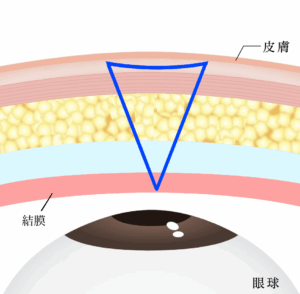
② Triangle Method (Supporting with Triangles)
ThreadTriangleA method of dispersing force by running it through.The triangle is the most structurally stable shape.
Benefits
• Rather than pinning difficult to return
• The line Easy to keep neat and tidy
• Compatible with the tarsal plate method(to prevent strain from concentrating on the tarsal plate)
People often say I'm prone to swelling...
→ This isDepending on the operator's actions。In my case,It actually causes less swelling than a stitch.
Suitable for
• Those seeking a balance between naturalness and stability
→ If you're going to bury it,This is the absolute minimum baseline.is.
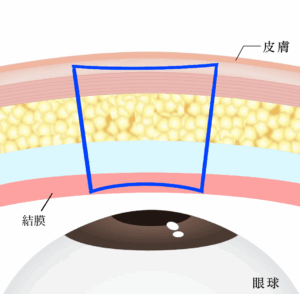
③ Square Method (Supporting with squares as “surfaces” / Emphasis on stability)
This method involves placing the thread in a square shape to support the eyelid with a surface.
Benefits
• Even for people with thick eyelids or excess fatThe line is stable
• Allows for softer indentation Lifting Method Compatibility ★
• Easy to recreate beautifully even with wide double eyelids
※Important Notes
• Is the tarsal plate method incompatible?
→ Force is applied from two directions,Risk of eyelid distortionThere is.
Suitable for
Thick eyelids / I want to make sure the width is substantial. People who are anxious about the return
→ If you're looking for stability, the "Elevator Method × Square" is an excellent choice.is.
⭐️ Here's the important thing
Patients often cannot specify how the sutures are placed.
The reason is simple.
The practitioner's “most familiar method”Because it's the least likely to swell and provides the most stable fit for that person.is.
Even with the same method,
Thread-passing layer / Balance of Power / Knot tension
The finished result is completely different with these.
⸻
■ The type of thread... actually doesn't make that much of a difference.
"Special Thread""Threads of different strengths""Long-lasting proprietary yarn"
You may see things like this in advertisements,Surgical sutures are standardized, and there is virtually no difference significant enough to affect outcomes.
Do not be misled.
⸻
■ Hearing all this, you might wonder, "So what's the best one?" but...
Buried is, after all, buried.is.
• Those who never return Can be kept beautiful for over 10 years
• People who are prone to slipping up Any method is prone to failure.
This is,The factor of "eyelid adaptation" is more significant than the relative merits of techniques.That's why.
Thick eyelids / Excess skin / Excess orbital fat
→ Implanted objects are prone to dislodgement.
→ Incision is more stable.
Thin eyelids / Prone to visible lines / Low fat content
→ Long-term stability is easily achieved
⸻
■ Thoughts While Examining Patients
Having performed numerous double eyelid surgeries, I have counseled many patients whose buried sutures repeatedly failed.
Among them,
"My buried nails absolutely won't come out.""It's made with special thread, so it lasts longer."
Many people were given this explanation and received the treatment.
However, when you actually look at the eyelids,
It is not due to the type or name of the thread, nor the advertising claims.Most cases involved eyelids that were fundamentally unsuitable for buried sutures.。
That's precisely why I want to say this loud and clear—
The most important thing in buried suture surgery is not the "method" but "choosing the right procedure for your eyelids."is.
The sad reality is that some doctors who cannot perform double eyelid surgery with high quality will push for buried suture procedures during consultations, even when the patient is not a suitable candidate.
On the other hand, there are conscientious doctors who will honestly tell you, "Since you're a candidate for an incision, I'll refer you to a doctor who's skilled at performing them."
Unfortunately, there's nothing to be done about this except call it luck, but the trick to spotting it is simple.
✅ Key points to watch
Are you thoroughly sharing double eyelid surgery cases on social media?
Doctors who have performed a significant number of incision procedures are more likely to accurately determine the appropriate technique for each patient, whether it be suture-based or incision-based.
⸻
■ Finally
Buried suture double eyelid surgery is an excellent starting point for double eyelid procedures.
The idea and choice of "starting with burial" is absolutely correct.is.
However, this is a point I want to be honest about.
Some eyelids are suitable for buried sutures, while others are not.
And “No matter how many times you bury them in ”unsuitable eyelids," they'll return when they return.
For example...
• The line becomes loose at least once a year.
• Repaired three or more times within two years
• Even if you loosen it, it immediately becomes loose again.
• Thick eyelids that are less prone to creasing
People who fit this pattern are,It's not that the buried suture is bad; it's just that the eyelid structure isn't suited for buried sutures.is.
In that case,The incision method is actually less burdensome and yields more stable results.
Insisting on deep embedding, adding more sutures, making the incision deeper...The more you repeat this, the more damage the eyelid tissue sustains, and the more scar tissue increases.The difficulty level increases when making an incision.
That's precisely why what's important is, "Which method is popular?But "Which method is special?nor,
「Which method—including buried sutures or incision—is best suited for your eyelids?」です。
Determining that together is our role as plastic surgeons.
Please feel free to come in for a consultation.
⸻
Reservations can be made here.
Complete your reservation in 60 seconds ▼
https://reservation.medical-force.com/b/d7bb811e-ebd5-4b93-93f8-588864b24f15
⸻
【Profile】
Masataka Fujihashi, MD, Plastic Surgeon
Leveraging expertise as a board-certified plastic surgeon, I offer comprehensive facial cosmetic procedures including eyelid and nose surgery, facial liposuction, thread lifts, and hyaluronic acid injections. From incisional surgeries and revision procedures requiring delicate design to minimally invasive injections and lifts with minimal downtime, I strive to provide treatments tailored to each patient's ideal outcome.
We are dedicated to achieving natural results and minimizing downtime, pursuing medical care that leaves you feeling confident in your choice through sincere consultations.
Designing natural beauty with trust.
We cherish that sentiment and apply it to our daily practice.
Read other blog posts ▼
https://biancaclinic.jp/author_cat/fujihashi/
【SNS】
Instagram ▶︎ https://www.instagram.com/dr_fujihashi?igsh=MTEzOW1sc3p3bGFibA%3D%3D&utm_source=qr
X ▶︎ https://x.com/dr_fujihashi?s=21
【Career】
March 2015: Graduated from the School of Medicine, Showa University
April 2015 Showa University Yokohama Northern Hospital Initial Clinical Training
April 2017 Showa University Hospital Department of Plastic Surgery
October 2017 Maebashi Red Cross Hospital Plastic Surgery / Cosmetic Surgery
April 2019 Nishio Municipal Hospital Plastic Surgery Department
April 2020 Showa University Fujigaoka Hospital Plastic Surgery Department
November 2020 Ota Nishinouchi Hospital Plastic Surgery / Cosmetic Surgery
July 2022 Tokyo Rosai Hospital Plastic Surgery / Cosmetic Surgery Department Head
July 2022: R.O.clinic (Part-time), Kusano Taro Clinic (Part-time)
April 2024 Deputy Director, Ginza TA Clinic
November 2025 BIANCA CLINIC
【Professional Affiliations and Qualifications】
Japanese Society of Plastic and Reconstructive Surgery Board-Certified Plastic Surgeon
Member of the Japanese Society of Aesthetic Plastic Surgery (JSAPS)
Member of the Japanese Society of Aesthetic Surgery (JSAS)