column (e.g. in newspaper)
2025.11.13
Treatment Options for Ptosis: Cosmetic Surgery vs. Insurance-Covered Surgery
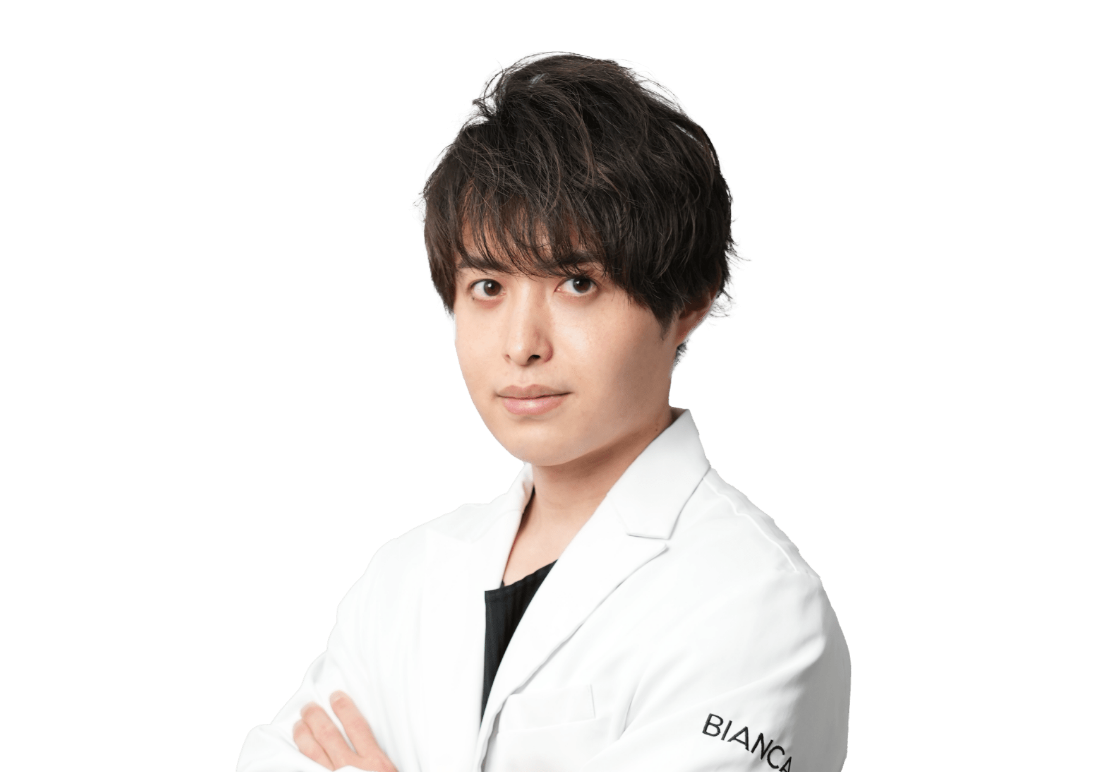
As a plastic surgeon certified by the Japanese Society of Plastic and Reconstructive Surgery, I have been involved in many cases of trauma, reconstruction, and congenital diseases, and have cultivated precise techniques and a deep understanding of anatomy. He entered the field of cosmetic surgery out of a desire to bring the power of cosmetics to his patients, as a change in one's appearance can also make one's mind more positive. Her specialties include general treatment of the eye area, injections, and sagging skin. I provide treatments that focus on beauty with the medical stance of "sincerely addressing the ideals of the patient.
Hello!
Designing natural beauty with trust.
I am Masataka Fujihashi, a board-certified plastic surgeon.

Last time, we explained the mechanism behind eyelid opening and the causes of ptosis.
(See previous blog ▶︎) https://biancaclinic.jp/blog/46274/)
This time, regarding treatment methodsI'll tell you about it.
Even with ptosis, the appropriate surgical method varies depending on the cause, severity, and desired outcome.
Here we will outline the main approaches and clarify the differences between cosmetic procedures and insurance-covered treatments.
⸻
■ Approaches to Ptosis Surgery
The goal of ptosis treatment is to restore the strength of the muscle that lifts the eyelid (levator muscle) so that it effectively transmits force to the tarsal plate.
The surgical approach is broadly Percutaneous approach と Transconjunctival approach It is divided into.
① Percutaneous approach
This method involves making an incision on the outer side of the eyelid (skin side) and operating while directly viewing the tendon membrane and Müller's muscle.
The wide surgical field allows for thorough visualization of structures, enabling highly reliable treatment.
Skin laxity excisionやFat lossSince it can be done simultaneously,The most standard surgical procedureis.
② Transconjunctival approach
This method is performed from the inner side of the eyelid (conjunctival side), with the advantage of leaving no scar on the outer surface.
On the other hand, advanced technical skills are required because the layers of the conjunctiva → Müller's muscle → levator aponeurosis must be handled within a narrow surgical field.
Assisting eyelid opening force through thread-based tacking (stitching)It is suitable for mild ptosis where there is much to do and downtime needs to be minimized.
⸻
■ Levator Advancement and Levator Shortening Procedures
Both procedures manipulate the levator aponeurosis, but they differ in their approach.
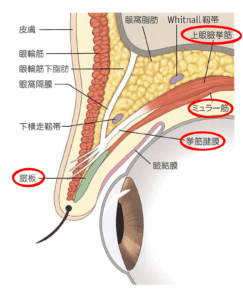
Source: 'Facial Plastic Surgery, 1st Edition' (Nihon Iji Shinposha, 2021), p.57, Figure 1, modified and reproduced
Levator advancement procedure has grownDissect the levator aponeurosis from the Müller muscleand,Reattachment to the tarsal plate alone(or fold to shorten) method.
It preserves the Müller muscle, resulting in relatively short downtime and a natural-looking opening.
Mild to moderate ptosisis suitable for.
If you simply want to slightly improve the appearance of your eyes through cosmetic procedures, a levator advancement alone is generally sufficient.
Levator Muscle Shortening Technique is,Shortened resection and fixation while maintaining the integrity of the levator aponeurosis and Müller's muscleThis is how to do it.
enables stronger lifting,Congenital or severe ptosisIt is effective, but requires advanced skills to treat the Müller muscle.
These procedures are rarely performed in cosmetic surgery and are mostly handled in the field of reconstructive surgery.
In cases where anterior transposition of the levator muscle alone does not yield satisfactory results, additional levator muscle shortening may be performed.
⸻
■ Pseudoptosis and Brow Lift
Even if it looks like ptosis, it may actually be It's just sagging skin covering it. There are cases where this happens.
This is called pseudo-ptosis, and it does not improve with muscle surgery.
In this case,Removing excess skin through a brow liftThis creates a natural eyelid opening and a refreshed upper eyelid.
Among those who come for consultations regarding ptosis due to aging, some have isolated pseudo-ptosis while others have it in combination with other conditions, making it one effective option.
⸻
■ The Difference Between Insurance-Covered Treatment and Out-of-Pocket Treatment
Eyelid ptosis surgery is,Narrowed field of vision More than half of the pupil is covered by the eyelidetc.,When certain diagnostic criteria are mettoCovered by insuranceis.
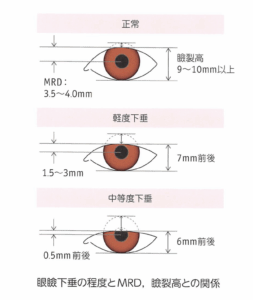
Source: 'Facial Plastic Surgery, 1st Edition' (Nihon Iji Shinposha, 2021) p.58, Figure 3, modified and reproduced
On the other hand, comments like "They look sleepy" or "I'd like their eyes to open a bit more,"When performed for cosmetic purposesはout-of-pocketwill be.
Insurance-covered treatments primarily aim to restore function (restore vision), whereas cosmetic surgery is characterized by designing outcomes that encompass aesthetic beauty.
However, if the doctor has experience in both reconstructive surgery and cosmetic surgery,Even with insurance-covered treatment, we ensure a finish that considers aesthetic aspects.Sometimes they take it into consideration.
⸻
■ Summary
Ptosis is not only a cosmetic concern but also a functional disorder that affects the comfort of daily life.
The appropriate procedure—whether a levator advancement, levator shortening, or brow lift—varies significantly from patient to patient.
What matters is,Consult a physician who understands both function and design and can propose the optimal treatment.
If you're experiencing concerns such as "difficulty opening your eyes," "looking tired," or "wanting more open eyes," please feel free to consult with us first.
⸻
Reservations can be made here.
Complete your reservation in 60 seconds ▼
https://reservation.medical-force.com/b/d7bb811e-ebd5-4b93-93f8-588864b24f15
⸻
【Profile】
Masataka Fujihashi, MD, Plastic Surgeon
Leveraging expertise as a board-certified plastic surgeon, I offer comprehensive facial cosmetic procedures including eyelid and nose surgery, facial liposuction, thread lifts, and hyaluronic acid injections. From incisional surgeries and revision procedures requiring delicate design to minimally invasive injections and lifts with minimal downtime, I strive to provide treatments tailored to each patient's ideal outcome.
We are dedicated to achieving natural results and minimizing downtime, pursuing medical care that leaves you feeling confident in your choice through sincere consultations.
Designing natural beauty with trust.
We cherish that sentiment and apply it to our daily practice.
Read other blog posts ▼
https://biancaclinic.jp/author_cat/fujihashi/
【SNS】
Instagram ▶︎ https://www.instagram.com/dr_fujihashi?igsh=MTEzOW1sc3p3bGFibA%3D%3D&utm_source=qr
X ▶︎ https://x.com/dr_fujihashi?s=21
【Career】
March 2015: Graduated from the School of Medicine, Showa University
April 2015 Showa University Yokohama Northern Hospital Initial Clinical Training
April 2017 Showa University Hospital Department of Plastic Surgery
October 2017 Maebashi Red Cross Hospital Plastic Surgery / Cosmetic Surgery
April 2019 Nishio Municipal Hospital Plastic Surgery Department
April 2020 Showa University Fujigaoka Hospital Plastic Surgery Department
November 2020 Ota Nishinouchi Hospital Plastic Surgery / Cosmetic Surgery
July 2022 Tokyo Rosai Hospital Plastic Surgery / Cosmetic Surgery Department Head
July 2022: R.O.clinic (Part-time), Kusano Taro Clinic (Part-time)
April 2024 Deputy Director, Ginza TA Clinic
November 2025 BIANCA CLINIC
【Professional Affiliations and Qualifications】
Japanese Society of Plastic and Reconstructive Surgery Board-Certified Plastic Surgeon
Member of the Japanese Society of Aesthetic Plastic Surgery (JSAPS)
Member of the Japanese Society of Aesthetic Surgery (JSAS)