column (e.g. in newspaper)
2025.12.05
My eyes won't open even if I cut the skin! It may be ptosis!

As a plastic surgeon, he has experienced many cases and has developed precise techniques and a deep anatomical understanding. Currently, combining his knowledge of plastic surgery with the latest technology, he provides a wide range of cosmetic treatments for skin, contouring, sagging, and other concerns of aging. He has also shared the responsibility of writing Japan's first textbook on gynecological cosmetic surgery, "Basic Techniques of Gynecological Cosmetic and Plastic Surgery. From her experience as an idol during medical school, she realized that "natural beauty" goes beyond the will to choose how you want to be, and she focuses on supporting her patients to "love yourself more every day". We are English-speaking and value counseling that is easy to talk to.
Hello, everyone!
Natural and elegant rejuvenationpropose,plastic surgeonのMs. Aliceis.

↓I wrote an article like this before.
Brow Lift? Double Eyelid Surgery? Forehead Lift? The Right Treatment for Your Sagging Eyelids
https://biancaclinic.jp/blog/46480/

"The skin on your upper eyelid looks heavy, so if we cut here, your eyes will open, right?"
——Many people come to our clinic thinking that way.
But actually,
Even if you cut only the skin, “the eyes won't open.”It is not uncommon.
Because what is truly causing it is,
Not the skin, but deep within the eyelid“Weakening of the levator palpebrae superioris muscle。
A state where the levator muscle is relaxedPtosisis called.
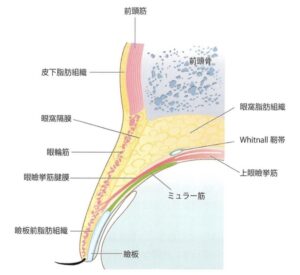
↑Quoted from "36 Essential Plastic Surgery Techniques for Board Certification, Part 2" by Kakuseido Publishing
Today, we'll cover a representative treatment offered at Bianca Clinic,MT MethodとBlepharoplastyWe will explain it in an easy-to-understand manner.
To begin with: What is ptosis?
“A condition where the eyelids do not lift sufficiently.
Only half of the pupil was visible, or they looked sleepy, or felt heavy—
Furthermore,Ptosis affects not only appearance,
Shoulder stiffness, headaches, fatigue, narrowed vision, and other physical discomfortsalso leads to.
So, when a patient presents with these symptoms, how do you diagnose ptosis?
Diagnostic Criteria for Ptosis: Key Points Physicians Actually Observe
In general examinations, diagnoses are made using the following indicators as a reference.
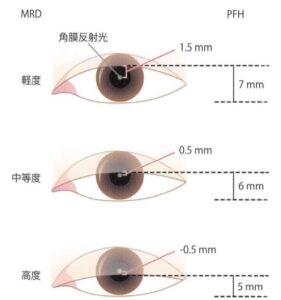
↑Quoted from "36 Essential Plastic Surgery Techniques for Board Certification, Part 2" by Kakuseido Publishing
① MRD (Margin Reflex Distance)
▼How do you measure it? (MRD-1)
Measure the distance in millimeters between the center of the pupil and the edge of the upper eyelid (near the lash line).
▼What do you know?
The most fundamental indicator showing how much the eyes are “open.”
The smaller the number, the more the pupil is obscured, indicating a stronger degree of ptosis.
▼Reference value
・Normal: 3.5–5.5 mm
・Mild: 1.5–2.7 mm
・Severe: -0.5mm or less (where part of the pupil is covered by the eyelid)
② Levator Function Test
▼How do you measure it?
1. First, the doctor will gently press and hold the area above your eyebrows to prevent you from using your forehead muscles (frontalis muscle).
2. In that position, have the patient look down as far as possible → then look up as far as possible.
3. Measure the eyelid displacement (mm).
▼What do you know?
A test to evaluate the “true strength” of the muscle that lifts the eyelid (levator palpebrae superioris).
Whether this is a weak spot or simply sagging skin significantly impacts treatment options.
▼Reference value
・Normal: 8mm or more
・Moderate: 4–7 mm
・Severe: 3mm or less
When the muscle strength itself is weak, an incision method is often necessary, and this serves as a factor in determining the treatment plan.
③ Lid Fissure Height
▼How do you measure it?
Measure the distance from the lowest point of the pupil (cornea) to the edge of the upper eyelid.
▼What do you know?
“An indicator of how wide the eyes appear to be open.
Combining it with MRD allows for more accurate assessment of the degree of prolapse.
Furthermore,
④ GenerationCompensation Sign
That's also one reason.
・Deep forehead wrinkles
・Always has raised eyebrows
etc.
This is the bodyTrying to compensate elsewhere for the inability to open one's eyesSign.
Common subjective symptoms
・My eyes get tired
・Narrow field of vision
・The eyelid rests on top of the eyelashes
・Trying to force my eyes open makes me tired
Taking these factors into account, a diagnosis is made based on both numerical data and symptoms.
So, what kinds of treatments are available?
At Bianca, we primarily recommend the following two methods.
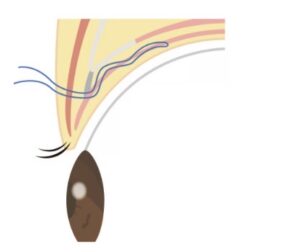
Treatment ① MT Method (Non-Invasive Ptosis Treatment)
The MT method involves suturing and shortening the levator muscle from the inner side of the eyelid.
“How to strengthen your muscle lifting power.
☑ Scratches are not visible from the outside
☑ Minimal downtime
That's the kind of treatment.
People who are suited for
・Mild to moderate ptosis
・I don't want to leave any scars
・I don't want to drastically change the double eyelid line
・Want to naturally enhance your eye power
It's also chosen by those who say, "My work is too busy to allow for long downtime."
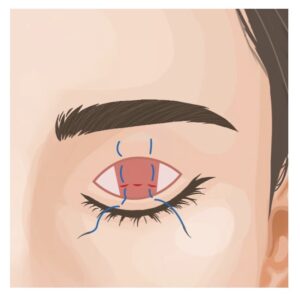
Treatment ② Eyelid Ptosis Correction via Incision (Skin Incision + Levator Aponeurosis Advancement)
Make an incision in the skin and directly observe the internal structure of the eyelid.
Improves all aspects of sagging, fat, and laxity of the levator muscleMethod.
This treatment is akin to a full upper eyelid makeover.
Features include:
・Can thoroughly repair the levator aponeurosis
・Suitable even for individuals with significant excess skin and fat (ROOF)
・You can design double lines simultaneously
People who are suited for
・Moderate to severe ptosis
・Significant skin laxity
・Thick, heavy eyelids
Individuals with symptoms such as these.
So which one is better?
■ Who Benefits from the MT Method
・I just want it to look natural
・Prefer minimal downtime
・Mild to moderate ptosis
■ Candidates for the incision method
・I want to improve my skin and fat at the same time
・I want to even out my double eyelid crease
・I want to make sure to open my eyes wide
・Moderate to severe ptosis
The best treatment varies depending on the thickness of your eyelids, the amount of fat, and the condition of your muscles.
The incisional method is technically far more challenging, but I myself have performed it meticulously and earnestly since my days in plastic surgery.
Summary: Simply cutting the skin won't open the eyes. Identifying the cause is crucial.
"Cut the skin and the eyes will open."
Many people have that image, but
The true cause is often “weakening of the levator muscle (ptosis).”
That's precisely why,Get an accurate diagnosis of your condition and choose your treatmentIt is important.
The structure of the eyelid varies from person to person.
If you're concerned, please consider scheduling an appointment.
We look forward to your inquiries!

Author: Arisu Hatade
Board-Certified Plastic Surgeon / Cosmetic Surgeon
After graduating from Kyushu University School of Medicine, he worked in plastic and reconstructive surgery and cosmetic surgery at university hospitals and affiliated facilities, obtaining board certification in plastic surgery.
With extensive experience in a wide range of cases, from facial and trunk reconstructive surgery to cosmetic surgery, I prioritize achieving natural and beautiful results based on anatomical knowledge.
Having worked as an idol during my student days, I possess a unique perspective that understands both “beauty for being seen” and “beauty as medicine.” This allows me to offer customized aesthetic medical treatments tailored to each individual patient.
In my personal life, I love traveling and gourmet food, and I share information about beauty and lifestyle on Instagram.
Reservations can be made here.
Complete your reservation in 60 seconds ▼
https://reservation.medical-force.com/b/d7bb811e-ebd5-4b93-93f8-588864b24f15
career
Graduated from the School of Medicine, Kyushu University
New Tokyo Hospital Initial Training
Jichi Medical University Hospital, Department of Plastic Surgery
Luce Clinic Employment
Shin-Koyama Municipal Hospital Plastic Surgery Department Employee
Teikyo University Hospital Department of Plastic Surgery
JR Tokyo General Hospital Plastic Surgery and Reconstructive Surgery Department Employee
Ariake Hifuka Clinic Employee
Professional Affiliations and Qualifications
Board-Certified Specialist, Japanese Society of Plastic and Reconstructive Surgery
Field of expertise
Cosmetic surgery (eyes, jawline, gynecological procedures, etc.)
Injection Therapy (Hyaluronic Acid, Botox, Fat Grafting)
Laser Skin Treatment
Regenerative Medicine and Anti-Aging Care