column (e.g. in newspaper)
2025.10.07
Can PicoSpot remove tattoos? Differences in wavelengths based on color

As an Assistant Professor, Associate Ward Director, and Chief of Dermatopathology at the university hospital dermatology department, I deepened my expertise through academic presentations and paper publications both domestically and internationally. I have handled a wide range of treatments, from birthmark therapy in children to adult pigmentation concerns, utilizing various lasers and injection therapies, while also contributing to community healthcare. Through encountering numerous cases, I strongly felt the potential and necessity of aesthetic medicine, resolving to pursue further expertise. Building upon my solid dermatological knowledge and meticulous diagnostic skills, I value treatments that gently support each individual's skin while bringing out its inherent beauty.
Did you know you can remove tattoos with PicoSpot?
More people in Japan are getting tattoos as a fashion statement. Also, are many people getting permanent makeup for their eyebrows (pico toning is often used for this)?
We understand that more people are requesting changes, such as modifying or removing designs, so we would like to provide information regarding removal.

I am Dr. Aya Hayama, a board-certified dermatologist.
When it comes to PicoSpot, it may be strongly associated with skin treatments for dark spots and freckles.
However, PicoSpot is actually a highly effective treatment for tattoo removal. Until now, removing tattoos required powerful lasers, which posed challenges such as significant pain, inflammation, and a high risk of scarring. PicoSpot,Compared to conventional nanosecond lasers, it shatters ink with an extremely short pulse width of one-thousandth of a second, minimizing thermal damage to surrounding skin while breaking down pigment.
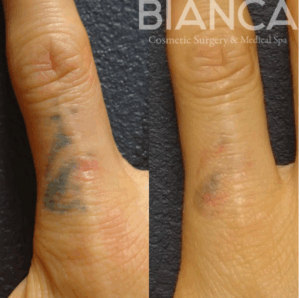
The greatest advantage of PicoSpot tattoo removal is its ability to break ink particles into finer fragments. This enables macrophages (immune cells that process foreign substances) within the body to efficiently expel the pigment,With each session, the tattoo's color gradually fades.。Carbon-based pigments such as black and dark navy blue exhibit particularly strong reactions.Removal tends to progress with relatively fewer sessions.
Furthermore, the wavelength used is extremely important.Many PicoSpot models can switch between multiple wavelengths, enabling efficient removal by selecting the appropriate wavelength for each pigment type.。
1064nm primarily reacts to black and dark blueIt causes minimal damage to the skin and reaches deep-seated pigmentation, making it the most versatile option.
532nm is highly effective against red, orange, and brown pigments, but since it acts on shallow layers, caution is required regarding inflammatory hyperpigmentation.is.
755nm excels at treating green and blue-green ink, offering the advantage of effectively removing previously difficult-to-treat cool-toned tattoos.is.
In this way, by combining multiple wavelengths, it becomes possible to uniformly fade even colorful tattoos.
Conventional Q-switched lasers have also been used for tattoo removal. However, because Q-switched lasers deliver pulses in the nanosecond range, they cause slightly more thermal tissue damage, which can lead to issues such as post-treatment inflammation and scarring.
PicoSpot physically shatters ink like a shockwave using shorter picosecond pulses, delivering high fragmentation power while minimizing thermal effects. This enables fewer treatment sessions and reduces the risk of pigmentation.


https://biancaclinic.jp/treatment_category/skin-care/freckles/picospot/
Number of required treatments
Treatment does not completely eliminate the condition in a single session,Generally, 4 to 10 sessions of irradiationIt requires multiple sessions. Often, the overall tone becomes slightly lighter after the first session, the outline becomes blurred after 3 to 5 sessions, and it becomes significantly less noticeable after the 7th session.The number of sessions required varies depending on the ink's density and color tone, the depth of the tattoo, and the body part.However, with each application, it gradually approaches a natural skin tone.Treatment intervals should ideally be spaced approximately 6 to 8 weeks apart to allow for skin recovery.
Post-irradiation course
After treatment, temporary redness or mild scabbing may occur. However, PicoSpot causes minimal thermal damage, resulting in relatively short downtime and a lower risk of post-inflammatory hyperpigmentation.When pigment is completely removed, temporary unevenness known as "white discoloration" may appear. This occurs because the skin's melanin temporarily reacts, making the area appear depigmented. In most cases, this improves over time.However, excessive output or short-term continuous irradiation increases the risk, making careful settings by an experienced physician crucial.
Additionally, in rare cases, depending on the depth of the tattoo or the nature of the pigment,Localized inflammation and fibrosis may occur, leaving behind changes in texture resembling scarring.Particularly on areas with a history of strong output from older machines or Q-switched lasers, skin reactivity may have changed. Therefore, it is safer to perform a test treatment on a small area beforehand.
After treatment, it is important to avoid UV rays and carefully moisturize the skin. Especially since the skin is in a sensitive state immediately after depigmentation, it is advisable to use sunscreen and low-irritation skincare products together.
The ability to treat pigment in the dermis—such as tattoos—using the same principle as picospot treatments for cosmetic purposes represents a major advancement in pico laser technology.
Summary of the Benefits of Tattoo Removal at Pico Spot
PicoSpot can deliver irradiation with an overwhelmingly shorter pulse width compared to conventional lasers,Tattoo removal also minimizes skin stress and excels in achieving beautiful results.。
It features multiple wavelengths capable of handling diverse pigments such as black, red, and green, enabling flexible adaptation to colorful designs.The greatest appeal lies in its ability to minimize scarring risk through reduced thermal damage while delivering high removal efficacy in fewer sessions.
Additionally, this treatment causes minimal inflammation and pigmentation after the procedure, making it a safe option even for those who have previously hesitated about tattoo removal. By carefully assessing the skin condition and ink reaction, the physician adjusts the wavelength and output, enabling safer and more reliable removal.
PicoSpot is the ideal choice for those who want to achieve visible results while minimizing pain and downtime, so we encourage you to consider it.