column (e.g. in newspaper)
2025.12.15
Which Cartilage to Use for Nasal Septum Extension? | Choosing Materials to Support the Nasal Framework
As a plastic surgeon certified by the Japanese Society of Plastic and Reconstructive Surgery, I have been involved in many cases of trauma, reconstruction, and congenital diseases, and have cultivated precise techniques and a deep understanding of anatomy. He entered the field of cosmetic surgery out of a desire to bring the power of cosmetics to his patients, as a change in one's appearance can also make one's mind more positive. Her specialties include general treatment of the eye area, injections, and sagging skin. I provide treatments that focus on beauty with the medical stance of "sincerely addressing the ideals of the patient.
Hello!
Designing natural beauty with trust.
I am Masataka Fujihashi, a board-certified plastic surgeon.

In the previous article, we explained what a nasal septum extension procedure entails.
In nasal septum extension, "which cartilage is used" significantly affects the final result.
This is because nasal septum extension is not a procedure to shape the tip of the nose, but rather a procedure to create the supporting framework for the nasal tip.
If the underlying structure is weak, even if the appearance is stable immediately after surgery, it becomes increasingly unstable over time, raising the risk of tilting or relapse.
Therefore, it is important to select materials with an understanding of the types and functions of cartilage.
⸻
■ Nasal septal cartilage

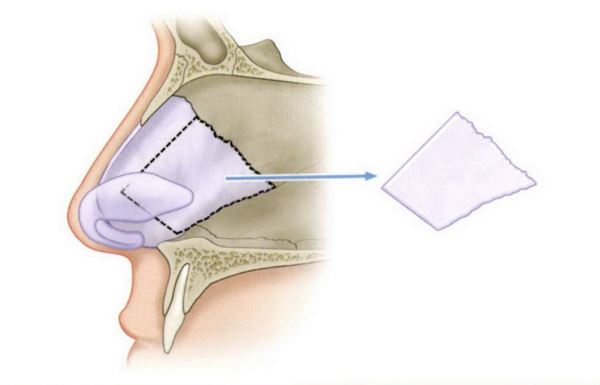
Source: 'Aesthetic Surgery Techniques: Rhinoplasty, 1st Edition' (Kakuseido Publishing Co., Ltd., 2012) p.35 (Figure partially modified for publication)
The nasal septal cartilage is the central cartilage separating the left and right sides of the nose deep within the nasal cavity, and it serves as the fundamental material for nasal septal extension.
Since it can be collected from inside the nose,Avoiding new injuriesIf a sufficient quantity can be secured, it is possible to create a foundation with excellent hardness and stability.
However, many Japanese individuals have smaller nasal septal cartilage, and cases where there is insufficient volume are not uncommon.
Additionally, while nasal septal cartilage is suitable for creating the framework, it tends to be too rigid for shaping the rounded tip and texture of the nose.
Therefore, in actual surgery,
Septal extension is performed using the nasal septal cartilage, while nasal tip reshaping and cartilage grafting for the nasal tip incorporate auricular cartilage.
This structure will be the basic framework.
⸻
■ Auricular cartilage

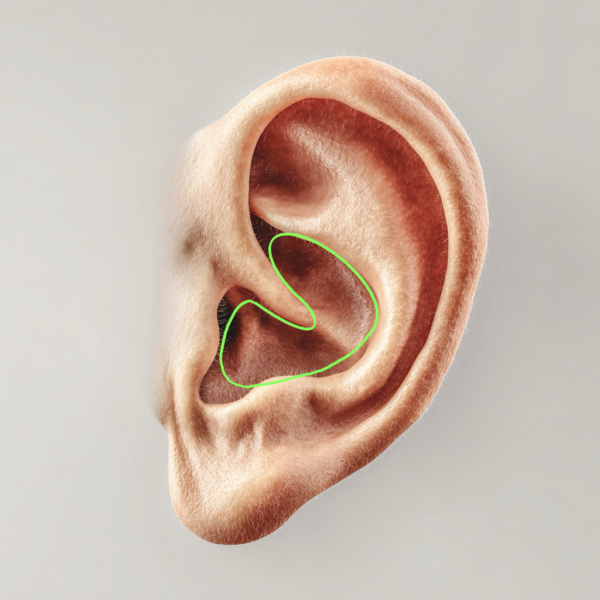
Ear cartilage is cartilage harvested from behind the ear.
The incision is made along the crease at the base of the ear, making the scar less noticeable, and the incision itself is only about 2 cm.
Because it is soft and supple,Naturally refine the roundness and texture of the nose tipSuited for the role.
This material is essential for softening the rigidity of the nasal septal cartilage and achieving a more natural-looking result.
Please note that,When performing nasal septum extension using only auricular cartilageCaution is required.
In this case,Use two pieces of auricular cartilage from both ears.The basicswill become.
Using only one side results in insufficient volume and strength for nasal septum extension, leading to a tilted nasal tip and structural instability.
⸻
■ Costal cartilage

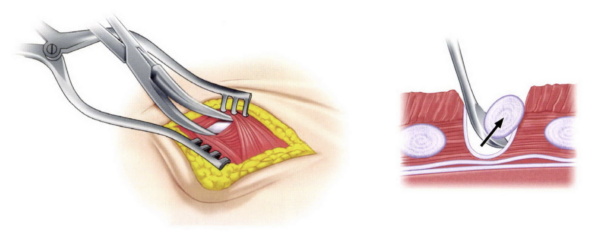
Source: 'Aesthetic Surgery Techniques: Rhinoplasty, 1st Edition' (Koseido Publishing Co., Ltd., 2012) p.34 (Figure modified for publication)
Costal cartilage is cartilage harvested from a portion of the ribs.
The incision is made along the crease beneath the breast, so the scar is easily concealed by the breast and becomes less noticeable over time.One drawback is that it leaves scars on the body.is.
HoweverEven when considering its disadvantages, it still offers sufficient benefits.
That is,Abundant quantities can be collectedでHigh strengthEven for those with a small nasal septal cartilage,can create a stable frameworkPeriod.
Not only nasal septum extension, but also,Can also be used simultaneously with rhinoplasty and aristocratic surgeryAs a result, in recent years, it has increasingly been used as a "rib cartilage nose full" procedure, where the entire nose is constructed solely from rib cartilage.
Harvesting costal cartilage does not significantly interfere with daily life, and exercise is possible approximately two weeks after surgery.
⸻
■ Key Considerations When Selecting Materials
The crucial factor in nasal septum extension is not which cartilage is used.
What degree of change do you desire for your current nose?
How much material is needed for that?
Selecting materials that match this design will lead to a stable finish over the long term.
To summarize the nasal septum extension procedure simply,
"Costal cartilage"
→ When you want to significantly alter the shape of the nose itself or make it substantially higher
"Nasal septal cartilage + auricular cartilage" or "Two auricular cartilages"
→ When you don't want to change the shape of your nose too much, but you want a decent height without going overboard
I believe this understanding is correct.
⸻
■ Summary
The cartilage used for nasal septum extension has different suitability and characteristics.
What matters is not the material itself, but selecting one that can provide sufficient support and stability according to the degree of change required.
This approach leads to stable surgical outcomes over the long term.
⸻
Reservations can be made here.
Complete your reservation in 60 seconds ▼
https://reservation.medical-force.com/b/d7bb811e-ebd5-4b93-93f8-588864b24f15
⸻
【Profile】
Masataka Fujihashi, MD, Plastic Surgeon
Leveraging expertise as a board-certified plastic surgeon, I offer comprehensive facial cosmetic procedures including eyelid and nose surgery, facial liposuction, thread lifts, and hyaluronic acid injections. From incisional surgeries and revision procedures requiring delicate design to minimally invasive injections and lifts with minimal downtime, I strive to provide treatments tailored to each patient's ideal outcome.
We are dedicated to achieving natural results and minimizing downtime, pursuing medical care that leaves you feeling confident in your choice through sincere consultations.
Designing natural beauty with trust.
We cherish that sentiment and apply it to our daily practice.
Read other blog posts ▼
https://biancaclinic.jp/author_cat/fujihashi/
【SNS】
Instagram ▶︎ https://www.instagram.com/dr_fujihashi?igsh=MTEzOW1sc3p3bGFibA%3D%3D&utm_source=qr
X ▶︎ https://x.com/dr_fujihashi?s=21
【Career】
March 2015: Graduated from the School of Medicine, Showa University
April 2015 Showa University Yokohama Northern Hospital Initial Clinical Training
April 2017 Showa University Hospital Department of Plastic Surgery
October 2017 Maebashi Red Cross Hospital Plastic Surgery / Cosmetic Surgery
April 2019 Nishio Municipal Hospital Plastic Surgery Department
April 2020 Showa University Fujigaoka Hospital Plastic Surgery Department
November 2020 Ota Nishinouchi Hospital Plastic Surgery / Cosmetic Surgery
July 2022 Tokyo Rosai Hospital Plastic Surgery / Cosmetic Surgery Department Head
July 2022: R.O.clinic (Part-time), Kusano Taro Clinic (Part-time)
April 2024 Deputy Director, Ginza TA Clinic
November 2025 BIANCA CLINIC
【Professional Affiliations and Qualifications】
Japanese Society of Plastic and Reconstructive Surgery Board-Certified Plastic Surgeon
Member of the Japanese Society of Aesthetic Plastic Surgery (JSAPS)
Member of the Japanese Society of Aesthetic Surgery (JSAS)