column (e.g. in newspaper)
2025.12.17
The Difference Between Nasal Septum Extension and Columellar Strut: "Adding Support" vs. "Structural Reconstruction"
As a plastic surgeon certified by the Japanese Society of Plastic and Reconstructive Surgery, I have been involved in many cases of trauma, reconstruction, and congenital diseases, and have cultivated precise techniques and a deep understanding of anatomy. He entered the field of cosmetic surgery out of a desire to bring the power of cosmetics to his patients, as a change in one's appearance can also make one's mind more positive. Her specialties include general treatment of the eye area, injections, and sagging skin. I provide treatments that focus on beauty with the medical stance of "sincerely addressing the ideals of the patient.
Hello!
Designing natural beauty with trust.
I am Masataka Fujihashi, a board-certified plastic surgeon.

When considering rhinoplasty, many people find themselves torn between the Columella Strut Method and septal extension.
Both are surgeries to support the tip of the nose,Clear differences in construction methods and stabilityThere is.
This difference significantly impacts both the rate of change and long-term stability.
⸻
■ What is the Colmerastrat Method?
The Columellar Strut Technique is a surgical procedure that involves placing a cartilage "strut" beneath the tip of the nose to support it from below.
This method is suitable for adjusting the angle of the tip of the nose and making minor positional corrections, and can be considered a relatively simple approach.
The Corme-Lestrade method, performed at many clinics, isWithout fixing it to the nasal septum, insert a column between the medial crura of the anterior alar cartilages. floating strutis.
Floating refers to a state where the nasal septum lacks a supporting structure, meaning it is suspended in midair.
This method also allows for some shaping of the tip of the nose immediately after surgery.

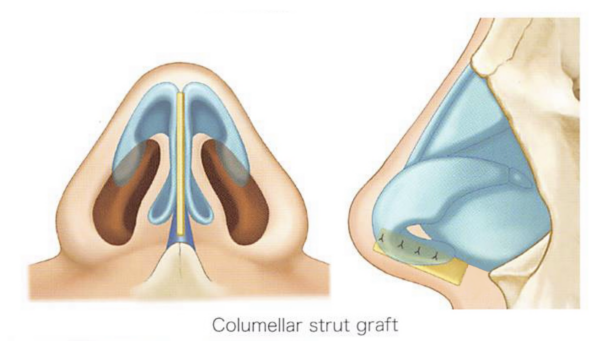
Source: 'Comprehensive Manual of Plastic Surgery Techniques VII: Aesthetic Medicine, 1st Edition' (Koseido Publishing Co., Ltd., 2019), p.137, Figure 5, partially modified and reproduced.
On the other hand,A method for securely suturing and fixing transplanted cartilage to structures such as the nasal septal cartilageis,fixed strutis called.
Fixed struts are selected when you want to achieve greater changes (such as nose projection or rotation) or when you need to strongly reinforce an unstable nose.
On the other hand, as the structure becomes more robust, the nose tends to become stiffer.
This method can be described as structurally approximating the Columella-Septum-Limbus (CSL) technique to nasal septal extension.
Some doctors prioritize postoperative stability and use the Cormer strut as a fixed strut.
I myself also tend to use fixed struts when working with cormelastrat.
⸻
■ The Crucial Difference from Nasal Septum Extension
Septal extension surgery involves directly fixing the transplanted cartilage to the existing nasal septum, thereby reconstructing the supporting framework itself.
Therefore, it is possible to control the position, orientation, and stability of the nasal tip more structurally.

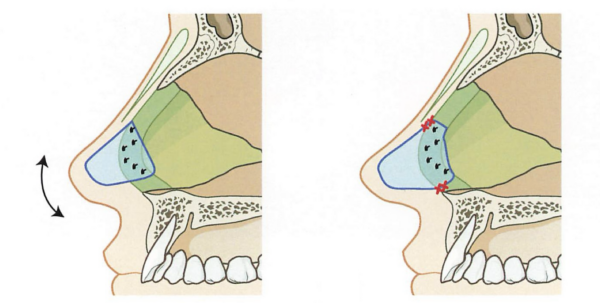
Source: 'Rhinoplasty, First Edition' (Sankei Publishing Co., Ltd., 2017), p.248, Figure 11-39, reproduced with modifications.
On the other hand, the Colmerat strut method using a floating strut results in a free-floating strut since it is not fixed to the nasal septum.
Therefore, even if the shape appears well-defined immediately after surgery, slight sagging or changes in angle may occur over time.
To clarify the structural differences,
・Cormer strut method (floating): A supplementary support that "accompanies" the column
・Cormer-Lustrat Method (fixed): A method that enhances bearing capacity through fixation
・Nasal septum extension: A method that "reconstructs" the bone structure itself
This is the difference.
⸻
■ Which should I choose?|Balance of Structure and Naturalness
The tip of the nose is a part that constantly moves during everyday expressions like smiling and talking.
Therefore, the level of strength achieved in the structure significantly affects the finished texture and how it moves.
nasal septum extensionis,By creating a solid framework, the position and orientation of the nose tip can be designed with greater size and flexibility.。
On the other hand, while the structure becomes more robust, it also becomes less flexible, making it easier to feel stiffness in the nose area.
It might be easier to understand if described as a procedure that sculpts the shape like a sculpture.
In contrast,Cormer-Lustrat methodWhile it does not match nasal septum extension in terms of the degree of change or design flexibility,The tip of the nose retains its mobility more easily, making it simpler to achieve a natural look that blends seamlessly with facial expressions.Here's how.
It's not a matter of which is superior; the appropriate method depends on how much you want to change and whether you prioritize naturalness or the amount of change.
⸻
■ Summary
Although the Columella-Lattice Method and Nasal Septum Extension both support the nasal tip, their structural approaches differ.
For achieving significant and stable changes, nasal septum extension is suitable. For subtle changes emphasizing natural movement and texture, the Columella Strut technique is preferable.
Using fixed struts can enhance stability even in a cormelast strut configuration.
The method you should choose depends on how much you want to change and what you want to prioritize.
⸻
Reservations can be made here.
Complete your reservation in 60 seconds ▼
https://reservation.medical-force.com/b/d7bb811e-ebd5-4b93-93f8-588864b24f15
⸻
【Profile】
Masataka Fujihashi, MD, Plastic Surgeon
Leveraging expertise as a board-certified plastic surgeon, I offer comprehensive facial cosmetic procedures including eyelid and nose surgery, facial liposuction, thread lifts, and hyaluronic acid injections. From incisional surgeries and revision procedures requiring delicate design to minimally invasive injections and lifts with minimal downtime, I strive to provide treatments tailored to each patient's ideal outcome.
We are dedicated to achieving natural results and minimizing downtime, pursuing medical care that leaves you feeling confident in your choice through sincere consultations.
Designing natural beauty with trust.
We cherish that sentiment and apply it to our daily practice.
Read other blog posts ▼
https://biancaclinic.jp/author_cat/fujihashi/
【SNS】
Instagram ▶︎ https://www.instagram.com/dr_fujihashi?igsh=MTEzOW1sc3p3bGFibA%3D%3D&utm_source=qr
X ▶︎ https://x.com/dr_fujihashi?s=21
【Career】
March 2015: Graduated from the School of Medicine, Showa University
April 2015 Showa University Yokohama Northern Hospital Initial Clinical Training
April 2017 Showa University Hospital Department of Plastic Surgery
October 2017 Maebashi Red Cross Hospital Plastic Surgery / Cosmetic Surgery
April 2019 Nishio Municipal Hospital Plastic Surgery Department
April 2020 Showa University Fujigaoka Hospital Plastic Surgery Department
November 2020 Ota Nishinouchi Hospital Plastic Surgery / Cosmetic Surgery
July 2022 Tokyo Rosai Hospital Plastic Surgery / Cosmetic Surgery Department Head
July 2022: R.O.clinic (Part-time), Kusano Taro Clinic (Part-time)
April 2024 Deputy Director, Ginza TA Clinic
November 2025 BIANCA CLINIC
【Professional Affiliations and Qualifications】
Japanese Society of Plastic and Reconstructive Surgery Board-Certified Plastic Surgeon
Member of the Japanese Society of Aesthetic Plastic Surgery (JSAPS)
Member of the Japanese Society of Aesthetic Surgery (JSAS)