column (e.g. in newspaper)
2025.12.21
Types of Alar Reduction (Nasal Wing Reduction) and Differences in Incision Placement

As a plastic surgeon certified by the Japanese Society of Plastic and Reconstructive Surgery, I have been involved in many cases of trauma, reconstruction, and congenital diseases, and have cultivated precise techniques and a deep understanding of anatomy. He entered the field of cosmetic surgery out of a desire to bring the power of cosmetics to his patients, as a change in one's appearance can also make one's mind more positive. Her specialties include general treatment of the eye area, injections, and sagging skin. I provide treatments that focus on beauty with the medical stance of "sincerely addressing the ideals of the patient.
Hello!
Designing natural beauty with trust.
I am Masataka Fujihashi, a board-certified plastic surgeon.


The nose appears wide, the nostrils protrude, and the nose looks large when smiling.
The root cause of these concerns lies not in the bridge of the nose, but in the "nostrils."
Widened nostrils are one factor that can make the entire face appear flat.
Therefore, properly shaping the nostrils can give not only the nose but the entire face a more refined and polished appearance.
There are several methods for alar reduction surgery (nose wing reduction surgery),Where to make the incisionThe effects and indications obtained vary.
⸻
■ What is Alarplasty (Nasal Wing Reduction)?
A nose wing reduction procedure involves excising skin from the alar base (the base of the nostrils) and the alar cartilage to reduce the width of the nose and minimize the spread of the nostrils.
This treatment is effective for concerns such as prominent nostrils, flared or upward-slanted alae, and a nose that widens significantly when smiling.
The surgery is performed by making an incision in a relatively inconspicuous area, such as inside the nose or at the base of the nostrils.
If you choose the right method, there's little need to worry about others noticing after the procedure.
⸻
■ Internal Approach|Method Involving Resection of the Nasal Floor
The internal approach is a method that involves excising the inner part of the nostril (the nasal floor).

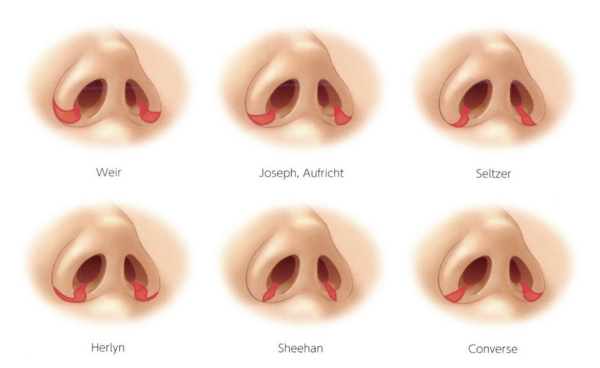
Source: 'Aesthetic Surgery Techniques: Rhinoplasty, 1st Edition' (Kakuseido Publishing Co., Ltd., 2012) p.137 (Figure modified for publication)
Without cutting to the outer edge of the nostrils, excess skin and subcutaneous tissue are excised and sutured from inside the nose.
This method
・Large nostrils
・Less outward projection of the outer part of the nose
・Slightly concerned about the width
This is suitable for people like that.
By threading sutures beneath the base of the nostrils, this technique minimizes retraction and reduces strain on the incision site, facilitating cleaner wound healing.
The scar runs from inside the nostril to the base of the nose and is hardly noticeable from the outside.
⸻
■ External Approach|A method involving excision of the outer part of the alar base
The lateral approach involves excising the outer part of the nostrils (lateral alar region).

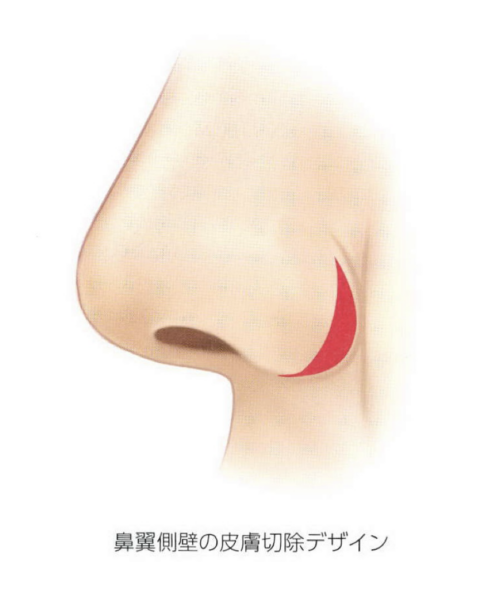
Source: 'Cosmetic Surgery Techniques: Rhinoplasty, 1st Edition' (Koseido Publishing Co., Ltd., 2012) p.146 (Figure modified and reproduced)
It is highly effective for cases where the nostrils protrude strongly outward.
However, because it involves making an incision on the outside, the scar tends to be more noticeable compared to other methods.
Particularly for those with high sebum production, close attention to the healing process is necessary.
This method
・The nostrils themselves are not large.
・Prominent nostrils
This is suitable for noses of this type.
Since the size of the nostrils themselves generally does not change, if both the size of the nostrils and the width of the alar base are a concern, consider combining this procedure with an internal approach.
⸻
■ Nasal Wing Edge Elevation|A Method Targeting the "Thickness" of the Nostrils
The reason for prominent nostrils isn't just their width or size.
nostrilsthicknessIt is not uncommon for them to give a strong, heavy impression.
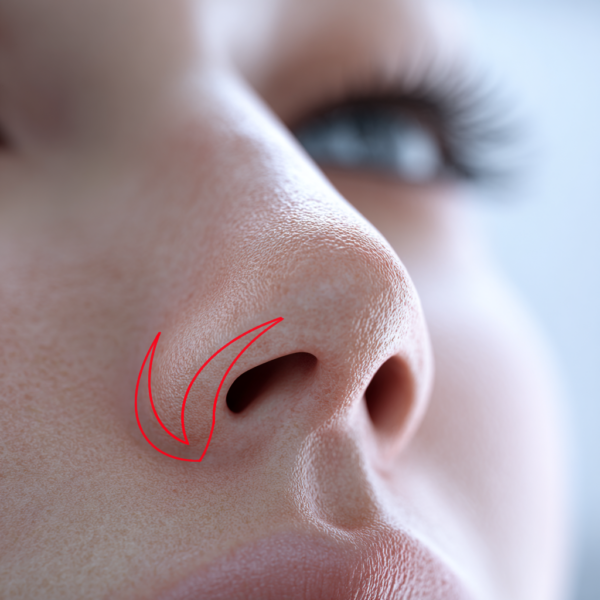
The nasal wings have a structure where the skin on the front and back sides overlap. If the skin itself is thick, the nostrils appear thick.
Since the skin itself cannot be made thinner, nostril rim lift involves removing skin from the nostril rim to achieve improvement.
This method not only reduces the thickness of the nostrils but also offers the potential to improve alar ptosis.
For those with heavy-looking nostrils, this is one effective option.

⸻
■ Key Considerations for Alar Reduction
The key point in alar reduction surgery is not "how much to reduce," but ratherWhere and to what extent should adjustments be made?is.
The medial approach, lateral approach, and alar rim elevation each have distinct indications and may be performed either alone or in combination.
Combining it with surgery on the bridge or tip of the nose can also help achieve a more natural overall balance of the nose.
⸻
■ Summary
For alar reduction surgery,
・Internal approach
・External approach
・Nasal alar rim elevation
There are several methods, and the effectiveness varies depending on the incision location.
Is it the width of the nostrils, the projection, or the thickness?
Selecting the appropriate surgical technique after accurately identifying the cause leads to a natural and balanced outcome.
⸻
Reservations can be made here.
Complete your reservation in 60 seconds ▼
https://reservation.medical-force.com/b/d7bb811e-ebd5-4b93-93f8-588864b24f15
⸻
【Profile】
Masataka Fujihashi, MD, Plastic Surgeon
Leveraging expertise as a board-certified plastic surgeon, I offer comprehensive facial cosmetic procedures including eyelid and nose surgery, facial liposuction, thread lifts, and hyaluronic acid injections. From incisional surgeries and revision procedures requiring delicate design to minimally invasive injections and lifts with minimal downtime, I strive to provide treatments tailored to each patient's ideal outcome.
We are dedicated to achieving natural results and minimizing downtime, pursuing medical care that leaves you feeling confident in your choice through sincere consultations.
Designing natural beauty with trust.
We cherish that sentiment and apply it to our daily practice.
Read other blog posts ▼
https://biancaclinic.jp/author_cat/fujihashi/
【SNS】
Instagram ▶︎ https://www.instagram.com/dr_fujihashi?igsh=MTEzOW1sc3p3bGFibA%3D%3D&utm_source=qr
X ▶︎ https://x.com/dr_fujihashi?s=21
【Career】
March 2015: Graduated from the School of Medicine, Showa University
April 2015 Showa University Yokohama Northern Hospital Initial Clinical Training
April 2017 Showa University Hospital Department of Plastic Surgery
October 2017 Maebashi Red Cross Hospital Plastic Surgery / Cosmetic Surgery
April 2019 Nishio Municipal Hospital Plastic Surgery Department
April 2020 Showa University Fujigaoka Hospital Plastic Surgery Department
November 2020 Ota Nishinouchi Hospital Plastic Surgery / Cosmetic Surgery
July 2022 Tokyo Rosai Hospital Plastic Surgery / Cosmetic Surgery Department Head
July 2022: R.O.clinic (Part-time), Kusano Taro Clinic (Part-time)
April 2024 Deputy Director, Ginza TA Clinic
November 2025 BIANCA CLINIC
【Professional Affiliations and Qualifications】
Japanese Society of Plastic and Reconstructive Surgery Board-Certified Plastic Surgeon
Member of the Japanese Society of Aesthetic Plastic Surgery (JSAPS)
Member of the Japanese Society of Aesthetic Surgery (JSAS)