column (e.g. in newspaper)
2026.02.27
Does the Hamra technique make your eyes look “blinky”? A specialist explains the post-operative changes and recovery points.

As a board-certified plastic surgeon by the Japanese Society of Plastic and Reconstructive Surgery, he has been engaged in a wide variety of periocular surgeries at university hospitals. Based on his solid anatomical knowledge and suturing skills, he is in charge of a wide range of surgeries around the eyes including sub-brow incisions and blepharoplasty incisions, as well as hyaluronic acid injections, Botox injections, and thread lifts. We also accept insurance coverage for droopy eyelids and inner eyelashes. We value natural and elegant results, and are known for our attentive counseling that attends to the patient's feelings.

Hello, I am Yumi Hattori from Bianca Clinic.
After the hamuloplasty, my lower eyelid looks red and flaky..."
'Are we just going to go back to the way things were? Isn't it a failure?"
We often hear these concerns at medical examinations. Because surgery is performed on the eye area, which is prone to changes in appearance, even small discomfort after surgery can cause concern. In this issue, I will explain the causes and progress of “akkanbei” that occurs after the Hamra technique, which approaches dark circles and sagging around the eyes, as clearly as possible from my perspective as a plastic surgeon.
What is the state of akkanbei that appears after the Hamra Method?
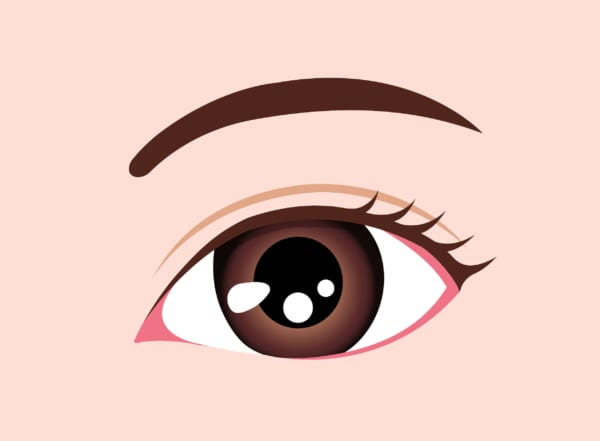
The Hamra technique is a surgical procedure to "move and reposition, without removing," the fat that causes puffiness and shadow circles under the eyes, in order to achieve a smooth, uneven eye contour. There are two Hamra techniques: the front Hamra technique and the back Hamra technique.
The "akkanbei" seen after the Hamra procedure refers to a condition in which the lower eyelid turns slightly outward and the red mucous membrane (conjunctiva) becomes easily visible. It may be accompanied by a feeling of dryness and rasping discomfort. Because of the sudden change in appearance, many people are concerned that it may be an aftereffect of the surgery. Because of the sudden change in appearance, many people are concerned that it may be an aftereffect of the surgery. In reality, however, most of them are part of the recovery process caused by postoperative swelling, swelling, and temporary contraction of the tissues. There is no need to immediately assume that "red eyelids = failure. First of all, it is important to calmly respond to this as one of the natural changes that can occur after surgery.
Reasons for akkanbei after Hamra Method surgery
In fact, there are two types of “akankabei” after the hamula procedure: those that settle down spontaneously with time, and those that occur as a result of surgical manipulation or tissue conditions. Here, from the standpoint of a plastic surgeon, we will summarize the main reasons why a "blinky" occurs after surgery and explain how it develops in an easy-to-understand manner.
Basically, most of the symptoms are temporary in the postoperative period!
Immediately after surgery for the Hamra technique, the lower eyelid tissue may swell, causing the lower eyelid to be pulled outward and the red mucous membrane to be easily visible. In particular, because the incision under the eye is relatively large in the Superficial Hamula Method, it is not uncommon to see redness of the conjunctiva for several weeks after the surgery. Nevertheless, most of these changes are part of the postoperative process. Over time, as the swelling goes down and the tissues become more familiar with each other, they will naturally settle down. To be honest, however, it is also true that there are cases in which the surgical operation, design, and postoperative management may cause a “blah blah blah” condition.
Case 1. a lot of excised skin
The Hamra technique approaches wrinkles and sagging under the eyes by properly removing excess skin. On the other hand, if too much skin is removed from the lower eyelid, the eyelid tends to be pulled downward and outward, resulting in an outward appearance like a bobbed eyelid. Especially after the age of 30s, the skin's elasticity and firmness gradually decrease. The amount of excision should be carefully determined based on the quality of the skin and the overall balance of the eye area, not simply because of sagging.
Case 2: Improper fixation position of the orbicularis oculi muscle
In the Hamra technique, the orbicularis oculus muscle, which supports the lower eyelid, may be pulled up and fixed as necessary. If the position and angle of the fixation and the strength of the pull are not properly balanced, the entire lower eyelid may be pulled outward, resulting in a noticeable ectropion.
The treatment of the orbicularis oculus muscle is one of the most delicate processes in the Hamra technique. Since the slightest difference in tension will affect the direction and movement of the eyelid after surgery, anatomical understanding and experience are essential to make the adjustment. Experienced physicians will fine-tune the eyelids to ensure that they are not pulled up too far than necessary, while assessing the condition of the muscles and the difference between the right and left eyelids, in order to achieve a natural looking eye. If the muscles remain tense, a blinky appearance may be noticeable after the surgery, so a preoperative consultation and careful judgment during the procedure are very important.
Case 3: Effects of temporary paralysis
After the Hamra Method procedure, the muscles that move the lower eyelids may become temporarily weakened due to swelling and local anesthesia. As a result, the ability to adequately lift the eyelids may be reduced, and the red mucosa may be more visible than before. These temporary paralyzing changes often occur as part of the recovery process after surgery, often over several weeks or months, and gradually return to normal. The important thing is not to touch or pull more than necessary. Even if you feel discomfort, it is important not to try to force the eyelid to move, but to remain calm and watch the progress so as not to interfere with the eyelid's recovery.
Case 4: Multiple factors are intertwined.
There is not necessarily only one cause of the akkanbei seen after the Hamra Method surgery. In fact, in many cases, in addition to the factors described so far, the degree of postoperative swelling and individual healing reactions may overlap and influence each other. The postoperative eye area gradually settles down over time as these various factors interrelate. Therefore, it is often premature to judge whether or not a surgery has failed based solely on the appearance of the eyes in the immediate postoperative period. If you feel uneasy, it is best to check the progress of the surgery with a doctor and follow the recovery process with him or her, rather than jumping to conclusions based on your own judgment.
What if the Hamra method is akkanbeki?
After a Hamra procedure, you may be asking yourself, "How long will this last?" Do I need to do anything?" There are many people who are at a loss to make a decision. The Internet is full of various information, but the condition of the eye area is different for each person, and the same response is not always the correct answer. Here, I would like to explain the basic concept and guidelines for considering consultation or revision surgery when a patient shows a blink after the hamula procedure, from a plastic surgeon's point of view.
The basic rule of thumb is to watch the patient for 1 to 3 months after surgery!
The exophthalmos seen immediately after surgery is often a temporary change. Symptoms caused by swelling, swelling, and tissue contracture gradually subside over time. Therefore, the basic rule of thumb is to observe patients for 1-3 months after surgery. Depending on the patient, the downtime may be as long as six months. Many people are anxious during this period because their appearance tends to change from day to day, but it is important to understand that they are still in the process of recovery.
In daily life,
- Don't rub your eyes hard.
- Cooling as needed
- Not extremely prone at bedtime
- Avoid activities that excessively stimulate blood flow, such as saunas and prolonged bathing
Please be aware of the following basic care. However, if there is not only discomfort in appearance, but also persistent dryness or rumbling, or if there are symptoms that interfere with daily life, we recommend that you consult a physician as soon as possible, rather than endure them.
In some cases, reoperation is necessary.
The postoperative akkanbei state (ectropion) is,
- Excessive amount of skin excised
- Too much fixation of the orbicularis oculi muscle.
- Scar contracture is occurring strongly.
and other structural causes, unfortunately, natural improvement cannot be expected and revision surgery may be considered in some cases.
Some of our patients come to our clinic for revision surgery after having undergone the Hamula Method at another clinic, because their "akkanbei" condition has not improved. Many of them come to our clinic with such feelings as, "I was told that it will heal with time, but I could not get rid of my anxiety. In revision surgery, we carefully select a method that is suited to the cause and condition of the problem. Also, the revision surgery is performed after about six months have passed since the first surgery and the condition of the tissue has stabilized. The important thing is not to say "it's a failure, so it's over," but to correctly evaluate the current condition and take appropriate action at the right time. For this reason, if discomfort persists, please do not keep it to yourself but consult a specialist.
Choosing the right clinic is important to avoid akkanbei with the Hamra method!
In order to prevent the Hamra method from causing an akkambé condition, where you have your surgery will greatly affect the outcome. Be sure to check the following points when selecting a clinic.
- Is the number of cases and results of the Hamra method sufficient?
- Is the description of the treatment and fixation of the orbicularis oculi muscle specific?
- Will the counseling session answer my questions properly?
- Are the risks and possible problems clearly explained?
- Will they listen carefully to your past treatment history and eye area concerns?
- Is there a postoperative follow-up and aftercare system in place?
The Hamra Method is not simply a surgery to move fat, but requires a sophisticated technique to determine the balance of skin, muscle, and supporting tissues. Therefore, it is not uncommon for a slight error in judgment of the amount of removal or fixation to result in a different outcome.
It is also important for the patient to provide accurate information as well as leave it up to the physician to reduce the risk of ectropion. Sharing information such as past surgical history, dryness of the eyes, and concerns in daily life will enable safer surgical selection. The shortcut to a regret-free Hamra procedure is not to make a decision based solely on "cheapness" or "ease of use," but to make a decision that includes long-term results and a sense of security.
Do not be hasty in monitoring the progress of the “akkanbete” after the Hamra Method.
In most cases, the “akkanbei” seen after the Hamra technique is a temporary change caused by swelling and the process of tissue blending. It is very natural to feel anxious that the surgery may have failed based on the immediate postoperative appearance, but in reality, in most cases, the situation settles down with the passage of time. On the other hand, it is also true that in some cases, the amount of skin removed and muscle treatment affect the results, making it difficult to improve with only follow-up observation. That is why it is important to place yourself in an environment where you can be properly assessed as to whether the condition is one that should be monitored or one that requires intervention.
At Bianca Clinic, physicians who are well versed in the Hamula Method carefully examine even the slightest postoperative changes, and place great importance on responding appropriately when necessary, without causing more anxiety than necessary. We also provide revision consultations for those who have had an outgrowth after undergoing the Hamula Method at another clinic, so that they do not have to "suffer alone". The eye area is a delicate area where a difference of just a few millimeters can greatly affect the impression. Therefore, let's not be in a hurry or make judgments on our own, but rather work together with a trusted doctor to monitor the recovery process. Is this okay?" This is the strength of our clinic. That is the strength of our clinic.
▶Hamra method isHere
▶The back hamula method isHere
▶Reservations can be made byHere