Various types of contraceptive counseling
CONTRACEPTIVE METHODChoose a stress-free contraceptive method that fits your lifestyle.
- Prevent unwanted pregnancies to protect your health and life plans
- Three contraceptive methods to choose from based on your lifestyle
- Make your time with your partner more enjoyable through reassuring sexual encounters

After engaging in general obstetrics and gynecology practice, including infertility treatment, perinatal care, and other insured treatments, I decided to shift my career to free practice and gynecological aesthetics, with the hope of “supporting women to enjoy their life as a woman” after my own experience fighting against illness. Today, while still being involved in insured medical care as an obstetrician/gynecologist, I am facing women's health issues based on medical evidence through "real femtec" such as gynecologic plastic surgery, Vaginal Growth® injections, and vaginal hyaluronic acid injections, based on my deep anatomical knowledge and skills. We are a leading provider of gynecological services in Japan.
She is also committed to social activities related to the dissemination of sex education, HPV vaccine awareness, and the improvement of women's quality of life. He is also actively involved in educating the public about medical knowledge, such as writing Chapter 7, "Vaginal Hyaluronic Acid Injection," in his specialty book, "The Basics of Cosmetic Surgery," which is the first book he reads when he becomes a cosmetic surgeon.

Effectiveness and ease of maintaining
Choose the birth control method that's right for you with your doctor
There are various contraceptive options available. Each has different characteristics, and the criteria for choosing a method vary from person to person—such as the duration of effectiveness, the effort required for taking or using it, side effects, compatibility with one's lifestyle, and cost. That's precisely why choosing the method that suits you best is so important.
At Bianca Clinic, our doctors recommend methods tailored to each individual, prioritizing both high contraceptive effectiveness and ease of continued use.
<List of Contraceptive Methods Offered at Our Clinic>
● Contraceptive Implant
● Low-dose birth control pills
● Mirena (IUS: Intrauterine System)
From the contraceptive methods listed above, we will recommend options that fit your lifestyle and concerns, ensuring they are sustainable for you. Feel free to discuss any worries you may have, such as: "I want reliable pregnancy prevention, but I want to minimize the hassle," "I'm concerned about hormonal effects," or "I hope to become pregnant in the future."
Downtime
DOWNTIMELow-dose birth control pills: During the initial period of use, side effects may include nausea, headaches, breakthrough bleeding, breast tenderness, and mood swings. There is a slight increase in the risk of blood clots.
Mirena: On the day of insertion, mild abdominal pain, bleeding, or irregular bleeding may occur.
Recommended for people like this
RECOMMENDED FOR:Features
CHARACTERISTICSWhat is a contraceptive implant?
The contraceptive implant is a hormonal birth control method that involves implanting a thin, stick-shaped device under the skin of the upper arm, providing contraceptive effectiveness for up to three years. Our clinic uses the contraceptive implant "Implanon NXT®️," which has a proven track record of use in over 100 countries. The device contains progestin (a type of progesterone). The hormone is gradually released within the body, suppressing the secretion of luteinizing hormone (LH) necessary for ovulation, thereby creating a state where pregnancy is less likely to occur.
Once inserted, the contraceptive implant provides protection for up to three years. It's chosen by those who feel anxious about taking the pill daily or who are reluctant to have an intrauterine device inserted.
It also helps improve menstrual cramps and heavy menstrual bleeding.
What are birth control pills?
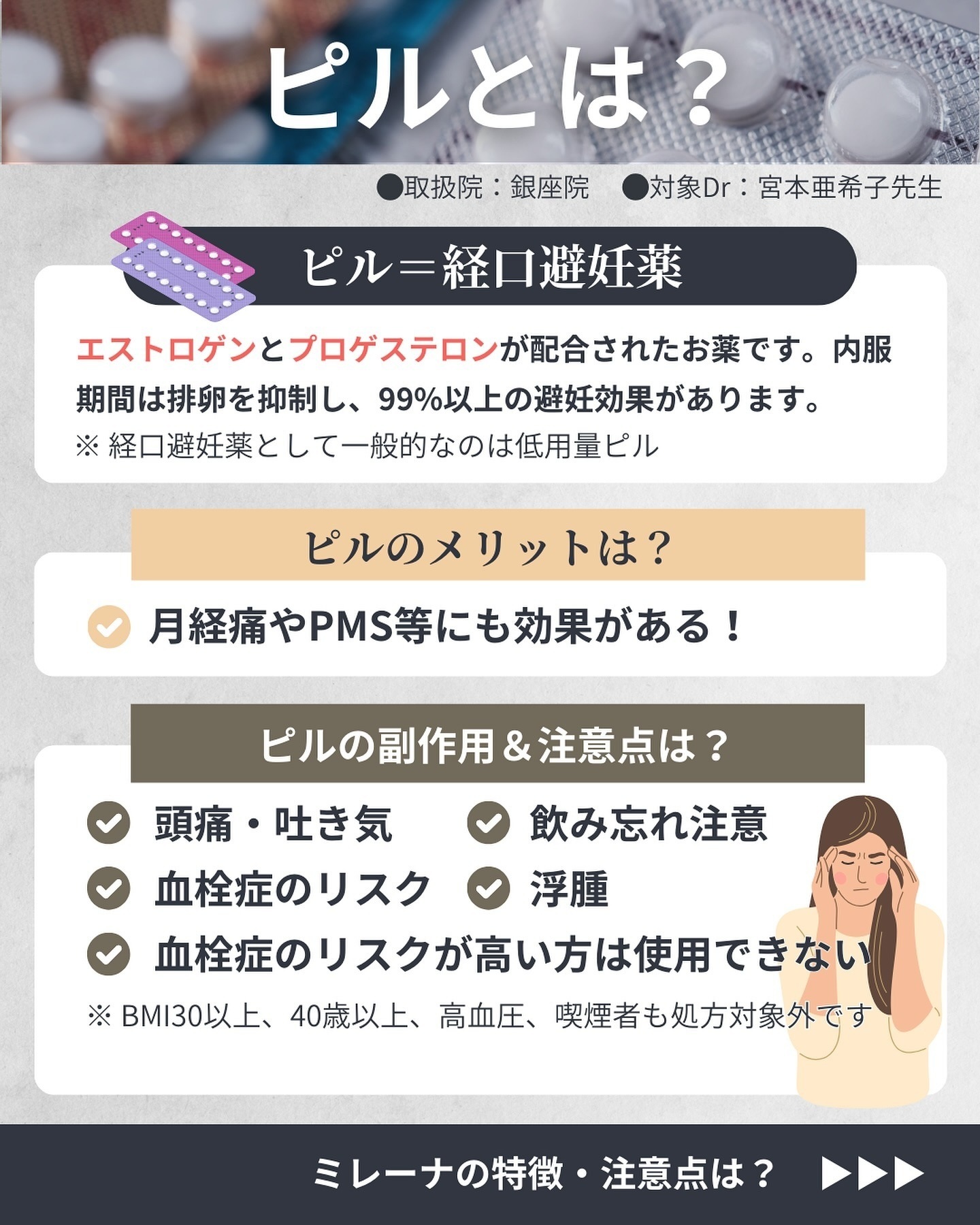
The pill is an oral contraceptive primarily composed of two types of female hormones: progesterone and estrogen. There are three main types: "low-dose pills," "medium-dose pills," and "emergency contraception pills," which differ in their hormone content. What is generally referred to as "the pill" is the low-dose pill.
Low-dose birth control pills suppress ovulation and provide contraceptive effectiveness when taken consistently at the same time each day. However, missing a dose can reduce effectiveness, so managing your schedule is crucial.
In addition to its contraceptive effects, some individuals may experience changes in their menstrual cycle, menstrual flow, menstrual cramps, or PMS (premenstrual syndrome) due to shifts in hormone balance. While individual experiences vary, these changes can sometimes enhance comfort in daily life.
What is Mirena?
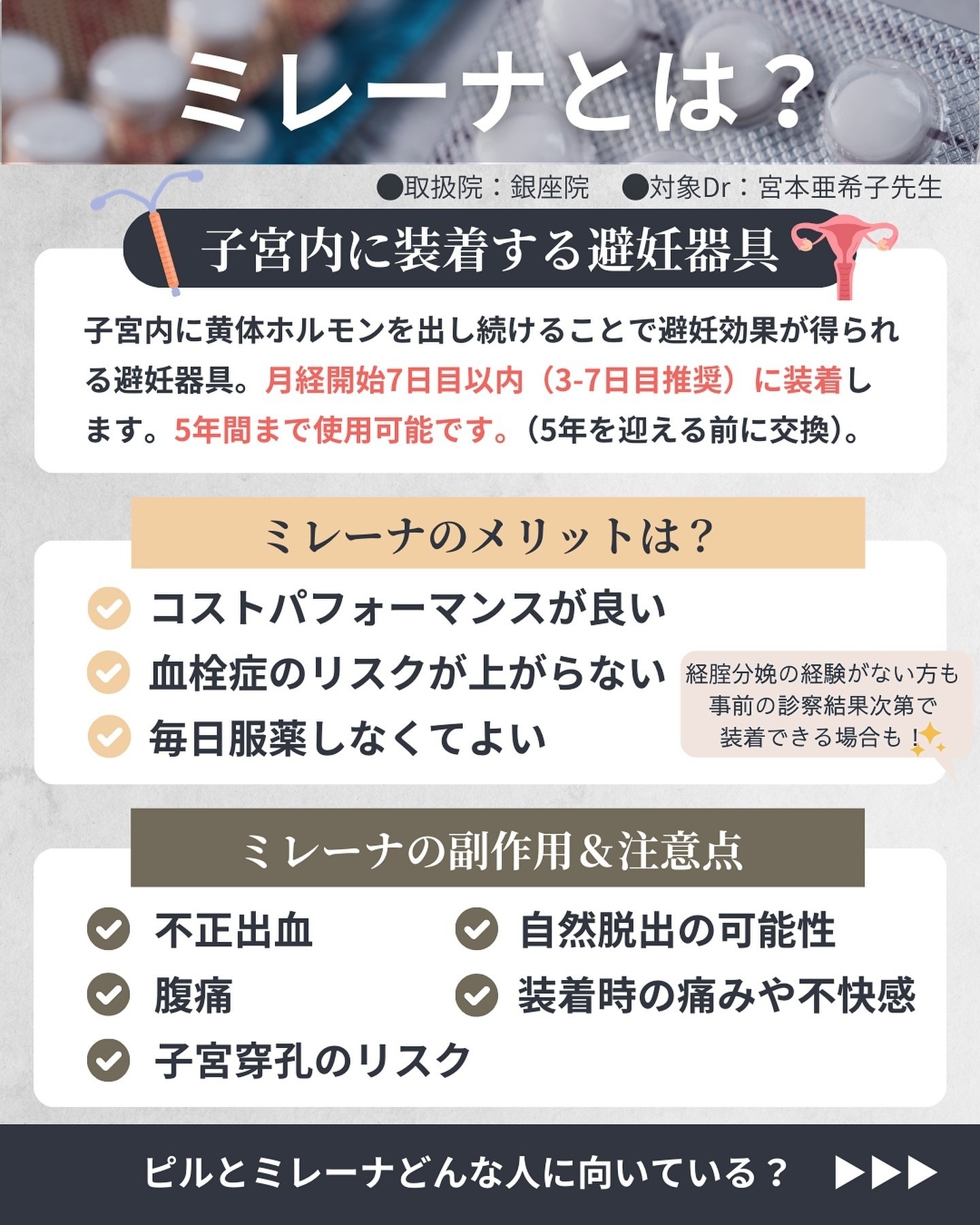
Mirena is an intrauterine contraceptive device (IUD), also known as an IUS (intrauterine progestin-releasing system). It is T-shaped and approximately 3 cm in size. It continuously releases levonorgestrel, a type of progestin, which keeps the endometrium thin to prevent implantation of a fertilized egg. It also works by altering the cervical mucus, making it difficult for sperm to enter the uterus.
This contraceptive provides up to five years of protection with a single insertion and requires no daily management. Furthermore, its hormonal action is expected to alleviate menstrual cramps and reduce menstrual flow, making it also used for treating dysmenorrhea, menorrhagia, and anemia.
Benefits
MERITCan prevent unwanted pregnancies
Contraception is a means of protecting yourself from the significant risk of unintended pregnancy. The peace of mind that comes from being able to choose whether to become pregnant or give birth contributes to emotional stability and expands your life choices.
Easy to adapt to your lifestyle
Choosing the right contraceptive method for your lifestyle and partnership allows you to continue using it without stress.
Increased sense of security regarding sexual activity
Proper use of contraception reduces the anxiety about pregnancy, resulting in a sense of security that allows you to relax and enjoy time with your partner.
Recommended Features
RECOMMENDED POINTSThe Difference Between Insurance-Covered and Out-of-Pocket Treatment for Low-Dose Birth Control Pills
Whether low-dose birth control pills are covered by insurance or require out-of-pocket payment depends on the purpose of use and the specific medication chosen.
For contraceptive purposes, treatment is generally self-pay. However, for conditions such as endometriosis or dysmenorrhea requiring treatment, insurance coverage is available.
Additionally, there are differences in the maximum prescription period: for out-of-pocket treatment, prescriptions can be issued for up to 6 months, while for insurance-covered treatment, prescriptions are generally limited to 3 months. Please note that our clinic only handles out-of-pocket treatment.
The low-dose birth control pills prescribed at our clinic are three types: "Favowar® 28," "La Bellefille® 28," and "Synphase® T28." Each is categorized as either monophasic or triphasic based on the hormonal balance in their formulation. Monophasic pills contain a consistent amount of hormones throughout the entire pack, while triphasic pills contain three types of tablets with gradually changing hormone levels. Our doctors will recommend the type best suited to your symptoms and constitution, so please consult with us during your initial counseling session.
The Difference Between Mirena and Contraceptive Implants
Both Mirena and contraceptive implants are long-acting hormonal contraceptive methods. However, they differ in how they work within the body, their insertion methods, their expected effects, and the nature of their side effects.
Both Mirena and contraceptive implants can help reduce heavy menstrual flow and menstrual cramps, making them suitable for those who wish to manage menstrual issues alongside contraception.
The insertion method for Mirena is intrauterine. On the other hand, the contraceptive implant is placed subcutaneously in the arm.
Regular inspections are conducted for peace of mind.
Our clinic conducts regular examinations not only to ensure prescriptions are issued by board-certified obstetricians and gynecologists after a thorough examination, but also to properly address any physical changes that may occur during treatment.
For patients using Mirena, our clinic performs transvaginal ultrasounds at 1 month, 3 months, and 6 months after insertion, followed by annual checkups thereafter. For those concerned about pain during insertion, nitrous oxide anesthesia is available upon request.
For patients taking low-dose birth control pills, we conduct annual blood tests, transvaginal ultrasounds, and cervical cancer screenings (Pap smears).
For patients using contraceptive implants, we perform transvaginal ultrasound checks every six months to one year.
Currently, there are cases where non-obstetricians and gynecologists prescribe contraceptive implants or low-dose birth control pills. However, prescriptions by doctors outside this specialty can be extremely dangerous, as they may be unable to handle issues such as regular check-ups or problems like abnormal bleeding or heavy bleeding. Therefore, this practice should be avoided.
Treatment Process
CONTENT OF TREATMENTCounseling and Examination
First, during your consultation, we will carefully listen to your wishes and concerns. While discussing your life plans, childbirth history, menstrual status, and current contraceptive methods, the doctor will conduct an examination to determine if the method is appropriate for you.

Transvaginal ultrasound
A transvaginal ultrasound will be performed to examine the condition inside the uterus and check for any abnormalities in the uterus or ovaries. Additionally, a cervical cancer screening will be conducted as needed.
Treatment and Prescription
We provide contraceptive device insertion or prescribe birth control pills. For contraceptive implants, local anesthesia is administered at the insertion site (inner upper arm), and the implant is placed under the skin. For Mirena, the device is inserted through the opening of the uterus while the patient is on the gynecological exam table.
Aftercare
To ensure your continued safety, we conduct regular checkups. Please visit our clinic according to your doctor's instructions regarding the timing of your checkup.

Schedule of Charges
PRICE LISTContraceptive implant
| Treatment Details | Standard rate |
|---|---|
| Attachment | ¥88,000 |
| Autologous tooth extraction | ¥16,500 |
| Extraction at another hospital | ¥49,500 |
Ultrasound examination required in advance
Birth control pills (self-pay)
| Content | Net Content | Amount |
|---|---|---|
| Favour 28 | 1 sheet | ¥2,800 |
| Label Field 28 | 1 sheet | ¥2,800 |
Milena
| Treatment Details | Standard rate |
|---|---|
| Milena Insurance coverage is also available. | ¥66,000 |
| Mirena Removal (At Our Clinic) | ¥11,000 |
| Mirena Removal (Performed at Another Facility) | ¥16,500 |
| Mirena replacement | ¥5,500 |

Lifestyle Beautyis
proposed.
Our goal is to move you beyond satisfaction.
Responding to the desire for greater beauty and health,
What can we do for the well-being of our patients?
Providing total beauty to make your life shine,
That is our policy.
Go to BIANCA and you'll find a smile.
That's the kind of place we're aiming for.
Frequently asked questions about various types of contraceptive counseling
Q&AWhen should contraceptive implants be inserted?
Insertion between the first and seventh day of menstruation allows for contraceptive effectiveness starting on the day of insertion. If inserted at any other time, it is necessary to use another contraceptive method concurrently for approximately one week until effectiveness stabilizes.
When should the contraceptive implant be removed?
The contraceptive effect lasts for up to three years, so the implant is removed within three years. If you wish to continue contraception, replacement with a new implant is necessary.
How do I remove a contraceptive implant?
The contraceptive implant is removed by making a small incision of a few millimeters in the skin of the upper arm, where it was inserted, using specialized instruments. The procedure is performed under local anesthesia, so you will feel little to no pain.
Do I need tests before getting a contraceptive implant?
Yes. During the examination, we will perform a transvaginal ultrasound to check for any abnormalities in the uterus or ovaries.
When the uterine muscle layer is thick, it is advisable to undergo testing, as there have been reports of severe bleeding occurring with oral progesterone preparations.
What should I do if I forget to take my birth control pill?
The appropriate course of action varies depending on the formulation and the length of time the medication was missed. Please follow the instructions provided by your doctor at the time of prescription.
How old can you be to take birth control pills?
Generally, after age 40, the decision is made by your doctor based on your health status and risk factors. However, this can vary depending on lifestyle habits and health status, so please consult your doctor.
When can I insert the Mirena? What's the best time to insert it?
The optimal time for inserting Mirena is within the first 5 days of your period, counting the first day of bleeding as day 1. The cervix is naturally open during this time, making insertion easier. To ensure a smooth procedure and your peace of mind, we recommend scheduling your appointment as soon as your period starts.
Does wearing Mirena hurt?
The sensation of pain varies depending on the narrowness of the cervix. Those giving birth vaginally tend to feel less pain because the cervix is dilated.
How is the Mirena removed?
Mirena comes with a removal string that the doctor uses to remove it.
If I'm using one of these contraceptive methods (Mirena, low-dose birth control pills, contraceptive implant), do I still need to use condoms?
From a contraceptive standpoint, condoms are generally unnecessary; however, condom use is required for the prevention of sexually transmitted infections.
【Treatment Details】Contraceptive Implant (Implanon NXT®️)
【Estimated Treatment Period and Number of Sessions】Per session ※May vary depending on individual condition. Effects last up to 3 years.
【Risks and Side Effects】Short-term headaches, irregular bleeding, mood swings, weight gain, temporary worsening of acne, etc.
【Important Notes Regarding Unapproved Medicines】
・This treatment may involve the use of unapproved pharmaceuticals that have not received regulatory approval in Japan.
・Medicines used in treatments are imported through personal import procedures under the supervision of a physician. For details, please refer to the Ministry of Health, Labour and Welfare's "Information on Medicines Requiring Caution for Personal Import."
https://www.yakubutsu.mhlw.go.jp/individualimport/purchase/index.html
・Except for products that have obtained pharmaceutical approval, there may be no other domestically approved pharmaceuticals containing the same ingredients.
・Serious risks or side effects may not yet be known.
・In the unlikely event of serious side effects, you may not be eligible for the national pharmaceutical adverse reaction victim relief system.
Treatment Details: Low-dose birth control pills
【Treatment Duration and Frequency Guidelines】 Take one tablet daily. *May vary depending on individual condition.
【Risks and Side Effects】Headache, nausea, edema, thrombosis, etc.
【Important Information Regarding Medications Used】
・The pharmaceutical product "Favowar® 28" has received pharmaceutical approval from the Ministry of Health, Labour and Welfare for the purpose of contraception (Approval Number: 22300AMX00044).
・The pharmaceutical product "Label Feuille® 28" has received pharmaceutical approval from the Ministry of Health, Labour and Welfare for the purpose of contraception (Approval Number: 22400AMX00482).
・The pharmaceutical product "Synphase T®28" has received pharmaceutical approval from the Ministry of Health, Labour and Welfare for the purpose of contraception (Approval Number: 21900AMX01800000).
However, it may be used for purposes or on body parts other than those for which it is approved.
・The pharmaceuticals used in treatment are procured under a physician's supervision: Favowar® 28 and Label Feuille® from Fuji Pharmaceutical Industries Co., Ltd., and Synphase T® 28 from Kaken Pharmaceutical Co., Ltd. For details, please refer to the Ministry of Health, Labour and Welfare's "Information on Pharmaceuticals Requiring Caution for Personal Import."
https://www.yakubutsu.mhlw.go.jp/individualimport/purchase/index.html
・There may be no other domestically approved pharmaceutical products with the same ingredients or performance.
・In the unlikely event of serious side effects, you may not be eligible for the national pharmaceutical adverse reaction victim relief system.
【Treatment Details】Mirena® (Levonorgestrel-releasing Intrauterine System)
【Estimated Treatment Period and Number of Sessions】Per session ※Varies depending on the condition.
【Risks and Side Effects】Irregular bleeding, abdominal pain, potential for spontaneous expulsion, pain or discomfort during insertion, and in rare cases, risk of uterine perforation.
【Important Information Regarding Medications Used】
・The pharmaceutical product "Mirena® 52mg" has received approval from the Ministry of Health, Labour and Welfare as a highly regulated medical device for the purposes of contraception, menorrhagia, and dysmenorrhea (Approval Number: 21600BZY00705000).
However, it may be used for purposes or on body parts other than those for which it is approved.
・Medicines used in treatments are procured from Bayer Pharmaceuticals Inc. under the supervision of a physician. For details, please refer to the Ministry of Health, Labour and Welfare's "Information on Medicines Requiring Caution for Personal Import."
https://www.yakubutsu.mhlw.go.jp/individualimport/purchase/index.html
・There may be no other domestically approved pharmaceutical products with the same ingredients or performance.
・Information regarding safety and other matters in other countries
-"Mirena® 52mg" is approved and sold in 122 countries worldwide (as of August 2023).
・In the unlikely event of serious side effects, you may not be eligible for the national pharmaceutical adverse reaction victim relief system.