column (e.g. in newspaper)
2026.03.25
How to fix ham eye? Why does it happen? Doctors explain the different causes in an easy-to-understand manner.

As a board-certified plastic surgeon by the Japanese Society of Plastic and Reconstructive Surgery, he has been engaged in a wide variety of periocular surgeries at university hospitals. Based on his solid anatomical knowledge and suturing skills, he is in charge of a wide range of surgeries around the eyes including sub-brow incisions and blepharoplasty incisions, as well as hyaluronic acid injections, Botox injections, and thread lifts. We also accept insurance coverage for droopy eyelids and inner eyelashes. We value natural and elegant results, and are known for our attentive counseling that attends to the patient's feelings.
Hello, I am Yumi Hattori from Bianca Clinic. I am Yumi Hattori from Bianca Clinic.
Bifold surgery is a very popular procedure, but we often hear these concerns during counseling.
"I made a double fold, but it's kind of unnatural..."
Her eyelids are puffy and she looks sleepy."
It may be “ham eye. Today, we will discuss how to correct this ham eye.
Why it happens
Can it heal itself?
What options are available to correct the problem?
These will be explained as clearly as possible.
What is "ham eye"? | What is "swollen looking double eyes"?
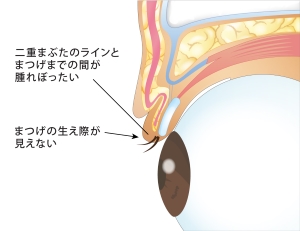
Ham eye is a condition in which the skin covers over the double line and the entire eyelid appears thick and swollen. The name comes from its appearance reminiscent of a boneless ham bound with thread. Although not a medical term, it is commonly used in the field of cosmetic medicine. It is similar in appearance to swelling during downtime, though,
- The plumpness doesn't disappear after a few months.
- Skin covering the eyelash line
- Your eyes look small.
If these conditions persist, you may have ham eye. I am not satisfied with my double vision after having gone to the trouble of making it ....... Actually, this is not an uncommon problem.
Why does ham eye occur? | Knowing the cause is the first step to improvement
There is no single cause of ham eye. In many cases, it is a combination of multiple factors.
Ham eye caused by too wide a double width
If the width of the eyelid is too wide, the skin of the eyelid will not be able to ride the line and the excess skin will be folded over. Simply put, the double fold is over-specified for the eyelid. The “idealistic design” that ignores the skeletal structure and skin thickness increases the risk of ham eye.
Ham eye caused by the amount of skin and fat in the eyelid
If you have thick skin to begin with, or if you have a lot of orbital fat or ROOF*, simple implantation alone will not be able to handle the volume. If the thick tissue is forced to fold in, it is natural that it will become plump. This type of case is not so much a case of "bad method" as it is a case of "incorrect design.
*ROOF...Fat that exists just below the orbicularis oculi muscle from below the eyebrow to the upper eyelid.
Hamming due to too much thread bite
If the thread is tied too tightly in the implantation technique, an unnatural bump is created. If the threads are pulled in too hard, especially on thick eyelids, an imbalance can easily occur, with a strong bite but a full appearance at the top. This is a point where the experience of the doctor has a great influence.
Can ham eye heal on its own? | Common Misconceptions and Limitations
When ham eye-like condition occurs after a bifacial surgery, many people wonder if it can be cured with massage or if it will return after some time. In fact, many people search for “ham eye, heal by yourself,” which shows the extent of their anxiety. However, the important thing to remember is that not all cases of ham eye have the same cause. Some cases settle down spontaneously, while others require medical correction. Let us first sort out the differences.
Cases that improve or do not improve with self-care
The potential for improvement of ham eye depends greatly on the cause of the problem. For example, if it is within a few weeks to a few months after the implantation, it is possible that the swelling and puffiness are still in the process of being resolved. In this case, the swelling will go down with time, and in many cases, it will naturally clear up. Caution should be exercised, however, when "structural problems" are the cause, such as the following.
- Double width is too wide
- There is excess skin.
- Adhesions not properly positioned
These are problems related to the internal structure of the eyelid itself. They are almost never expected to improve with massage or self-care, and there is a risk of sagging or indentation if they are touched forcibly. If structure is the cause, redesign through medical correction is necessary. This discernment of "will it get better if I wait?" and "should I consider correction?" is very important.
What is the approximate time frame when a modification can be considered?
In many cases, those who come to us saying, "I may have a ham eye..." are actually still experiencing swelling during their downtime. Swelling after a double blepharoplasty can be stronger than expected. Therefore, it is difficult to judge whether it is really a ham eye or not until the swelling has completely settled down.
<In case of implantation
Downtime for implantation is generally about one week.
- Swelling is easily noticeable for 2-3 days after surgery
- Large swelling settles down in about a week.
The appearance stabilizes approximately one month after surgery. Therefore, at least one month should pass before considering revision surgery. Do not make a decision too early.
<In case of incision
Because the incision method is more invasive to the tissue, swelling subsides more slowly.
- Strong swelling for about 3 days after surgery
- Peak swelling around 1 week
- Large swelling subsides in 2-3 weeks.
However, "reduced swelling does not = complete stabilization". It takes time for the internal scar to soften. Therefore, if you are considering revision surgery, the ideal timing is after six months or more, if possible.
How to Correct Ham Eye|Two Options for Different Causes
Fixing a ham eye does not work with the idea of "fixing something anyway". Is it a double width problem or excess skin? The approach depends entirely on the cause. Here we will review two typical correction methods, including the differences in their indications.
(1) Correction method by adjusting and redoing the double line
If the cause of ham eye is a wide double width, we correct it by redesigning the width to be appropriately narrow. If the double width is too wide for the thickness of the eyelid, the skin will not fold in properly and volume will tend to accumulate on top. The current line is reset and adjusted to a natural width that matches the condition of the eyelid. Depending on the condition of the eyelid, the following specific methods are used.
- For the implantation method:Stitches are removed and re-fixed in the appropriate position
- Incision method:Release of adhesions or redesign
The key here is not simply to “narrow” the width, but to redesign it while keeping a balance with the excess skin and fat content. Correcting a double fold is more of a "re-setting" than a redo. The goal is to achieve a natural and comfortable result by adjusting the line to match the structure of the eyelid.
Ham eye correction by excision of the skin above the eyelashes
One of the relatively common choices for correcting ham eye is supratrash excision. It is also commonly referred to as “ham eye correction. Supralash excision involves removing a few millimeters of skin just above the lashes and removing the excess skin to address the ”overhang“ on the double fold line.
The point is that the double fold line itself is not changed significantly. In this case, the supratrash dermabrasion is the best choice. The incision is made along the eyelash line, so the scar is relatively inconspicuous. The incision is made along the lash line, rather than on the double fold line, to achieve a natural-looking result.
However, it is very important to determine the amount of skin removed. If too much is removed, it can cause eyelid closure problems and discomfort, and if too little, the change will be insufficient. The hamate correction method requires millimeter-by-millimeter design, rather than “just cutting.
▶ Bianca Clinic's supratrichiasis skin excision (ham eye correction) isHere
What is important in ham eye correction is "discernment" rather than "method"!
We have discussed several methods of correction, but in fact, the most important thing is not which technique you choose. What is really important is to determine exactly why you have ham eye.
Misjudging the cause of the ham eye will reduce satisfaction.
The reason ham eye correction is so difficult is that there is more than one cause.
For example,
- Narrowing the double width only, even though it is caused by excess skin
- The double width is too wide, but the skin is removed.
If there is such a “discrepancy between cause and effect,” the expected improvement will not be achieved. Ham eye correction is not just a redo, but a redesign. In many cases, the desire for a "prettier double fold" leads to widening of the eye line, resulting in a "ham eye.
Where is the volume, where is the excess, and where is the deficiency? If the surgery is performed without sufficient analysis of this issue, satisfaction will inevitably decline.
Correction design that considers future eyelid changes
More importantly, the "just for now" perspective is not sufficient. As the eyelids age, changes can occur such as sagging skin, fat loss, and changes in eye opening. Therefore, in the revision process, it is necessary to design a plan that takes into account the current state of the eyelid plus future changes. At Bianca Clinic, our physicians, who have performed numerous bifacial surgeries and revisions at other clinics, perform a detailed evaluation of the anatomy of the eyelid before making a diagnosis. That is why we value discernment over ham eye correction methods.
The right choice for correcting ham eye is important for the right cause.
Ham eye is caused by a combination of various factors such as double width, excess skin, amount of fat, and position of adhesions. That is why the success or failure of a revision depends more on the “accuracy of diagnosis” than on the surgical procedure itself. Is it swelling or a structural problem? Is it a width problem or a skin problem? If you decide on a ham eye correction method without sorting out the cause, you may not be satisfied with the result. Correction is not a “do-over” but a redesign with an eye on the future.
Instead of simply deciding "let's make it narrower" or "let's cut it,
- Skin thickness
- fatty constitution
- Ptosis or not
- Prediction of future sagging
The revision plan is designed comprehensively, including the following Ideally, the next revision surgery should be the “last” one. If you are wondering if this is really the right solution, you can start with just a diagnosis. Stopping once and sorting out the cause is actually the shortest way, even though it may seem like a roundabout way.
▶Counseling appointments are available atHere