column (e.g. in newspaper)
2026.05.26
Mid-Facelift Case Study: How Does the Impression Change with Cheek Positioning? A Plastic Surgeon Explains the Progress, Changes, and Indications

As a plastic surgeon certified by the Japanese Society of Plastic and Reconstructive Surgery, I have been involved in many cases of trauma, reconstruction, and congenital diseases, and have cultivated precise techniques and a deep understanding of anatomy. He entered the field of cosmetic surgery out of a desire to bring the power of cosmetics to his patients, as a change in one's appearance can also make one's mind more positive. Her specialties include general treatment of the eye area, injections, and sagging skin. I provide treatments that focus on beauty with the medical stance of "sincerely addressing the ideals of the patient.

Hello!
Designing natural beauty with trust.
I am Masataka Fujihashi, a board-certified plastic surgeon of the Japanese Society of Plastic and Reconstructive Surgery.
For those considering a mid-facelift, you may be wondering, "How much of a difference is there in actual cases?", "What kind of changes can be seen in cases similar to mine?", and "I want to see actual cases." A mid-facelift is a procedure that corrects the positional relationship of the midface, from under the eyes to the cheeks, but the extent of the changes varies greatly depending on bone structure and the degree of sagging. Therefore, when considering the procedure, it is important to understand the tendency of the changes through actual cases. This time, based on actual mid-facelift cases performed at Bianca Clinic, we will specifically explain what kind of changes can be seen.
What is a mid-face lift? A procedure that addresses sagging from under the eyes to the cheeks
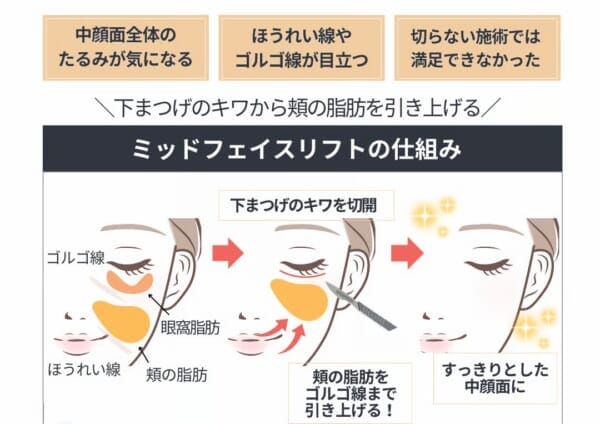
First, let's organize the concepts behind a mid-facelift.
What area is the mid-face?
The mid-face refers to the area from under the eyes to the center of the cheeks (around the cheekbones to the base of the nose). It's a crucial area that relates to facial volume and a youthful appearance. This region is prone to changes with age, such as sagging cheeks, a lengthened mid-face, or shadows appearing from under the eyes to the cheeks. These changes can also affect the appearance of the nasolabial folds and marionette lines.
The basic concept of a mid-facelift
A mid-facelift isn't simply a procedure to pull up the skin. It's a treatment that addresses the overall balance of the face by lifting the tissues supporting the cheeks and repositioning the volume in the midface. Therefore, it's easier to understand it as a procedure that reshapes the face's structure and appearance, rather than just a wrinkle-erasing treatment.
▶Bianca Clinic Mid-Face Lift Menu Page
Case Introduction of Mid-Facelift | Explanation of Actual Changes
From here, we will explain the changes seen, based on a case of mid-face lift performed at Bianca Clinic.
Results may vary from person to person.
Case 1: A case with puffiness under the eyes and sagging in the cheeks.
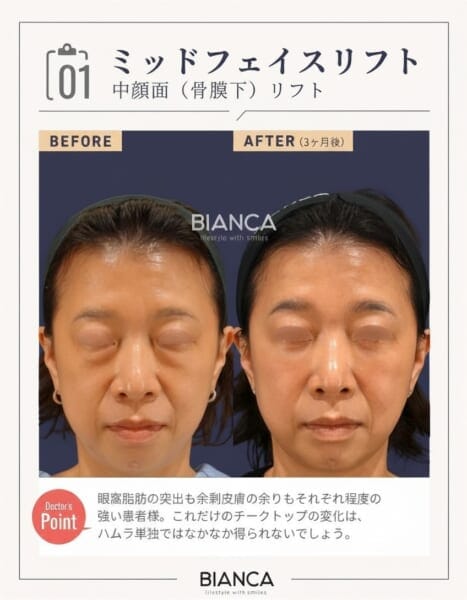
[Treatment]: Mid-face lift (subperiosteal) [Image description]: Left: Before treatment, Right: 3 months after treatment [Cost]: ¥880,000 [Side effects/Risks]: Bruising, hematoma, infection, residual symptoms such as dimpling, peripheral nerve damage in the cheeks, etc.
In this case, in addition to puffiness under the eyes, the cheeks were slightly lower, creating unevenness and shadows from the eyes to the cheeks. The low position of the cheekbones also affected the overall impression of the midface.
By repositioning the cheeks with a mid-facelift, the tops of the cheeks are returned to a higher position, creating a gradual change in the three-dimensionality of the mid-face.
As a result, the connection from the eyes to the cheeks becomes natural, and changes are visible in the overall impression. This is one of the representative cases that clearly demonstrates the fundamental changes of a mid-face lift.
Case ② A case where the patient had significant excess skin and noticeable sagging in the mid-face.
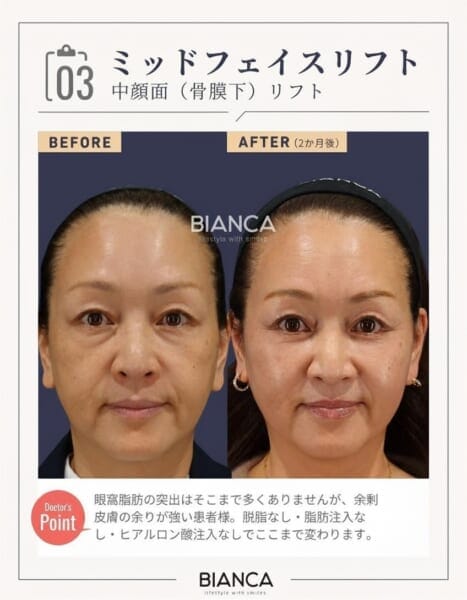
[Procedure] Mid-face lift (subperiosteal) [Description of images] Left: Before procedure, Right: 2 months after procedure [Cost] ¥880,000 [Side effects/Risks] Symptoms such as bruising, hematoma, infection, and depression may remain, as well as peripheral nerve damage in the cheeks.
In this case, the sagging of the cheeks caused an uneven distribution of volume in the midface, leading to a somewhat heavy appearance. There was also excess skin, making the cheeks appear lower. By repositioning the cheeks with a midface lift, the cheekbones were lifted, and a change in the midface balance is observed. As a result, the overall facial impression has become refreshed and balanced.
In cases where changes in cheek position and excess skin are involved, a midface lift may be an option.
Case 3: A case where the unevenness around the eyes and cheeks due to aging was noticeable.
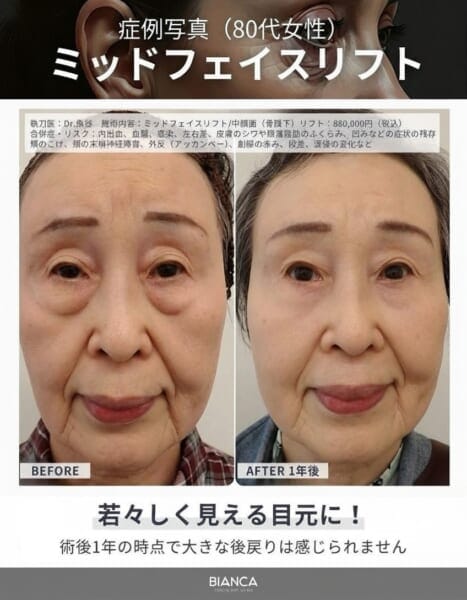
[Procedure] Mid-face lift (subperiosteal) [Image description] Left: Before surgery Right: 1 year after surgery [Cost] ¥880,000 [Side effects/Risks] Bruising, hematoma, infection, residual symptoms such as indentations, peripheral nerve damage in the cheeks, etc.
This is a mid-face lift case for a woman in her 80s. Due to the decline of connective tissues in the mid-face associated with aging, depressions and shadows were prominent from the eyes down to the cheeks. A distinct step-off was particularly noticeable from under the eyes to the cheeks, giving an overall tired appearance.
The mid-facelift improves the position of the cheeks, leading to a more balanced and three-dimensional mid-face, which also alters how shadows appear. As a result, the impression from the eyes to the cheeks is softened, giving the entire face a gentler, more youthful appearance. A characteristic of this case is that significant relapse has not been observed even one year after surgery, indicating a relatively stable progression.
▶Case of Mid-Face Lift at Bianca Clinic
Mid-Facelift Progress: How Do Post-Operative Changes Progress?

When considering a mid-facelift, the postoperative recovery is likely one of the points you are concerned about. Here we explain the general recovery timeline.
Post-operative to 1 week of progress: Period when swelling and bruising are likely to appear
Immediately after a mid-face lift, you may experience the following symptoms:
- Swelling
- bruising
- Swelling
- Discomfort
These will peak a few days to about a week after surgery, and then gradually subside. While there are individual differences, swelling and bruising often become less noticeable in about 1-2 weeks. It generally takes about a month for the impact on daily life to become negligible.
Mid-face lifts tend to have a slightly longer downtime compared to tear trough treatment because they involve a larger treatment area. However, swelling and bruising often occur within the area that can be hidden by a mask, making it relatively easy to return to daily life. Additionally, regarding post-operative care, washing your face and applying base makeup are possible from the day after surgery, but it is common practice to refrain from eye makeup and contact lens use for about one week after the procedure.
1-3 Months Post-Procedure: The settling and stabilization phase
About one month after surgery, swelling and puffiness will subside further, and the position of the cheeks will gradually stabilize. Your appearance will start to look more natural, approaching a more settled impression. It typically takes about 2 to 3 months for significant swelling to decrease and the results to stabilize. Around this time, you'll likely begin to notice changes in the three-dimensionality and balance of your mid-face. However, it can take about 3 to 6 months after surgery for the results to be fully complete, including the resolution of minor swelling and settling of tissues. Additionally, as the mid-face lift is a surgical procedure, long-term effects can be expected.
Cases suitable for a mid-face lift

A mid-face lift is not a suitable procedure for everyone. Depending on the condition of your face, there are cases where it is appropriate and cases where it is not.
Examples of Mid-Facelift Applications
A mid-facelift is often considered in the following cases:
- The position of the cheeks has dropped.
- Golgoth lines are prominent.
- The middle of the face looks long.
- The cause of nasolabial folds is sagging cheeks.
In this way, a mid-face lift may be appropriate when changes in position are involved.
Cases where the effects of a mid-face lift are less noticeable
On the other hand, different treatments may be more suitable in the following cases.
- Wrinkles in the skin itself are the main concern.
- Lack of volume is the main cause.
- Sagging along the jawline is the main concern.
In cases like this, it may be difficult to achieve the desired change even with a mid-face lift, and you might feel that "a mid-face lift is ineffective." The important thing is to choose not based on the procedure name alone, but to determine if it suits the patient's facial condition.
How to Determine Changes and Adaptations from Mid-Facelift Cases
Mid-face lifts are procedures that change the overall balance of the face by adjusting the position of the cheeks. As seen in the case studies introduced in the article, the results vary from person to person, and the outcome depends greatly on bone structure and the condition of sagging. Furthermore, many cases where people feel that "mid-face lifts are ineffective" are not due to the procedure itself, but rather a mismatch between its suitability and expectations.
What's important is not to judge solely by appearance, but to choose a treatment based on the structural reasons behind the change. At Bianca Clinic, we examine the overall condition of your face and propose treatments that are suitable for each individual. If you are considering a midface lift, please consult with us first.
▶Bianca Clinic Counseling Reservation Form