column (e.g. in newspaper)
2026.03.25
Does the natural adhesion method require stitches? Is it unnecessary? |Questions of concern explained from a physician's point of view

With deep medical insight cultivated as an internal medicine specialist, I bridge aesthetic surgery, dermatology, and internal medicine. Having spent my childhood in China, I communicate fluently in Japanese, Chinese, English, and Korean. Possessing an international perspective—evidenced by invitations to present at overseas conferences—I actively promote techniques as a Key Opinion Leader (KOL) for GOURI and REJURAN®. My specialty procedures include double eyelid surgery, skin-nurturing boosters, and body hyaluronic acid treatments. My approach leverages the holistic understanding of the body cultivated through internal medicine to guide patients toward natural, healthy beauty.
Hello, I am Senhime Akashi from Bianca Clinic.
I have a question: "The natural adhesion method uses threads, doesn't it? Do I need to remove the stitches?"
If I don't like it, can I put it back together properly?"
These are the questions that are really frequently asked during a counseling session for the natural adhesion method. As it turns out, the natural adhesion method basically does not require suture removal. However, there are exceptions. In this article, I would like to talk a little more about the “natural adhesion method and suture removal” from a doctor's point of view.
What is the Natural Adhesion Method? | The Choice Between Resuspension and Incision
There are two main types of bifacial surgery.
- Embedding method:A method of creating lines by fastening the eyelids with medical threads. Since no scalpel is used, downtime is relatively short and can be redone.
- Incision method:A method of creating a double fold by making an incision in the eyelid skin and adjusting excess fat and skin. The stability of the line is relatively high and can be expected to last for a long period of time.
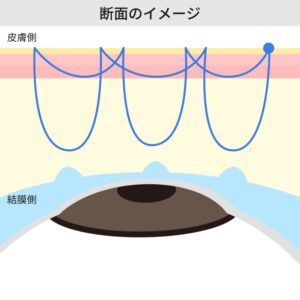
Which is better, natural adhesion or implantation?" The first thing to know is that the natural adhesion method is a type of implantation. In the natural fixation technique, a tiny hole (millimeter scale) is made in the eyelid, a thread is inserted, and a natural adhesion is created between the eyelid elevator muscle and the skin to form a double fold line.
The key is to use the “adhesion reaction,” in which the tissues adhere to each other, rather than relying solely on thread fixation. For those who want to stabilize the surgery but feel that an immediate incision is too difficult, the natural adhesion method is an option.
Does the natural adhesion method require stitches? Is it unnecessary? |Points that are often misunderstood are summarized.
When researching the natural adhesion method, you may see information such as "stitches are required" or "it cannot be corrected. On the other hand, there are also explanations that "stitches are not necessary," and many people are confused as to what is true.
Therefore,
- Lines are more stable than with the regular implantation method.
- Less downtime than incision
- Less noticeable scarring and natural finish
This is a balanced type of characteristic. In this section, we will organize the relationship between the spontaneous adhesion method and suture removal from a structural and medical point of view.
Natural adhesion method is basically a "no stitches" procedure
In principle, the natural adhesion method is a procedure that does not require the removal of stitches. The threads used are medical grade microfiber threads that are embedded within the tissue of the eyelid. Therefore, the threads are not exposed on the surface of the skin. The threads are designed to remain in the body and usually stabilize without any problems with only follow-up observation, so there is no need to go to the hospital for thread removal. Some people are concerned when they hear that there are threads in the skin, but due to the structure of the skin, the threads do not appear on the surface, and the procedure basically stabilizes naturally as it is.
▶ Double implantation method: The natural adhesion method isHere
When will there still be stitches?
Although the natural adhesion method basically does not require suture removal, suture removal and adjustment may be necessary in the following cases
-
- Excessive biting...If the postoperative biting is unnaturally strong and does not settle down over time, the tension of the threads may be too strong. In this case, the stitches may be removed and readjusted.
- Prolonged pain, swelling, and internal bleeding...Normal downtime is 1-2 weeks, but if these symptoms persist for more than a month, infection or inflammation may be present. The cause will be confirmed and stitches will be removed if necessary.
- If you wish to change the design... If you wish to "change the width" or "change the shape", we will remove the stitches once and perform the surgery again (i.e., redo the surgery).
This is possible because the natural adhesion method is a procedure that is easy to correct.
Is it true that the natural adhesion method is difficult to remove stitches?
I thought the spontaneous adhesion method was difficult to remove stitches because of its complex structure."
Once you do it, you can't fix it, can you?"
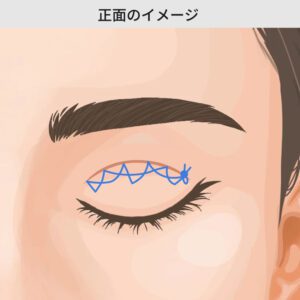
Although these questions are sometimes asked, there is actually no need to be overly concerned if you understand the structure correctly. The natural adhesion method uses a single long thread to sew up the eyelid. The line is formed with a single thread, so to speak, just like sewing. Therefore, there is only one ball of thread per eye. When removing the thread, the thread ball can be checked and pulled out through a small hole to remove the entire thread.
On the other hand, implantation methods such as 2-point and 3-point fixation are designed to fixate at multiple points, and there are multiple thread balls depending on the number of fixations. This is not a matter of superiority or inferiority, but a difference in structure. The natural fixation method has a single ball of thread, which makes the approach to suture removal relatively simple. This makes it a procedure that can be adjusted and redone.
Does the natural adhesion method ever feel "removed"?
Many people search for “Natural Adhesion Method removed”. After a while after the surgery, it is quite common for people to feel anxious, "The line seems to have faded..." or "Has this already been removed?" After a while after the surgery, there are actually many cases where people feel uneasy. However, first of all, it is important to know that "I feel like it has been removed" does not always mean that it has really been removed.
Cases that are really taken and cases that are not.
In the spontaneous adhesion method, there are times when the postoperative appearance is easily misinterpreted as "removed". The natural adhesion method is a procedure that takes approximately one to three months for the tissues to attach to each other and become stable. Immediately after surgery, the line is often strongly and clearly visible due to swelling, but as the swelling subsides, the line may temporarily appear shallower. This is a natural change on the way to completion and does not mean that the threads have actually been removed or adhesions have been removed.
It is also affected by changes in impression due to receding swelling and inflammation. Originally, the eyelid is an area where the appearance of width changes depending on one's physical condition and sleep state. As the postoperative swelling subsides, the line may look more natural than it did at first, and some people feel that the line has become weaker or has been removed. In many cases, however, this is a normal change that occurs as the tissue stabilizes.
Why "I feel like I got it" does not equal "failure
The spontaneous adhesion method is not a procedure in which the finished product is determined immediately after surgery.
- Changes can occur until adhesions stabilize.
- Impression changes as swelling goes down.
- Final range settles in 1-3 months.
Because of this process, it is often too early to judge in the early postoperative period. Of course, there are some cases where the adhesion really weakens and the line disappears, but they are not frequent. The important thing is not to be hasty and assume that the surgery is a failure.
Around one month after surgery, the change is still in process. If you are concerned, do not judge for yourself and be sure to see your doctor. The natural adhesion method is a procedure that is completed with proper follow-up. Calm evaluation is important when you are anxious.
The key to the natural adhesion method is to identify the doctor rather than "whether or not to remove the stitches"!
When people talk about natural adhesions, they tend to focus on topics such as whether or not the stitches can be removed and whether or not they are difficult to remove. What is really important, however, is whether or not it is possible to accurately determine whether or not a natural adhesion can be established on the eyelid. And whether or not it is possible to design with the future in mind.
What eyelids are suited for natural adhesion?
The natural adhesion method is not a "threading procedure" but a "procedure to establish adhesion". Therefore, it is necessary to comprehensively assess the following factors
- eyelid thickness
- fatty constitution
- Skin sagging
- Power of Eyelid Raising Muscle
If you decide on a design without accurately determining these factors,
- Too much bite.
- The line gets shallower.
- There is a difference between right and left
This can lead to problems such as the following. In other words, the important thing is not whether or not a double fold can be created, but whether or not a stable natural adhesion can be established on that eyelid. This is where a doctor's experience and anatomical understanding come into play.
Dual design that even calculates the passage of time
The ideal width of a bifocal fold is not the only thing that determines the bifocal fold. Eyelids change little by little with age. Skin loosening due to aging, daily swelling, and eye-opening habits. These factors will affect the appearance of a double fold over time. For example, if the double fold line is too wide, it may appear heavy when the skin drops back after several years. Conversely, a line that is too narrow may in some cases become buried and difficult to see when the skin begins to sag.
Therefore, the important thing is not to judge only by whether it is cute now or not, but whether it will still look natural in 5 or 10 years. Designing with the passage of time in mind will lead to the creation of double-layered eyes that you will not regret.
Properly understand the natural adhesion method and suture removal, and make a choice you will not regret.
The natural adhesion method is basically a procedure that does not require stitches to be removed. In the event of an emergency, revisions are possible, and information such as "stitches are difficult to remove" or "stitches cannot be redone" is not necessarily accurate. In addition, anxiety that the stitches "feel removed" is often a mid-stage of the process, and there is no need to reach a conclusion at an early stage. What is important is not to be swayed by information that stirs up anxiety, but to correctly understand the mechanism and process of the procedure. Another important thing is to choose a doctor who can determine whether the adhesions will stabilize and design a plan for the future.
The natural adhesion method is a useful option for achieving a natural and stable double-exposed eye without the use of a scalpel. However, there are indications for any procedure. Making an informed decision will lead to satisfaction with the results. If you have any doubts or concerns, please do not keep them to yourself, but consult Bianca Clinic first. A correct understanding is the first step toward making a choice you will not regret.
▶Counseling appointments are available atHere