column (e.g. in newspaper)
2026.07.02
What’s the Difference Between Eagle-Nose Correction and Hump Removal? Rhinoplasty from the Perspective of Profile Balance

Specialist in rhinoplasty. He is a board certified plastic surgeon by the Japanese Society of Plastic and Reconstructive Surgery. Based on the principle of “maximum effect with minimum treatment,” I propose the best surgical techniques and plans for my patients from various angles. He specializes in designs that beautifully accentuate the "individuality" of the patient while taking into account the golden ratio of the face. In particular, we create full-custom-made prostheses by combining CT and Vectra data to create full-scale blueprints, which are then precisely finished based on clay prototypes handmade from scratch on a skull model. The shape of the prosthesis can be reproduced with high precision as per the presented simulation, so that even the most detailed wishes can be met and stable results can be achieved.
“When I look at my profile, I'm self-conscious about the prominence of my nose bridge.” "My nose looks more prominent in photos."—Because of concerns like these, many people consider "eagle nose correction."
However, even though it’s often referred to as “correcting a hooked nose,” it’s not simply a matter of “shaving down the protrusion.” In reality, the impression created varies greatly depending on how the bridge of the nose, the tip, and the forehead connect, and depending on how it’s shaved down, the profile can end up looking unnatural. In recent years, in particular, there has been a growing emphasis on “harmony with the entire face” rather than simply removing the hump.
So in this article, we’ll explain in detail the differences between eagle-nose correction and hump removal, as well as the key points for achieving a natural-looking profile.
What Is an “Eagle Nose,” and How Does It Affect the Appearance of Your Profile?
First, let’s take a look at the characteristics of an aquiline nose, its causes, and how it affects the impression it makes.
What exactly is an “eagle nose”?
An “eagle nose” refers to a condition where the central part of the nasal bridge protrudes forward, creating what looks like a “step” when viewed from the side. This protruding part is called a “hump” and is formed by a bulge in the bone or cartilage. Even if it isn’t particularly noticeable from the front, the line of the nose tends to appear uneven when viewed from the side, and many people feel that this makes their nose “look large” or gives them a “harsh impression.”
In addition, because an aquiline nose tends to emphasize sharpness and bone structure, some people worry that it “makes them look masculine” or “makes it difficult to achieve a soft appearance.”
There isn't just one reason why a nose may appear hooked.
The appearance of a hooked nose isn’t simply due to a prominent nasal bridge. In some cases, the nasal bone and septal cartilage are developed due to a person’s natural bone structure, while in others, the line of the nasal bridge may have changed as a result of past trauma or other factors.
In addition, if the tip of the nose is turned downward, the difference in height relative to the center of the face is emphasized, which can make the nasal hump appear more prominent than it actually is. Furthermore, the impression created can vary depending on how the forehead transitions into the nose and the overall three-dimensional contour of the face. Even with a similarly pronounced aquiline nose, some people appear to have a “natural” look while others have a “strikingly prominent” one—this difference stems from variations in skeletal balance.
An aquiline nose can be an attractive feature, depending on one's facial features
While in Japan there are many people who seek advice on how to “get rid of an aquiline nose,” overseas, an aquiline nose is sometimes viewed as a “unique feature” or “attractive trait.” Particularly in the West, a well-defined bridge of the nose often conveys an impression of intelligence, maturity, and elegance.
In fact, what makes a face beautiful isn’t simply that its features are small or prominent; rather, it’s the “overall balance” of the face that matters most. Even a hooked nose can be a source of unique charm if it harmonizes with the person’s bone structure and facial contours.
For this reason, in recent hawk-nose correction procedures, the emphasis tends to be placed not on “removing the hump” per se, but on “adjusting it to achieve a natural balance that blends with the facial features.” What matters is not whether the hump is present or absent, but whether it is in harmony with the face as a whole.
The Difference Between Eagle Nose Correction and Hump Removal | Why “Just Shaving It Down” Isn’t Enough
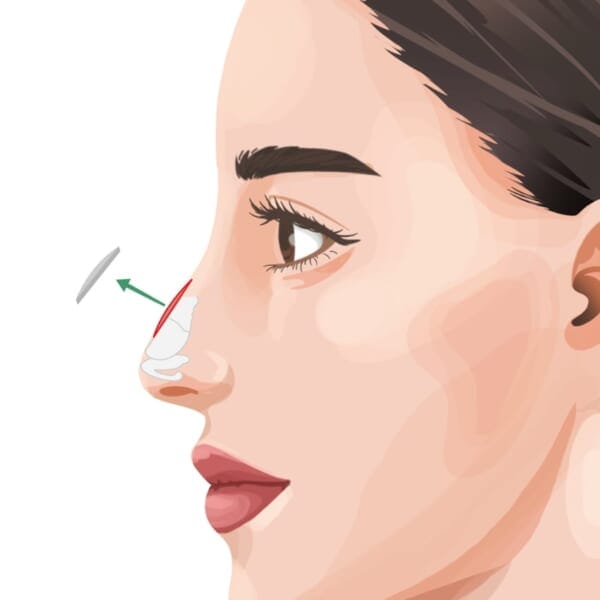
Two procedures you often hear about for correcting a hooked nose are “hump reduction” and “hooked nose correction.” While both procedures address the protrusion along the bridge of the nose, there are actually differences in their underlying approaches and the desired outcomes.
A hump reduction is a procedure in which the protruding portion in the center of the nasal bridge is shaved down to create a smoother contour. It is a relatively simple procedure and is sometimes performed to correct mild to moderate cases of a hooked nose.
On the other hand, “eagle nose correction” isn’t just about shaving down the hump. It also includes cases where the overall balance of the nose is adjusted by combining procedures such as adjusting the width of the nasal bone, reshaping the tip of the nose, and performing cartilage grafts. In other words, while hump reduction is a “procedure to correct a protruding area,” eagle nose correction is a “procedure that takes into account the balance of the entire profile.”
In fact, if too much of the hump is removed, the bridge of the nose may appear flat, or the tip of the nose may be overly emphasized, resulting in an unnatural silhouette. Therefore, rather than simply “removing the protrusion,” it is important to design the nose while considering its connection to the forehead and the tip of the nose.
What’s needed to naturally correct a hooked nose is a design that takes into account the “entire face,” not just the “nose itself.”
When correcting a hooked nose, simply shaving down the bump does not necessarily guarantee a natural-looking result. The key is to design the procedure while considering the “overall balance of the face”—not just the bridge of the nose, but also the forehead, tip of the nose, and mouth area.
Here, we’ll provide a detailed explanation of BIANCA CLINIC’s approach to “natural eagle-nose correction and hump removal.”
“A profile that makes people think, ”She was always beautiful,“ rather than ”She’s changed”
BIANCA CLINIC’s hawk nose correction and hump removal procedures are characterized by a focus on “harmony with the entire face,” rather than simply shaving down the hump. If the bridge of the nose is straightened too much, it can actually look unnatural or give the appearance of having undergone plastic surgery. For this reason, we sometimes deliberately leave a slight sense of three-dimensionality, taking into account the connection to the facial structure and forehead, as well as the balance with the tip of the nose.
It is also important to consider not only the immediate results of rhinoplasty but also how the nose will change over the course of several years. Procedures that place excessive strain on the tissue may lead to future deformities, discomfort, or the need for revision surgery.
At BIANCA CLINIC, we prioritize designs that make it easy to maintain a natural appearance over the long term, while also taking care to minimize strain on the skin and soft tissues. We aim not only for the current aesthetic result but also for a “nose that looks natural even as time passes,” and we propose treatment plans tailored to each individual.
Combining tip plasty with septal extension to achieve a more natural balance
In procedures to correct an eagle nose or remove a nasal hump, the treatment is not limited to reshaping the hump alone; in some cases, it may be combined with tip plasty or septal extension as needed.
For example, if the balance between the tip of the nose and its position or height is disrupted after reducing the nasal hump, the tip of the nose may appear to stick out or give the nose a flat, featureless appearance. In such cases, we aim to achieve a more natural silhouette by refining the shape of the nasal tip through rhinoplasty or adjusting its orientation and height through septal extension.
BIANCA CLINIC employs doctors who specialize in rhinoplasty and offers a wide range of procedures, including tip rhinoplasty and septal extension. Taking into account your current bone structure, skin thickness, and ideal appearance, we carefully evaluate a variety of options from multiple perspectives to determine the procedure best suited for you.
“Rather than simply focusing on ”eagle-nose correction,” we recommend treatments that look truly natural and are tailored to your bone structure and the overall balance of your face.
Case Study | Achieving a Natural Profile with “Eagle Nose Correction Without Excessive Shaving”
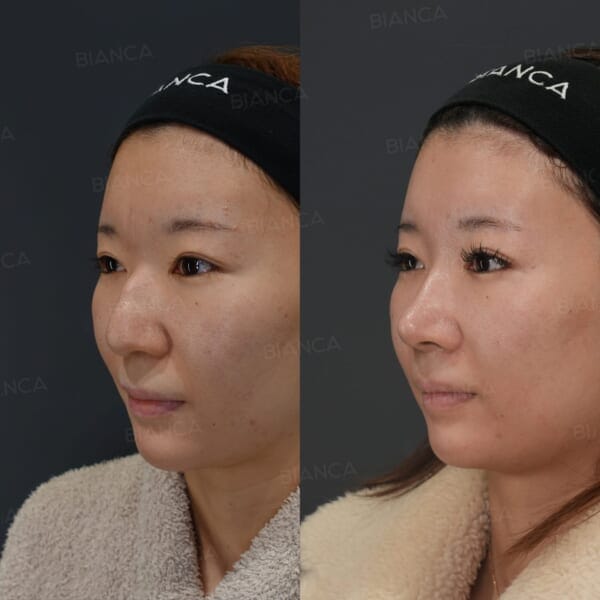
[Procedure Name] Eagle Nose Correction · Hump Removal + Nasal Bone Osteotomy and Narrowing · Septum Extension · Rhinoplasty · Aristocratic Nose Surgery · Nasal Tip Reduction
[Photo Caption] Left: Before treatment; Right: 3 months after treatment
[Costs] Eagle Nose Correction, Hump Removal + Nasal Bone Osteotomy (Narrowing) 880,000 yen; Septum Extension (Rib Cartilage) 880,000 yen; Rhinoplasty (thin rib cartilage strips, when performed simultaneously with nasal septum extension): 330,000 yen; “Aristocrat” Surgery (when performed simultaneously with nasal septum extension): 330,000 yen; Nasal Tip Reduction (when performed simultaneously with nasal septum extension): 165,000 yen
[Side Effects and Risks] Deviation of the nasal bridge and tip, scarring, relapse, infection, etc.
In the case described above, rather than simply shaving down the hump, the procedure combined a nasal bone osteotomy, septal extension, and tip plasty to adjust the overall balance of the profile. The design was carefully planned to ensure harmony with the patient’s facial features, preventing the bridge of the nose from becoming unnaturally narrow.
https://biancaclinic.jp/gallery/58618/
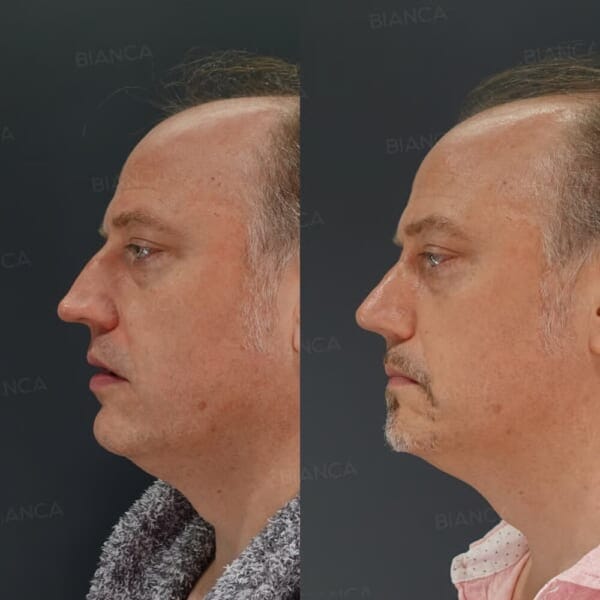
[Procedure Name] Nasal Tip Reshaping (Cormel Strut Method), Nasal Tip Reduction, Hump Resection, Nasal Bone Osteotomy
[Photo Caption] Left: Before treatment; Right: 6 months after treatment
[Costs] Nasal Tip Reshaping (Cormel Strut Method): 110,000 yen; Nasal Tip Reduction: 330,000 yen; Nasal Hump Removal: 330,000 yen
[Side Effects and Risks] Swelling, bruising, pain, scarring, relapse, asymmetry, infection, etc.
In this case, by combining a hump reduction with tip plasty, we created a natural, seamless line from the bridge of the nose to the tip. Our goal is not only to eliminate the protrusion but also to achieve a balance that gives the entire profile a softer appearance.
BIANCA CLINIC's Eagle Nose Correction | Frequently Asked Questions
When considering eagle nose correction, it’s not uncommon for people to feel anxious or have questions. Here, we’ll provide easy-to-understand explanations of the questions about eagle nose correction that BIANCA CLINIC frequently receives.
Are the scars from a hooked nose correction noticeable?
For eagle nose correction and hump removal, there are two methods: the closed method, which involves making an incision inside the nostrils, and the open method, which involves making an incision along the columella between the nostrils. The closed method is characterized by less noticeable scarring.
Even with the open rhinoplasty technique, the scar on the columella is often barely noticeable. Since the incision site varies depending on the procedure and the shape of your nose, please schedule a consultation to discuss your options.
How long is the downtime for a hooked nose correction?
Although individual results may vary, postoperative swelling typically peaks after 2 to 3 days and tends to subside within about 1 to 2 weeks. A cast is worn for one week after surgery. Once the tape cast is removed, you may apply makeup.
When can I start wearing glasses again after a hooked nose correction?
In general, you can start wearing glasses about one week after an eagle-nose correction procedure. For specific timing, follow your doctor’s instructions while monitoring your post-operative progress.
When can I start blowing my nose after a hooked nose correction?
In most cases, you can gently blow your nose starting around two weeks after surgery. However, please be careful not to blow your nose too hard for about one month after surgery.
What kinds of things do you discuss during counseling?
We consider not only the bridge of the nose but also the balance with the E-line and the tip of the nose, as well as skin thickness and bone structure, to determine a design that complements the entire face.
A “holistic view of the entire face” is essential for natural-looking correction of a hooked nose
When performing a hawk nose correction or hump removal, it is important to consider the “overall balance of the face”—including the tip of the nose, the forehead, and the mouth—rather than simply shaving down the hump. In recent years, in particular, there has been a growing trend toward prioritizing a natural design that blends with the patient’s original bone structure, rather than a nose that looks obviously surgically altered.
It’s also important to choose a procedure with an eye not only on the immediate results but also on long-term stability and the impact on your body. Rather than simply focusing on “getting rid of a hooked nose,” why not consider what kind of profile balance best suits your facial features as you explore the options that are right for you?
▶For Those Who Want to Learn More About Eagle Nose Correction and Hump Removal
▶Read other blog posts by Yu Yagasugi