column (e.g. in newspaper)
2024.12.27
What is the Epigenetic Clock Test? Bianca's Aesthetic Medicine Specialist, Yoko Maeda, Explains!

To maximize your beauty, care for both the inside and outside is essential. We aim to bring advanced anti-aging treatments, such as peptide therapy common overseas, to our Japanese patients. While aesthetic medical approaches may offer more gradual results, they are crucial for building the foundation that supports beauty and youth. We combine nutritional therapy and lifestyle improvements with hormone replacement, peptide therapy, and regenerative medicine to propose personalized treatment plans. We provide long-term support for health and beauty from within.

As medical advances shed light on the mechanisms of aging, the concept of longevity—meaning not merely living longer, but living healthily and enjoying life—is gaining traction.
And one indicator for longevity is the epigenetic clock test.
What is the Epigenetic Clock Test?
Epigenetic clock testing is a method for measuring biological age. Aging is defined as the natural process of change beginning in early adulthood, during which bodily functions gradually decline.
While aging is a universal process, the rate varies from person to person. The ability to check this aging speed is the defining feature of the epigenetic clock test. While there are various methods for measuring biological age, this test is currently considered the most reliable indicator.
The Difference Between Chronological Age and Biological Age
Even people of the same chronological age can appear younger or older. This difference stems from varying rates of aging. The pace of human aging varies greatly from person to person and does not necessarily correlate with chronological age, which is why some individuals appear younger or older than their actual age.
Biological age is used as an indicator of the rate of aging. By comparing the difference between your chronological age and your biological age, you can gauge the progress of your own aging.
There are several methods for measuring biological age, one of which is the epigenetic clock test.
<Chronological Age and Biological Age>
◆Chronological age... Represents the number of years since birth. Even individuals of the same chronological age may exhibit differences in physical condition and function.
◆Biological age…An age expressed based on the state of bodily tissues and cells. It reflects bodily function, the degree of aging progression, and the risk of age-related diseases.
How does the epigenetic clock test work?
To understand how the epigenetic clock test works, we must first explain DNA methylation. Various studies have shown that biological age correlates with DNA methylation.
DNA is the blueprint for building our bodies, located within the cell nucleus. While the DNA sequence remains unchanged throughout life, the attachment of methyl groups to DNA alters gene expression. This binding of methyl groups to DNA is called DNA methylation. For example, changes in the resulting proteins can lead to signs of aging such as gray hair and wrinkles.
The Epigenetic Clock test measures the pattern of methyl groups that bind to DNA as we age. It analyzes subtle chemical changes in specific parts of the DNA using AI to determine biological age.
◆DNA methylation… The process by which methyl groups attach to or detach from DNA, which carries genetic information, thereby suppressing gene expression.
Research has also revealed that DNA methylation is associated with aging.
The biological age measured by the epigenetic clock has also been found to correlate with visible aging. In other words, if we can achieve a rejuvenation of biological age, we can also look younger.
Here, let me introduce a study.
The graph below is from a paper investigating the effects of long-term calorie restriction on DNA methylation measurements of biological aging in healthy adults. It shows changes in aging indicators under ad libitum feeding (AL) and calorie restriction (CR).
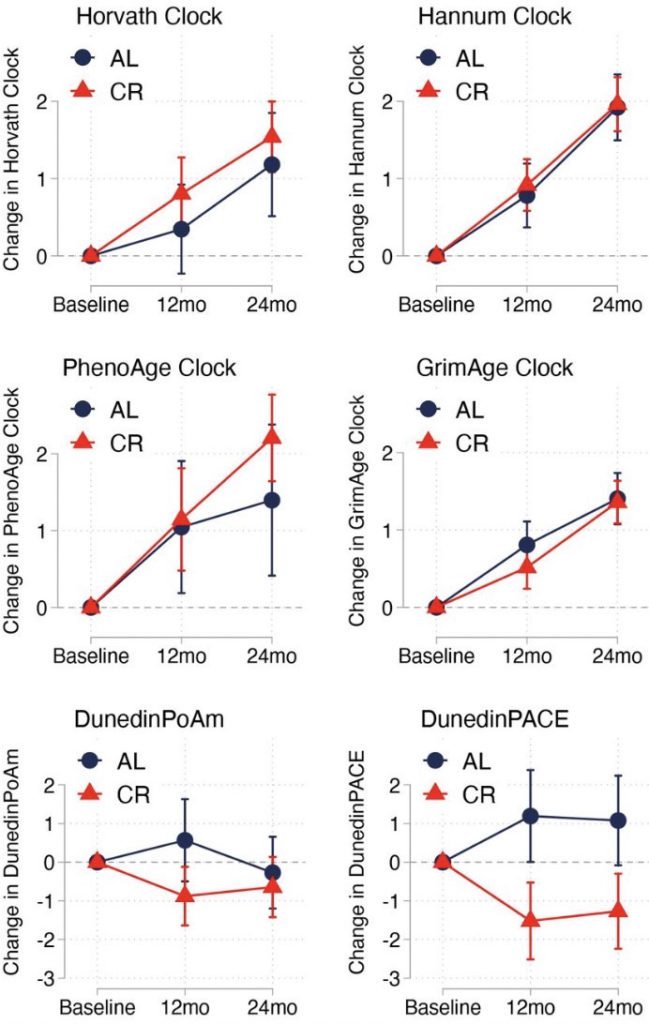
Quote:https://www.medrxiv.org/content/10.1101/2021.09.21.21263912v1.full
In this study, calorie restriction was statistically confirmed to potentially slow the pace of aging as measured by the DunedinPACE index (graph at bottom right). While calorie restriction does not completely "stop aging," the results suggest it may "help slow the progression of aging."
In anti-aging medicine, the recognition that the rate of aging can be controlled is becoming increasingly widespread. This opens the door to approaches aimed at rejuvenating biological age. For instance, many conscious choices can be made in daily life: taking necessary nutrients through supplements, learning which nutrients and foods suit you best, and engaging in regular strength training or sports. Furthermore, medical approaches such as hormone replacement therapy and intravenous therapy are also available.
First, understanding your biological age is the first step in anti-aging care.
Methods for determining biological age other than the epigenetic clock test
Until now, biological age has been visualized through tests such as telomere testing, which measures genetic age based on telomere length, and AGEs (Advanced Glycation End-products) testing, which assesses the accumulation of aging substances by measuring glycation levels within the body.
◆Telomere Test…A method for measuring genetic age based on telomere length.
Telomeres are structures located at the ends of chromosomes that protect them. Repeated cell division shortens telomeres, and shorter telomeres are said to be associated with an increased risk of disease.
◆AGEs Test (Advanced Glycation End-products Test)…A method to measure the degree of glycation by determining how much AGEs have accumulated in the body.
AGEs stands for Advanced Glycation Endproducts, substances that accelerate aging formed when excess carbohydrates bind with proteins. Blood tests measure levels of pentosidine, one such AGE.
Among the many testing methods available, the epigenetic clock test is currently regarded as the most reliable indicator. The epigenetic clock test emerged in early 2020. It is widely used in anti-aging clinics overseas, including the United States, as a method to reflect the body's age related to the incidence and mortality rates of various diseases and aging.
The high reliability of epigenetic clock testing is evident from the fact that numerous clinical trials utilizing this method are being conducted even at world-renowned universities in aging-related research.
For epigenetic clock testing, visit Bianca Clinic!
"Want to check your body's aging level and rejuvenate?" "Where can I get my biological age measured?" If this sounds like you, please consult Bianca Clinic. Bianca Clinic focuses on longevity and is one of the few clinics in Japan offering epigenetic clock testing. The Epigenetic Clock Test not only reveals your biological age but also provides personalized anti-aging care recommendations, insights into your current health status, disease risks, and prevention methods. We explore medical approaches to rejuvenate your biological age from within. If you're interested in anti-aging care or longevity, please come in for a consultation!
▷ Details and pricing for the Epigenetic Clock Test (Biological Age Test)Here
Bianca Clinic Aesthetic Medicine Director
Dr. Yoko Maeda Profile
https://biancaclinic.jp/doctor/maeda/
Completed initial training at Okinawa Prefectural Nanbu Medical Center and Children's Medical Center. Worked in the Department of Radiology at Kyoto Prefectural University of Medicine and at an aesthetic clinic. Encountered high-dose vitamin C intravenous therapy at a seminar by the Intravenous Therapy Research Society. Studied abroad as a Research Fellow at the L'Ordin Clinic in the United States. Achieved notable accomplishments, including passing the American Academy of Anti-Aging Medicine's specialist certification exam at the youngest age.
Currently serving as a Medical Director of Aesthetic Medicine at BIANCA CLINIC. The role of a Medical Director of Aesthetic Medicine is to propose methods for regulating the body from within, thereby approaching beauty through health. We address various physical discomforts and concerns, including female menopausal symptoms, male menopausal symptoms, fatigue recovery, FAGA (female pattern hair loss), ED (erectile dysfunction), and muscle enhancement. As a professional in anti-aging care that treats aging from within the body, I propose treatments tailored to each patient from among methods utilizing regenerative medicine and advanced medical technologies. Through an approach aimed at improving constitution and rejuvenating biological age, I provide support for Longevity—not merely extending lifespan, but achieving healthy longevity.
<Aesthetic Medicine Services>
◆Male Menopause
◆FAGA
◆Biological Age (Epigenetic Clock/Biological Age Test)
◆Muscle Building
◆Peptide Therapy
◆Hormone Replacement Therapy (HRT)
◆Orthomolecular Nutrition Therapy
◆Hydrogen Therapy
◆NMN Intravenous Therapy
◆Exosome Injection
◆Purified and Concentrated Stem Cell Culture Supernatant Infusion
◆High-Concentration Vitamin C IV Drip
◆Placenta injections, etc.
<Professional Affiliations and Qualifications>
◆Director, Japanese Society of Aesthetic Medicine
◆American Academy of Anti-Aging Medicine (A4M) Certified Specialist
◆A4M Anti-Aging, Metabolism, and Functional Medicine Fellowship
◆American Academy of Advanced Medical Sciences Chelation Specialist
<Check out more information about Dr. Yoko Maeda's aesthetic medicine practice here>
Dr. Yoko Maeda's Instagram account (@dr.yokomaeda) isHere
The official Instagram account for Bianca Clinic (@biancaclinic) isHere
The official YouTube account for Bianca Clinic isHere