column (e.g. in newspaper)
2026.07.02
What Is an “Eagle Nose”? How Is It Different from a “Hooked Nose”? We Explain Rhinoplasty Approaches to Achieve Your Ideal Nose Bridge!

Specialist in rhinoplasty. He is a board certified plastic surgeon by the Japanese Society of Plastic and Reconstructive Surgery. Based on the principle of “maximum effect with minimum treatment,” I propose the best surgical techniques and plans for my patients from various angles. He specializes in designs that beautifully accentuate the "individuality" of the patient while taking into account the golden ratio of the face. In particular, we create full-custom-made prostheses by combining CT and Vectra data to create full-scale blueprints, which are then precisely finished based on clay prototypes handmade from scratch on a skull model. The shape of the prosthesis can be reproduced with high precision as per the presented simulation, so that even the most detailed wishes can be met and stable results can be achieved.

Hello! I’m Yu Yagasugi, a board-certified plastic surgeon recognized by the Japanese Society of Plastic and Reconstructive Surgery.
Today, I’d like to talk about correcting a hooked nose. A hooked nose is one of the most common nose-related concerns we hear about at Bianca. Some people who are troubled by a hooked nose seem to try various methods—such as massaging the bridge of their nose or pressing down firmly from above—in the hope of “fixing it on their own!”
However, to get straight to the point, it’s virtually impossible to correct an eagle nose on your own. In fact, applying strong pressure can damage the subcutaneous tissue, causing the area to swell even more and potentially making the eagle nose even more noticeable.
If you’re serious about correcting a hooked nose, consulting a cosmetic clinic is one option to consider. But first, let’s explain exactly what a hooked nose is, comparing it to a snub nose—a condition it’s often confused with. We’ll also provide a clear explanation of the hooked nose correction procedures we perform at Bianca, so please use this as a reference.
What is an eagle nose?
An "eagle nose" (washibana) is a nose shape characterized by a bulge in the center of the bridge when viewed from the side. You can easily see this for yourself by touching your nose: the upper half is made of bone, while the lower half is made of cartilage. If the junction between the bone and cartilage protrudes noticeably forward, this is what is known as an eagle nose.
In addition, a nose with a tip that droops downward and a bridge that curves forward is also referred to as an “eagle nose.” While this type of nose is often thought to be common among Westerners, in reality, there are quite a few Japanese people who are troubled by a mildly pronounced eagle nose.
The Difference Between a Hooked Nose and a Straight Nose
Both the hooked nose and the aquiline nose share the characteristic of having a high bridge and a downward-pointing tip. For this reason, at Bianca, we consider the hooked nose to be a type of aquiline nose and do not make a clear distinction between the two. However, strictly speaking, there are the following differences.
- Eagle nose… The center of the bridge of the nose protrudes forward, and the nose has a gentle curve overall.
- Hooked nose… The base of the bridge of the nose is stepped, and the bridge slopes straight down toward the tip of the nose.
While an eagle nose curves upward like a bird’s beak, a hooked nose—as the name suggests—is characterized by its “hook”-like shape. Both types of noses are prominent and stand out.
“The aquiline nose, also known as the ”beautiful nose”
An eagle nose is also known as a “beautiful nose,” and personally, I think it’s a very lovely nose. Many celebrities have this type of nose, and what makes it so attractive is how the bridge looks straight and sleek when viewed from the front, doesn’t it?
However, because it tends to give the impression of being masculine and strong, it can be a source of concern for those who want to project a softer, more feminine image. In recent years, there has been a growing trend even among men toward preferring androgynous, soft facial features, so it seems that a large, prominent aquiline nose is increasingly seen as a source of self-consciousness.
The nose is located at the center of the face and is a prominent feature. Furthermore, a prominent, eagle-like nose tends to stand out, so it’s not uncommon for people to come to us saying, “Every time I look in the mirror, I can’t help but notice my nose…” In addition, many people are concerned that a downward-pointing nose—often referred to as a “hooked nose”—makes them look like they have a so-called “witch’s nose.”
While a hooked nose is one of the charming features of a person’s appearance, it can also be a source of concern—such as when it stands out too much on the face or doesn’t match the person’s ideal facial features. At Bianca, we empathize with these concerns and offer a variety of approaches to correcting a hooked nose.
BIANCA's Diverse Approaches to Correcting a Hooked Nose
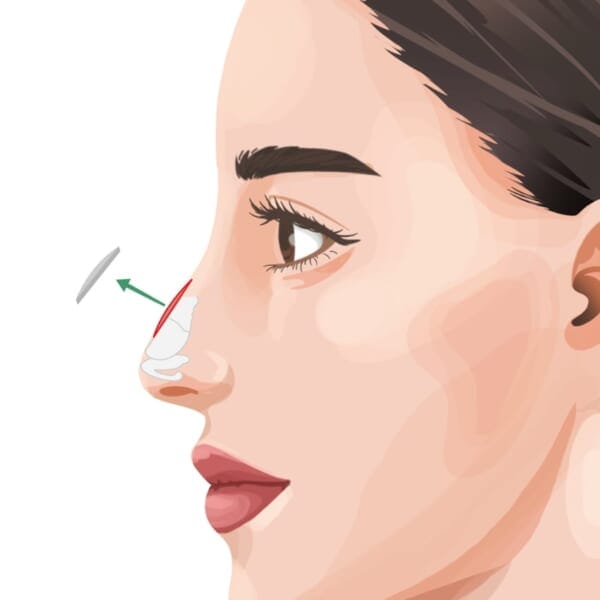
To correct a hooked nose, it is necessary to make the protrusion in the center of the bridge of the nose—known as the “hump”—less noticeable. There are two main approaches to achieving this.
- Lower the hump
- Raise the top or bottom of the hump
We’ll now introduce the specific treatment details for these approaches.
Eagle Nose Correction and Hump Removal
Hump reduction is a surgical procedure that smooths out the protruding area in the center of the nasal bridge by removing the bone itself. It is a method for lowering the hump and is best suited for patients with a relatively prominent hump. For patients with mild to moderate humps, a hump resection is performed. Hump resection involves shaving down the nasal bone with a file-like instrument and excising the cartilage portion with a scalpel. This procedure requires more delicate adjustments.
Since shaving down the hump can actually make the bridge of the nose appear wider when viewed from the front, it is common to perform a “nasal bone osteotomy to narrow the bridge” at the same time to refine the lower part of the bridge.
prosthesis insertion
This procedure involves inserting silicone above the hump and toward the tip of the nose to balance the entire nasal bridge, thereby minimizing the appearance of the central bulge. In other words, it is a surgery that evens out the height of the nasal bridge above and below the hump without shaving down the hump itself.
However, if you focus too much on creating a straight bridge to match the height of the hump—and end up making the area from the hump to the glabella too high—you may end up with an unnatural-looking bridge, often referred to as an “Avatar nose.” To achieve a naturally shaped nose that looks seamless, it is essential to carefully assess the overall balance of the nose.
“Non-surgical options,” such as hyaluronic acid injections, are also available
Depending on the condition of a hooked nose, hyaluronic acid injections may be an option to refine the nasal contour and make any unevenness less noticeable. The injections are administered to the tip of the nose or around the hump, with the goal of evening out the height of the hump.
If you’re worried about surgery or would prefer to avoid major procedures, please feel free to consult with us. However, since this treatment does not address the bone structure itself, hump reduction or rhinoplasty to correct a hooked nose may be more appropriate if you’d like to significantly reduce the prominence of your nasal bridge.
Before-and-After Photos of Eagle Nose Correction
This patient had two main concerns: "the bridge of the nose is too high" and "the tip of the nose droops." However, the request was to "not make the bridge of the nose completely straight, but to retain the subtle curve of the aquiline nose as a distinctive feature."
The procedure involved shaving down the hump, refining the bridge of the nose to make it slimmer, and lengthening the nasal septum to add height to the tip. After the procedure, the nose retains a subtle hint of its original aquiline appearance while appearing less prominent.
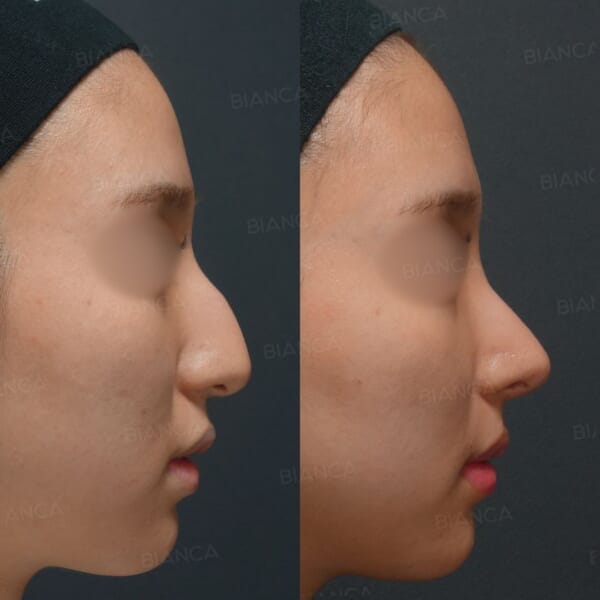
[Procedure Name] Hump Resection + Nasal Bone Osteotomy for Narrowing and Septum Extension (Using Septal Cartilage, Auricular Cartilage, and Autologous Cartilage)
[Photo Caption] Left: Before treatment; Right: 3 months after treatment
[Cost] Hump Resection + Nasal Bone Osteotomy (Narrowing): 880,000 yen; Septum Lengthening Surgery (using septal cartilage, auricular cartilage, or autologous cartilage): 770,000 yen
[Side Effects, Risks, etc.] Crooked bridge or tip of the nose, scarring, relapse, infection, etc.
The Ideal Eagle-Nose Correction: Guided by an Understanding of Nasal Anatomy and Aesthetic Sensibility
At Bianca Clinic, we place great emphasis on thorough consultations using the 3D simulation system, VECTRA®. Even when we speak generally about concerns regarding a hooked nose, each patient’s current nasal condition and desired outcome are completely unique.
Actually…
"I want to fix my hooked nose, but I don't want it to be completely straight."
"I want to make it a little milder while retaining the hint of the eagle's beak."
"I want to reshape my hooked nose to give it a more feminine look, but I'd like to keep a little bit of the hump."
As you can see, sharing the overall atmosphere and nuances is extremely important.
I don’t believe that completely removing a hooked nose is the only correct approach. Viewing the hooked nose as an important part of the individual’s unique character and working together to determine how much of its distinctive appearance to preserve is one of the key aspects of the consultation. I carefully clarify the patient’s preferences and the nose shape that best suits them by thoroughly comparing these with simulation results.
Did you know that in recent years, among Wanhong (Chinese influencers), the “eagle nose” look—which features a pronounced bridge and a nose tip that’s just as prominent—has become a trend?
“The approach of ”deliberately leaving a slight hawk-like nose when performing the correction” not only allows you to achieve a natural-looking nasal bridge that appears as if it were natural from birth, but also has the added benefit of making the midface appear shorter. However,
In some cases, correcting an aquiline nose naturally can be difficult to achieve using only off-the-shelf implants. At Bianca, we take great pride in designing the nasal bridge to suit each patient’s unique facial features and preferences, and in proposing fully custom-made implants. If you’re worried that “I want to correct my hooked nose, but I don’t know what kind of nose would suit me…,” please feel free to come in for a consultation.
▶Bianca's "Eagle Nose Correction and Hump Removal" Details Page
Frequently Asked Questions About Eagle Nose Correction and Hump Removal
Finally, I’ll answer some common questions we receive from patients regarding eagle-nose correction.
Q. How long does it take for the nose to look natural after an eagle-nose correction or hump removal?
Postoperative swelling gradually subsides, and in most cases, it takes about six months for the nose to fully settle into its final shape.
Q. Are the scars from an eagle-nose correction or hump removal noticeable?
For eagle-nose correction and hump reduction, there are two methods: the closed method, which involves making an incision inside the nostrils, and the open method, which involves making an incision along the columella between the nostrils.
One of the key features of the closed rhinoplasty technique is that the scars are less noticeable. Even with the open rhinoplasty technique, the scar on the columella is often barely visible. Since the incision site varies depending on the procedure and the shape of your nose, please consult with us during your initial consultation.
Q. What is the downtime for a hooked nose correction or hump removal?
Although individual results may vary, postoperative swelling typically peaks after 2 to 3 days and tends to subside within about 1 to 2 weeks. A cast is worn for one week after surgery. Once the tape cast is removed, you may apply makeup.
If you're concerned about an eagle nose or a hooked nose, please consult BIANCA's “nose surgery specialists.”
While an aquiline nose or hooked nose is usually caused by a natural skeletal structure, there are also people whose noses have gradually become more aquiline as they’ve grown. Among Bianca’s patients, there are quite a few who confide that they’ve “been troubled by this for many years” or “can’t bring themselves to like their own face because of their aquiline nose.”
At Bianca, we do our utmost to address these concerns and offer suggestions to help you achieve your ideal nose. If you’re concerned about a hooked or eagle-like nose, or if you’d like to know what nose shape suits you best, please feel free to contact Bianca for a consultation.
▶For Those Who Want to Learn More About Eagle Nose Correction and Hump Removal
▶Please contact us via the online reservation form.
▶Read other blog posts by Yu Yagasugi