column (e.g. in newspaper)
2026.07.06
What Is a CO2 Laser (for Removing Moles and Warts)? An Easy-to-Understand Explanation of Its Expected Effects, Benefits, and Drawbacks

As an Assistant Professor, Associate Ward Director, and Chief of Dermatopathology at the university hospital dermatology department, I deepened my expertise through academic presentations and paper publications both domestically and internationally. I have handled a wide range of treatments, from birthmark therapy in children to adult pigmentation concerns, utilizing various lasers and injection therapies, while also contributing to community healthcare. Through encountering numerous cases, I strongly felt the potential and necessity of aesthetic medicine, resolving to pursue further expertise. Building upon my solid dermatological knowledge and meticulous diagnostic skills, I value treatments that gently support each individual's skin while bringing out its inherent beauty.
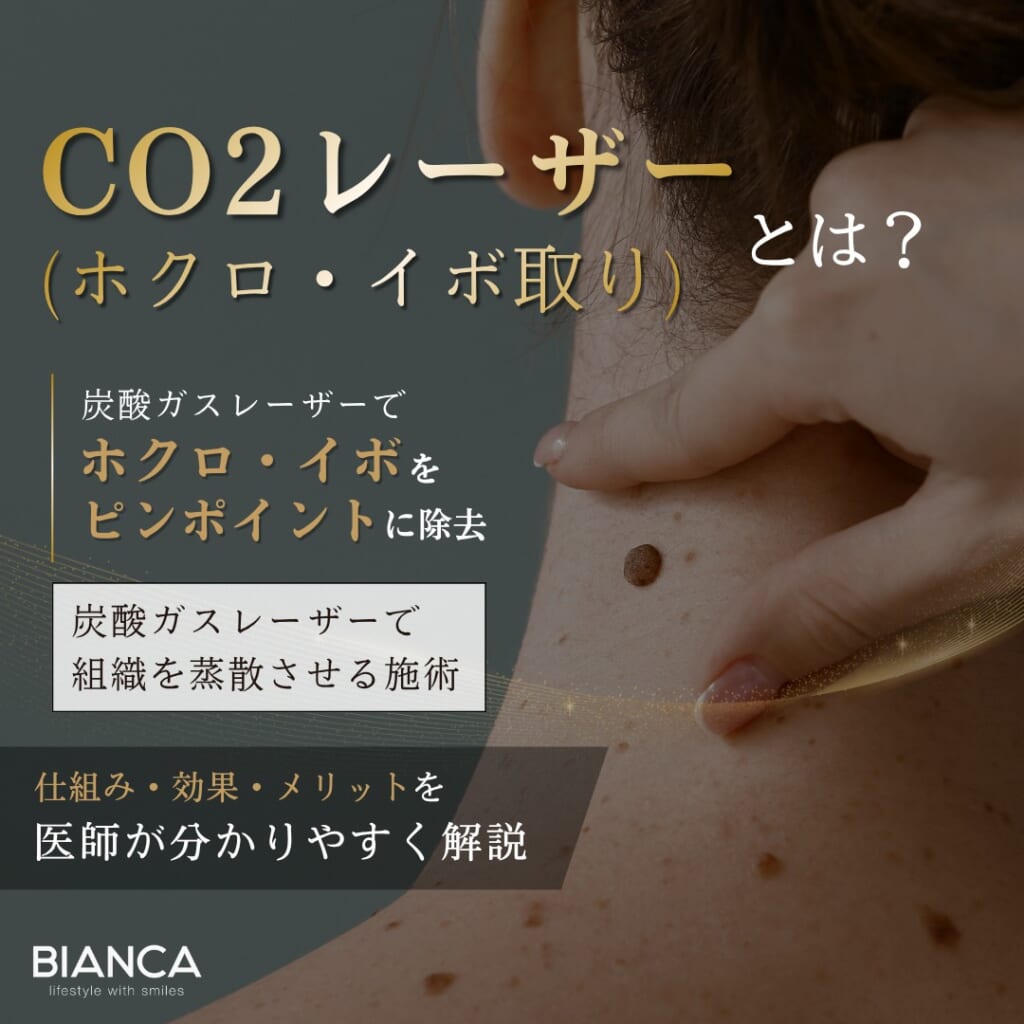
Many people are probably wondering, “How does it work?” and “Will there be any scars left after the procedure?”
At BIANCA CLINIC, we do not decide on a treatment method based solely on the appearance of moles or warts; instead, our doctors assess the type, size, elevation, and depth before recommending a treatment.
In this article, we’ll explain how CO2 lasers work, their effects, benefits, and precautions from a doctor’s perspective.
What is a CO2 laser treatment (for removing moles and warts)?
A CO2 laser treatment uses thermal energy generated by the reaction with moisture in the tissue to precisely vaporize moles and warts.
How CO₂ lasers interact with water in tissue
A CO₂ laser is a carbon dioxide laser with a wavelength of 10,600 nm. When the laser light is absorbed by the water content in moles and warts, thermal energy is generated.
This heat causes the moisture within the tissue to evaporate, leading to the ablation of the tissue at the treatment site. CO₂ laser treatments utilize this mechanism to remove moles and warts.
Because the heat causes the small blood vessels surrounding the treatment site to coagulate, the procedure can be performed with less bleeding than when using an incision.
Treatment methods vary depending on the condition of the mole or wart.
Although moles and warts may look similar, they vary in size, elevation, and depth. In some cases, a CO2 laser is the appropriate treatment, while in others, alternative methods—such as excision—may be considered.
For moles that are large or deep, a CO2 laser may not be suitable, and excision may be considered in some cases. Additionally, for deep moles, the treatment may be divided into multiple sessions to minimize post-treatment indentations.
Rather than focusing solely on cosmetic concerns and proceeding with treatment immediately, it is important for a doctor to first examine the condition of the mole or wart and select the appropriate treatment method.
The Importance Bianca Clinic Places on Consultations and Treatment Planning
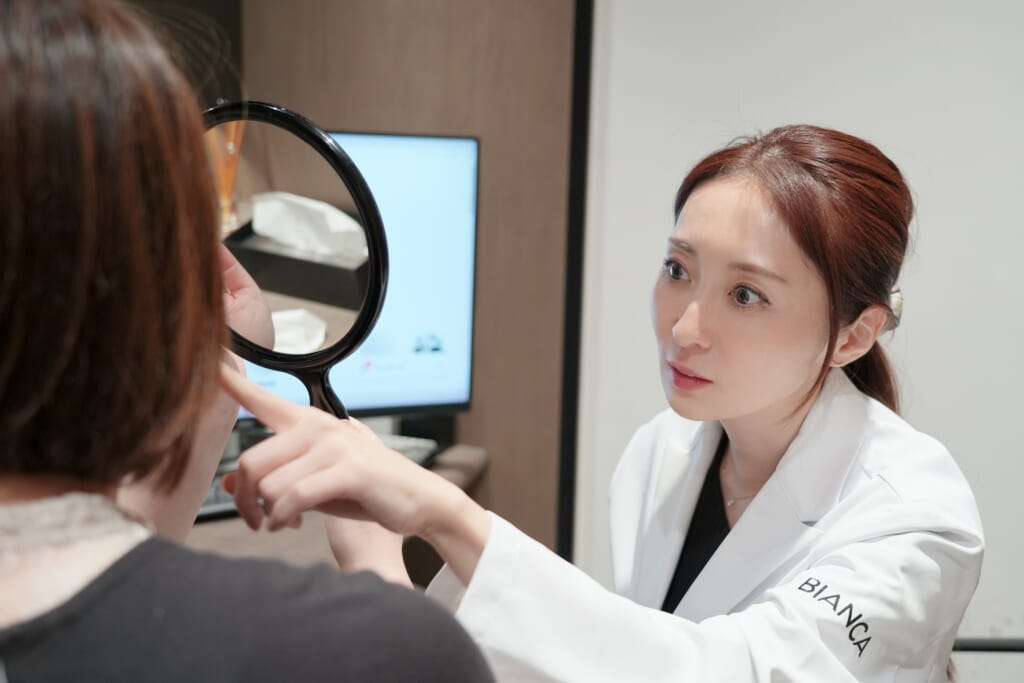
At Bianca Clinic, we use dermoscopy to examine moles and warts, and the high-performance VISIA skin analysis system to assess skin condition. Based on the results of these examinations, we determine whether CO₂ laser treatment is appropriate and, if so, the appropriate treatment intensity.
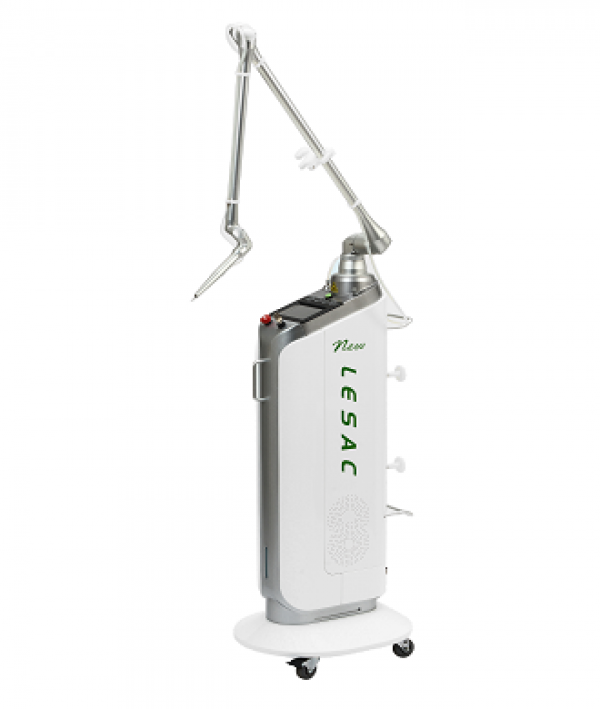
We use the “NEW Rezac” CO2 laser device for our treatments. Taking advantage of its ability to deliver precise, pinpoint energy to moles and warts, we perform the procedure in a way that minimizes heat exposure to the surrounding skin.
▶Detailed Information on CO2 Lasers (Mole and Wart Removal)
What results can I expect from CO2 laser treatment (for removing moles and warts)?
CO2 laser treatment can effectively remove raised moles, warts, and raised age spots, making them less noticeable.
The main benefits of CO2 lasers are as follows:
- Removing a Raised Mole
- Removing small warts on the face and neck
- Make raised spots less noticeable
Since CO2 lasers vaporize tissue containing water, they are used to remove raised moles and warts on the skin. Even if there are multiple small warts on the face or neck, it is possible to treat them one at a time.
Although it is sometimes used to treat seborrheic keratoses—a type of raised skin spot—its purpose and mechanism of action differ from those of laser treatments designed to lighten flat spots. Therefore, the CO₂ laser is not suitable for all types of spots that appear as dark patches on the skin.
Immediately after the procedure, the area where the mole or wart was removed will appear temporarily sunken, but as new skin forms, it will gradually blend in with the surrounding skin.
On the other hand, redness and pigmentation may persist for a certain period of time. If the mole is deep, some pigment or tissue may remain, causing it to become noticeable again. Keep in mind that, to avoid making the wound too deep, the procedure may be performed in multiple sessions.
Results and post-treatment recovery vary depending on the type and depth of the mole or wart, the patient’s constitution, and the treatment area. During the consultation, I make sure to confirm not only whether the mole or wart can be removed, but also whether removal with a CO2 laser is the appropriate method.
What are the pros and cons of CO2 laser treatment (for removing moles and warts)?
While CO2 lasers can precisely target moles and warts, they carry risks such as redness, hyperpigmentation, indentations, and keloids, and require post-treatment care.
Advantages of CO2 Lasers
- Allows for precise treatment of moles and warts
- In some cases, the procedure can be performed while minimizing bleeding.
- Depending on their size and number, they can be treated relatively quickly.
- Local anesthesia can be used to manage pain
CO₂ lasers can gradually vaporize moles and warts while adjusting the treatment area and depth. One advantage is that they minimize damage to the surrounding healthy skin.
Because it has a thermal coagulation effect, it may help reduce bleeding compared to surgical incision. Additionally, depending on the size and number of lesions, the procedure can be completed in a relatively short amount of time.
Local anesthesia is typically used during the procedure. While some patients choose to proceed without anesthesia, the level of pain varies from person to person, so please discuss this with us during your consultation if you have any concerns.
Disadvantages and Precautions of CO2 Lasers
- Redness, a sensation of heat, and scabs may develop
- Pigmentation, indentations, scars, or keloids may remain
- Care using ointments and protective tape is necessary
- Pigment or tissue may remain, which could require additional treatment
- May not be suitable depending on the condition of the mole or wart
After the procedure, you may experience redness, a sensation of heat, or scabbing. Depending on the depth of the treatment and your individual constitution, it cannot be ruled out that post-inflammatory hyperpigmentation, indentations, scars, or keloids may remain.
Rubbing the affected area or forcibly removing scabs may delay the skin's healing process. It is important to follow your doctor's instructions, protect the area with ointment or a bandage, and keep the skin moisturized while protecting it from UV rays.
In addition, with deep moles, some pigment or tissue may remain, causing the mole to become noticeable again.
To minimize scarring, we may divide the treatment into several sessions.
If you have questions about the post-treatment recovery process or would like to know which treatment is best suited for your moles or warts, please consult with a doctor during your consultation.
Frequently Asked Questions
The pain, downtime, and post-treatment care associated with CO2 laser removal of moles and warts vary depending on the size and depth of the mole or wart.
Q. Can you briefly explain what a CO2 laser is?
A. A CO2 laser uses thermal energy generated by the reaction with water in the tissue to vaporize moles and warts. By adjusting the treatment area, it allows for precise, targeted treatment of the affected areas.
Q. How painful is a CO2 laser treatment (for removing moles and warts)?
A. We typically use local anesthesia to minimize pain. However, you may feel some discomfort when the anesthetic is injected or when the laser is applied. The level of pain varies depending on the treatment area and the size of the treatment.
Q. How long is the downtime for mole and wart removal using a CO2 laser?
A. The treated area must be protected with tape or similar material for a certain period of time. Redness and pigmentation may persist longer than the protection period, and the recovery process varies depending on the depth of the mole or wart, the treatment area, and the individual’s constitution.
Q. I'd like to know how to care for my skin and what precautions to take after a CO2 laser treatment.
A. Follow your doctor’s instructions and protect the treated area with ointment or a bandage. It’s also important to keep the area moisturized and protect it from UV rays, and to avoid rubbing the affected area or forcibly peeling off scabs.
Q. Is CO2 laser treatment for mole and wart removal covered by insurance?
A. As a general rule, the removal of moles and warts for cosmetic reasons is considered an out-of-pocket service. However, if there is a suspected health issue, the procedure may be covered by insurance depending on the diagnosis and treatment method. A doctor will examine the condition of your warts and moles, so please schedule a consultation first.
If you are interested in having moles or warts removed with a CO2 laser, please contact BIANCA CLINIC.
CO2 laser treatment (for removing moles and warts) is a procedure that vaporizes the water within the tissue to remove raised moles, warts, and other growths.
It is characterized by reduced bleeding compared to surgical excision and the ability to perform precise, targeted procedures.
The appropriate treatment method depends on the type, size, and depth of the mole or wart.
At BIANCA CLINIC, a doctor will assess your condition and discuss treatment options, including alternatives to CO2 laser therapy. If you have concerns about moles or warts, please schedule a consultation to discuss your options.
▶Detailed Information on CO2 Laser Treatments (Mole and Wart Removal)
▶Please contact us via the online reservation form.