Aiya Hayama
2026.11.20
What Is PicoSpot? A Doctor Explains How PicoSure Works and Its Effects

As an Assistant Professor, Associate Ward Director, and Chief of Dermatopathology at the university hospital dermatology department, I deepened my expertise through academic presentations and paper publications both domestically and internationally. I have handled a wide range of treatments, from birthmark therapy in children to adult pigmentation concerns, utilizing various lasers and injection therapies, while also contributing to community healthcare. Through encountering numerous cases, I strongly felt the potential and necessity of aesthetic medicine, resolving to pursue further expertise. Building upon my solid dermatological knowledge and meticulous diagnostic skills, I value treatments that gently support each individual's skin while bringing out its inherent beauty.

"I want to get PicoSpot treatment because I want to remove some noticeable spots."
I imagine there are quite a few people who think that way.
PicoSpot is known as a laser treatment that targets dark spots and freckles. However, some of you may be wondering what “pico” actually means and how the treatment works to lighten dark spots.
In this article, I’ll focus on the features of the “PICOSURE®” system used at BIANCA CLINIC and discuss the effects of PicoSpot treatment as well as key considerations when choosing a treatment.
What is the PicoSpot treatment?
PicoSpot is a treatment that uses a laser pulse lasting just a picosecond—an extremely short duration—to target the melanin pigment that causes dark spots.
At Bianca Clinic, we use the “PicoSure®” picosecond laser developed by CynoSure, Inc. of the United States.
PicoSure’s 755 nm Wavelength and Its Effect on Pigment Spots
Depending on the wavelength, lasers are absorbed more easily by certain substances, and the way light penetrates the skin varies.
The 755-nm alexandrite laser, which forms the basis of PicoSure, is absorbed by the melanin pigment that causes dark spots; this technology utilizes this property to deliver energy to the pigment.
At this point, you might be thinking, “If it reacts to melanin, doesn’t that mean it can remove any kind of dark spot?”
In fact, the depth of pigmentation and the condition of the skin vary depending on the type of dark spot. The suitability of a treatment isn’t determined by wavelength alone.
Another key feature of PicoSure is its pulse duration—the “picosecond”—which is also part of its name.
How it breaks down melanin pigment with a short pulse duration measured in picoseconds
A picosecond is a unit of time equal to one trillionth of a second. A picosecond focuses laser energy into this extremely brief interval.
So, what does a short irradiation time mean?
Q-switched lasers, which have been used for removing dark spots, primarily emit pulses in nanoseconds (one-billionth of a second).
Q-switched lasers also utilize not only thermal effects but also photomechanical effects caused by instantaneous shocks. Picosecond lasers are characterized by even shorter pulse durations, making photomechanical effects a more central factor. [1]
This might be a little hard to understand, but the idea is that the laser’s energy creates an instantaneous shock that acts on the microscopic structures containing melanin.
After treatment, the affected pigment is gradually broken down through the skin's metabolic processes and cellular activity.
However, this does not mean that picosecond lasers have absolutely no thermal effects. While thermal effects do occur, a key feature of PicoSure is its ability to leverage photomechanical effects due to the short pulse duration.
With PicoSpot, you can target specific dark spots with concentrated light.
For example, suppose you have a single, noticeable spot on your cheek. In such cases, we adjust the treatment area to match the size and shape of the spot and direct the laser energy to the affected area.
This is the basic concept behind PicoSpot.
However, just because a spot is dark doesn't mean you should use a high-intensity setting.
The appropriate treatment settings vary depending on the depth and amount of pigmentation, as well as the condition of the skin. This is because excessive stimulation can actually lead to post-inflammatory hyperpigmentation and other issues.
To make the most of a laser’s characteristics, it is important to determine which lesions to treat and under what conditions to apply the laser.
What kind of results can you expect from PicoSpot?
PicoSpot is primarily used to lighten pigmented lesions caused by melanin, such as age spots and freckles.
Since the reaction varies depending on the depth of the pigment and the type of lesion, let’s take a look at the characteristics of each.
Effectiveness against age spots and freckles
Senile lentigines, which are caused by factors such as ultraviolet radiation, are one of the primary conditions treated with PicoSpot.
Clinical studies have also been conducted on the effects of picosecond lasers.
A study has been conducted comparing 532-nm and 755-nm picosecond lasers in 30 Asian patients with senile lentigines. [2]
Although both lasers were shown to improve pigmented lesions, the 755-nm laser resulted in a significantly greater reduction in the darkness of the spots at the 12-week follow-up.
These studies also demonstrate that a 755-nm picosecond laser is one effective treatment option for senile lentigines.
Can it target pigment located deep within the skin, such as in the ADM?
Some dark spots contain pigment deep within the skin.
ADM (acquired dermal melanocytosis) is a condition characterized by the presence of pigment cells in the dermis. It may appear grayish-brown or bluish in color and differs from common senile lentigines.
ADM is one of the conditions that can be treated with PicoSure, but multiple treatment sessions may be necessary.
So even if a spot looks the same at first glance, the approach needed is different, right?
At Bianca Clinic, we start by diagnosing your age spots before determining the appropriate treatment.
Here, I’d like to share what I consider important when examining skin spots.
Before considering how to remove dark spots, it’s important to first correctly identify the nature of the lesion.
Both senile lentigines and seborrheic keratoses can appear as brown spots. However, seborrheic keratoses may have a rough or raised surface, and the treatment options differ accordingly.
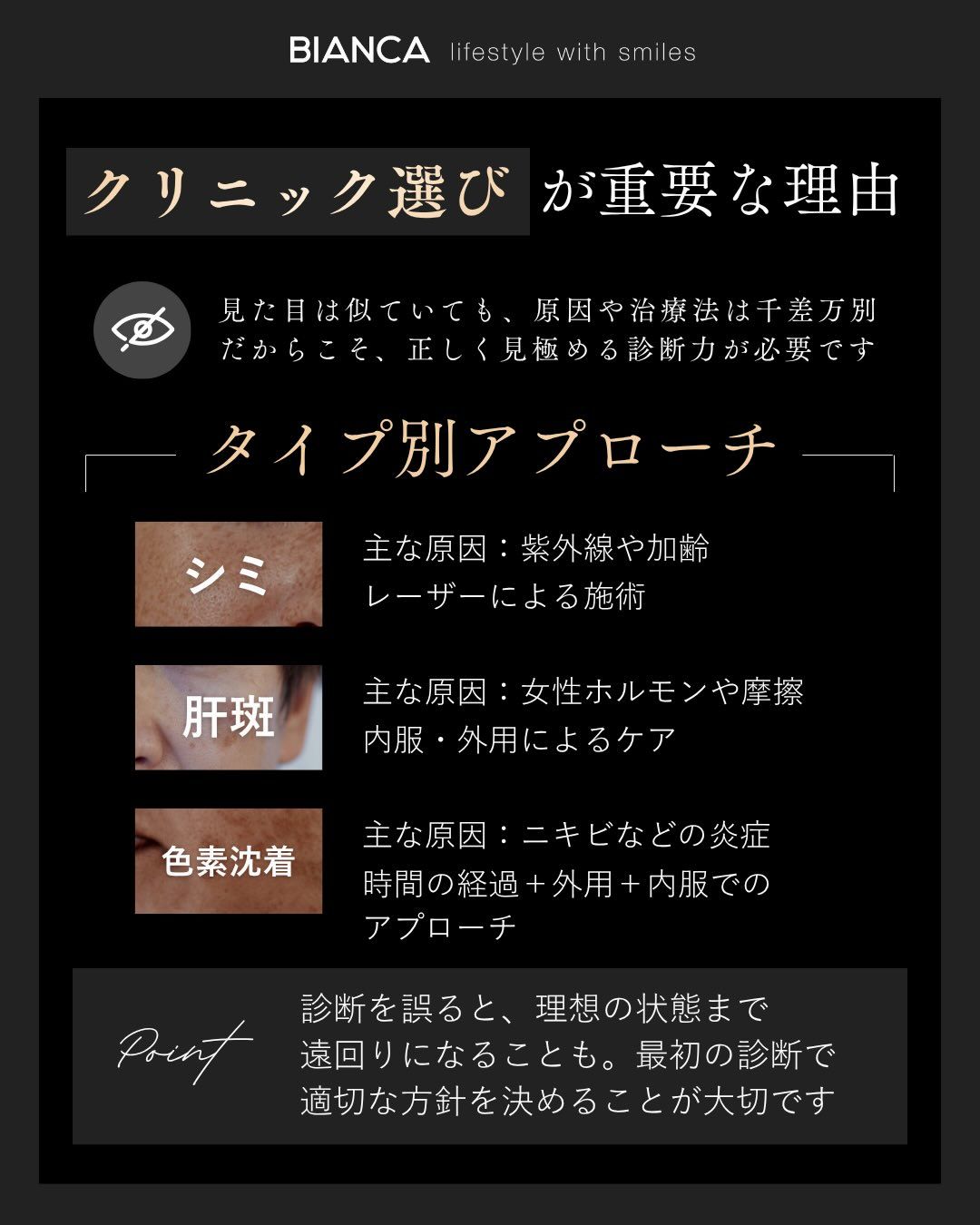
In addition, there are many other conditions that resemble dark spots, such as melasma, pigmented nevi (moles), and actinic keratosis. Some of these require differentiation from malignant lesions, so an accurate diagnosis prior to laser treatment is essential.
In addition, since melasma can worsen when irritated, we avoid treating it with PicoSpot in the same way as we would for typical senile lentigines.
At Bianca Clinic, we begin with a visual and physical examination by a physician, and consider using dermoscopy for magnified examination or a biopsy as needed.
In addition, we utilize the VISIA high-performance skin imaging system. By visualizing the distribution of pigmentation and the overall condition of the skin through images, patients can see the condition of their age spots for themselves.
However, in some cases, multiple conditions—such as senile lentigines and melasma—may coexist. This is why, even if you request PicoSpot treatment, we may recommend a different procedure, oral medication, or topical treatment based on the results of your consultation.
I believe that what matters isn't just getting PicoSpot treatment itself, but choosing the method that's right for your current skin condition.
What are the pros and cons of PicoSpot?
The advantage of PicoSpot is that it can target specific pigmented spots with precision. However, there are also risks, such as post-treatment hyperpigmentation, so it’s important to understand both sides of the issue.
Benefits | You can target specific dark spots with the light treatment
One of its key features is the ability to target specific areas—such as the cheeks or temples—where noticeable dark spots are present.
Depending on the condition, changes may be visible after just one treatment, making this a viable option for those concerned about localized dark spots.
Disadvantages | Side effects such as hyperpigmentation may occur
After laser treatment, you may experience redness, temporary darkening of spots (known as “darkening”), or scabbing.
Post-inflammatory hyperpigmentation may cause dark spots to appear temporarily darker, or, conversely, the skin may become pale or develop blisters. Post-treatment results vary from person to person.
I'll discuss downtime and aftercare in detail in a separate article.
Frequently Asked Questions About PicoSpot
After explaining how PicoSpot works and its benefits, we’ll also address some of the questions patients commonly have.
Q. Can PicoSpot remove dark spots in just one session?
A. In some cases, dark spots may lighten after a single treatment. However, the number of treatments required varies depending on the darkness and depth of the pigmentation, as well as the type of lesion, and multiple treatments may be necessary.
Q. Is PicoSpot effective for light spots?
A. Even faint spots may be suitable for treatment. However, if there is little melanin pigment, the reaction may be difficult to detect. It is also important to distinguish them from other conditions, such as melasma.
Q. Can PicoSpot also help fade hyperpigmentation caused by acne scars?
A. PicoSpot is not necessarily the first-line treatment for hyperpigmentation caused by acne scars. Depending on the severity of the hyperpigmentation and the condition of the skin, we may consider other options, such as topical treatments.
Q. Can moles be removed with PicoSpot?
A. Moles are different in nature from common age spots. We will first conduct a diagnosis and then consider treatment options—including methods other than laser therapy—based on the specific condition.
Q. Even if I have dark spots removed with PicoSpot, is it possible for them to reappear?
A. Yes. Since pigmentation may reappear in the same area or new spots may form after the treatment, be sure to continue using sun protection even after the procedure.
Let's understand how PicoSpot works and decide on the treatment that's right for your dark spots.
PicoSpot is a treatment that targets melanin pigment by utilizing a wavelength of 755 nm and a pulse duration measured in picoseconds.
However, the best method varies depending on the type of dark spot.
At BIANCA CLINIC, our doctors will assess the condition of your dark spots and determine the treatment best suited for you. If you’re unsure whether your dark spots are suitable for PicoSpot treatment, please feel free to consult with us.
▶ BIANCA CLINIC Pico Spot Treatment Page
▶ BIANCA CLINIC Counseling Appointment Page