column (e.g. in newspaper)
2026.11.05
What Happens 10 Years After a Nasal Septum Extension? Yu Yagasugi of Bianca Clinic Explains the Possibility of Changes Over Time, Such as Reversal and Deformation

Specialist in rhinoplasty. He is a board certified plastic surgeon by the Japanese Society of Plastic and Reconstructive Surgery. Based on the principle of “maximum effect with minimum treatment,” I propose the best surgical techniques and plans for my patients from various angles. He specializes in designs that beautifully accentuate the "individuality" of the patient while taking into account the golden ratio of the face. In particular, we create full-custom-made prostheses by combining CT and Vectra data to create full-scale blueprints, which are then precisely finished based on clay prototypes handmade from scratch on a skull model. The shape of the prosthesis can be reproduced with high precision as per the presented simulation, so that even the most detailed wishes can be met and stable results can be achieved.

Although nasal septum extension is a procedure that is expected to maintain the shape of the tip of the nose over the long term, this does not necessarily mean that there will be absolutely no changes 10 years later. Changes over time, such as regression or deviation, may occur.
Hello. I’m Yu Yagasugi from BIANCA CLINIC.
Some of you may be thinking, “I’d like to have a septal extension, but I’m worried that the tip of my nose might lose its shape in 10 years,” or “I’ve already had the surgery and want to know how my nose will change over time.”
In this article, from the perspective of a board-certified plastic surgeon recognized by the Japanese Society of Plastic and Reconstructive Surgery, I will explain the long-term outcomes of septal lengthening, the changes that may occur over time, and the key points we prioritize to achieve the most stable results possible.
What Happens 10 Years After a Nasal Septum Extension? Long-Term Stability
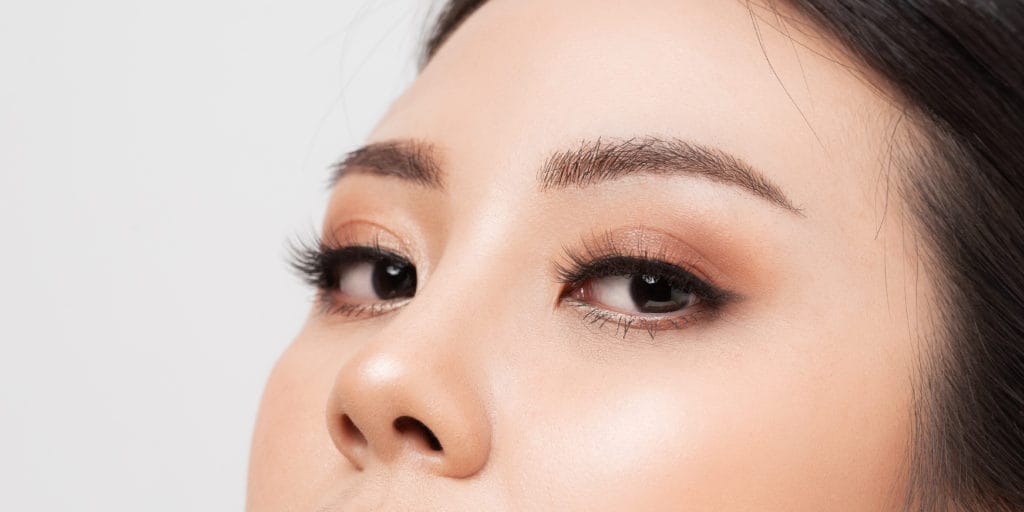
It is not possible to categorically state that the results of a nasal septum extension “will remain exactly the same 10 years after the procedure.” First, let’s take a look at the long-term outcomes, keeping in mind what a nasal septum extension procedure actually entails.
Does a nasal septum extension revert to its original state over time?
A nasal septum extension is a procedure in which cartilage is grafted onto the nasal septum—which supports the tip of the nose—to adjust the height, length, and angle of the nasal tip.
Unlike procedures such as hyaluronic acid injections, where the injected material is absorbed over time and the shape changes, this procedure involves reshaping the underlying structure—such as cartilage—that supports the tip of the nose, making it a characteristic feature that the shape can be expected to be maintained over the long term.
However, undergoing the procedure does not guarantee that there will be absolutely no changes in the future. For example, long-term stability and the risk of changes over time vary significantly depending on factors such as how much the tip of the nose was raised or lengthened, the type and amount of cartilage used, and the degree of support provided by the original nasal septum.
If significant changes are made to the tip of the nose, this can place additional strain on the tip and the underlying tissues. It’s important to be aware that, depending on various factors, the position of the nasal tip may change over time.
A nasal septum extension does not necessarily lose its shape after 10 years.
Some people worry about the nose reverting to its original shape or becoming deformed after a septal extension procedure, but this does not mean that the shape of the nose will inevitably change 10 years later. Furthermore, changes do not suddenly occur just because 10 years have passed since the surgery.
There are individual differences in whether changes occur over time, the extent of those changes, and when they begin to become noticeable. After surgery, it is important to monitor the long-term progress to assess the extent of any changes, including the height and orientation of the tip of the nose, asymmetry, and the contour of the grafted cartilage.
Potential Changes Over Time 10 Years After Septal Lengthening
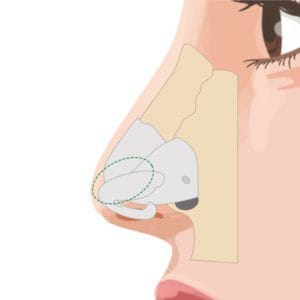
Possible changes over time that may occur 10 years after a septal extension procedure include relapse, deviation, and the transplanted cartilage becoming more noticeable. We will explain the causes of these changes.
The position of the tip of the nose changes or reverts to its original position
In cases of septal extension, if the grafted cartilage does not provide sufficient support, or if the nose tip is extended excessively in an attempt to achieve a significant change, the strain on the nose tip may increase, potentially causing gradual changes in its height, length, and angle.
This is sometimes perceived as a so-called “relapse.” However, this does not necessarily mean that the condition returns to exactly the same state as it was before treatment.
The tip or bridge of the nose is crooked, or there is a noticeable asymmetry between the left and right sides
In nasal septum lengthening, the final result is influenced not only by the grafted cartilage but also by the condition of the nasal septum itself, which serves as the foundation. If the nasal septum is already tilted or curved, adding cartilage to lengthen the tip of the nose may cause the tilt to become more noticeable over time.
In addition, extending the tip of the nose more than necessary can place excessive strain on the nasal septum and the grafted cartilage, which may lead to a tilt in the tip or columella, or asymmetry between the nostrils. In particular, when rib cartilage is used, there is a possibility* that a phenomenon known as “warping”—in which the cartilage itself bends or twists over time—may occur.
Of course, using costal cartilage does not guarantee that the spine will bend; the procedure must be performed with due consideration for the nature of the cartilage, as well as the method of preparation, placement, and fixation.
*References: Hui Chen, Xiancheng Wang, Yiwen Deng (2023), “Complications Associated with the Use of Autologous Costal Cartilage in Rhinoplasty: An Updated Meta-Analysis』/Aesthetic Plastic Surgery, 47(1), 304–312
The outline of the transplanted cartilage may be noticeable
When the tip of the nose is raised or lengthened through septal extension, this places additional strain on the skin and soft tissues of the nasal tip. In cases where the skin on the nasal tip is naturally thin, or when a large amount of cartilage is grafted, the outline of the cartilage may become more noticeable over time.
Furthermore, as we age, our skin and surrounding tissues gradually change. Therefore, it is possible that the shape of the transplanted cartilage—which may not have been noticeable immediately after the procedure—could become more apparent over time.
As we age, the appearance of our nose and face as a whole changes.
Over the course of 10 years, the condition of the skin, bones, and other structures gradually changes. Even if the nose itself—which underwent a nasal septum extension—remains unchanged, changes in the surrounding tissues and the overall balance of the face can give it a different appearance than before.
It is perfectly natural for our faces and bodies to change as we age. That is precisely why, when considering a septal extension procedure, it is important not to assume that “the shape will remain the same for the rest of your life,” but rather to choose the procedure with an eye toward future changes.
Factors That Determine the Long-Term Stability of Nasal Septum Lengthening
The long-term stability of nasal septum lengthening depends on various factors, including not only the type of cartilage used but also the extent of the lengthening and the condition of the underlying nasal septum.
Cartilage for transplantation, such as nasal septal cartilage, auricular cartilage, and costal cartilage
In a nasal septum extension procedure, a structure is created to support the tip of the nose using nasal septal cartilage, auricular cartilage, or costal cartilage.
Since each type of cartilage varies in size, thickness, hardness, and supportive strength, it is not possible to simply say, “This type of cartilage will last the longest.” The amount and strength of cartilage required vary from person to person, depending on the patient’s original nose shape, the condition of the nasal septum, and the desired position of the nasal tip.
For this reason, at Bianca Clinic, rather than focusing solely on a specific type of cartilage, we prioritize selecting the most appropriate surgical technique after carefully assessing the condition of the patient’s nose and the amount of extension required.
How high and long should the tip of the nose be?
When considering the long-term stability of a septal extension, the extent to which the tip of the nose is repositioned is also an important factor. While some patients may request that “the tip be raised as high as possible” or that “the tip be extended downward further,” the greater the degree of change, the greater the potential strain on the tip of the nose and the nasal septum.
When it comes to rhinoplasty, bigger changes aren't necessarily better.
During the consultation, we will review your desired design and the structure of your nose, and determine the extent of the changes within a reasonable range while taking long-term comfort into account.
Condition of the Nasal Septum, Which Serves as the Foundation
In a nasal septum extension procedure, grafted cartilage is secured to the existing nasal septum to support the tip of the nose. Therefore, it is essential to assess not only the grafted cartilage but also the condition of the underlying nasal septum.
If the nasal septum is naturally deviated or lacks sufficient structural support, this may lead to a tilted nasal tip or asymmetry after surgery; therefore, the procedure must be performed after carefully assessing the condition of the nasal septum.
BIANCA's Approach to Nasal Septum Extension: A Design That Looks Ahead to the Next 10 Years
We’ll introduce the key design principles for nasal septum extension—aiming for a natural and beautiful result by achieving the necessary changes with as little treatment as possible—along with case photos.
Rather than making drastic changes, determine the “necessary amount of change”
When performing a septal extension, what I prioritize is determining “how much needs to be changed,” rather than “how much can be changed.”
Simply making the tip of the nose higher or longer doesn’t necessarily make the entire face look more beautiful. It’s important to consider the balance with the bridge of the nose, the mouth, and the facial contours, and to find a position that blends naturally with the individual’s features.
That is why, guided by the principle of “maximum results with minimal treatment,” we propose changes tailored to each individual, taking into account the long-term impact.
Use 3D simulation to fine-tune height, length, and angles

At Bianca,3D Simulation System (VECTRA®)We have implemented it.
Since even a few millimeters of change in the nasal tip during septal extension can alter the overall appearance of the face, we work with the patient before surgery to visualize the results using 3D images, discussing how much to raise or lengthen the nasal tip and what angle to give it.
When undergoing a simulation, it is important not only to express your desired outcome but also to review the actual structure of your nose and the condition of your skin, and then work with your doctor to agree on a realistic design.
If you’re worried about “what your nose will look like 10 years after a septal extension,” be sure to ask for a thorough explanation during your consultation—not only about the desired results but also about the surgical technique, potential changes over time, and associated risks.
[Case Studies] Check out BIANCA CLINIC's before-and-after photos, including nasal septum lengthening procedures
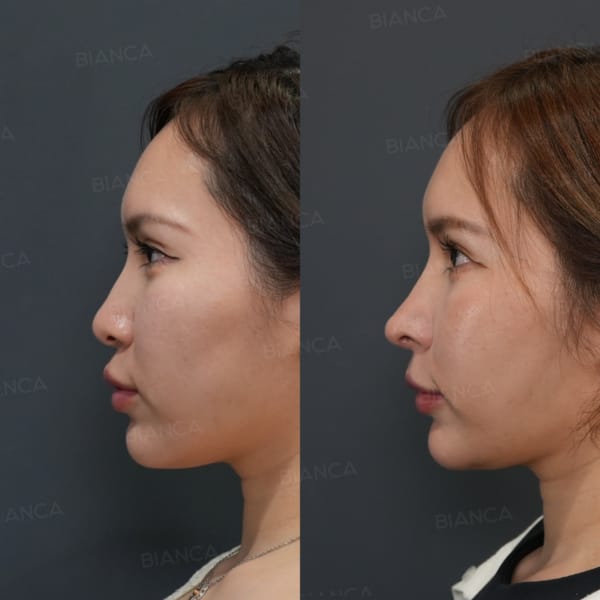
[Procedures Performed] Septal extension, tip rhinoplasty, alar base augmentation (using thin rib cartilage grafts)
[Image Caption] Left: Before treatment; Right: 4 months after treatment
[Costs] Nasal Septum Extension / Rib Cartilage Graft: 924,000 yen; Nasal Tip Reshaping: 346,500 yen; Nasal Wing Base / Thin Rib Cartilage Graft: 346,500 yen
[Side Effects and Risks] Nasal Septum Lengthening: Swelling, bruising, infection, etc. Nasal Tip Reshaping (Correction of a “Bulbous Nose”): Swelling, bruising, pain, scarring, relapse, asymmetry, infection, etc.
Base of the Nostrils / Aristocratic Rhinoplasty (Crushed Rib Cartilage Graft): Swelling, bruising, infection, discomfort at the graft site, and the nostrils appearing wider, etc.
*The information provided reflects the menu and prices at the time of the treatment. As the current offerings and fees may have changed, please contact us for details.
This is a case that combines nasal tip reshaping and thin rib cartilage grafting to the alar base, with a focus on septal extension.
Before the procedure, the tip of the nose was slightly upturned, and the mouth appeared to protrude. Four months after the procedure, the position of the nasal tip has been corrected, resulting in a sharper profile of the nose, and the balance from the tip of the nose to the mouth has taken on a clean, refined appearance.
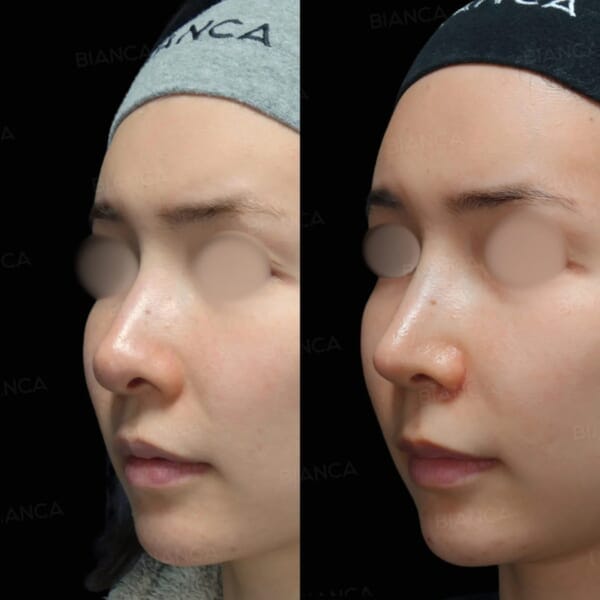
[Procedures] Nasal septum extension, alar reduction (reduction of the nostrils), nasal tip reduction, revision surgery from another clinic
[Image Caption] Left: Before treatment; Right: One month after treatment
[Costs] Nasal septum extension (nasal septal cartilage + auricular cartilage + autologous cartilage): 770,000 yen; alar reduction (reduction of the nostrils): 550,000 yen; Nasal Tip Reduction: 173,300 yen when performed simultaneously with septal extension; Revision from Another Clinic (Nasal Tip Revision and Implant Modification): 330,000 yen
[Side Effects and Risks] Nasal Septum Lengthening: Scarring, Reversal, Asymmetry, Infection, etc.
Nasal Wing Reduction (Alar Reduction): Deviations in the nasal bridge or tip, scarring, relapse, infections, etc.
Nasal Tip Reduction/Rhinoplasty (Correction of a "Round Nose"): Swelling, bruising, pain, scarring, relapse, asymmetry, infection, etc.
*The information provided reflects the menu and prices at the time of the treatment. As the current offerings and fees may have changed, please contact us for details.
This is a case in which nasal septum extension was combined with alar reduction (reduction of the nostrils) and tip reduction to correct a procedure performed at another clinic.
Before the procedure, the tip of the nose was slightly rounded and upturned, making the nostrils quite visible. Through septal extension, the position and orientation of the nasal tip were adjusted, and the nasal tip and alar base were also refined. One month after the procedure, the nasal tip appeared sleeker, giving the nose a more refined appearance.
What should I do if I'm concerned about changes that have occurred some time after a nasal septum extension procedure?
If, after undergoing a septal extension procedure, you notice changes in appearance—such as “the tip of my nose looks more crooked than before” or “I’m concerned about asymmetry”—or changes in function, such as nasal breathing, we recommend consulting your doctor.
We will determine whether a revision is necessary after reviewing the details of previous procedures, the graft materials used, and the current condition of the nasal septum and nasal tip.
At Bianca Clinic, we also offer consultations for patients who have undergone nasal septum lengthening at other clinics. Let’s start by assessing your current condition and exploring your options together.
Frequently Asked Questions About the 10-Year Outcome of Septal Lengthening Surgery
We’ll address common questions from patients regarding nasal septum lengthening 10 years later, including whether the results revert, how long they last, and whether revisions are possible.
Q. If I have a nasal septum extension, will it revert to its original state in 10 years?
Just because 10 years have passed doesn't mean things will necessarily go back to the way they were.
However, depending on the condition of the grafted cartilage, the supporting structures, and the extent of the extension, the position of the tip of the nose may change over time, or the results may revert to their original state. The postoperative course varies from person to person depending on the surgical technique, the type of cartilage used, and the original condition of the nose.
Q. Will the shape of my nose after a septal extension last a lifetime?
A septal extension procedure is not a procedure that can guarantee the nose will “maintain the same shape for life.”
While creating a structure that supports the tip of the nose using the patient’s own cartilage can help maintain the shape over the long term, changes will still occur over time, including those associated with aging of the nose and face.
To maintain a beautiful nose for as long as possible, it is important to choose a doctor with whom you can discuss the long-term outlook and work together to develop a design that aligns with your ideal appearance while remaining structurally feasible for your nose.
Q. Can the rib cartilage used for septal extension become crooked after 10 years?
Over time, costal cartilage may undergo “warping,” a condition in which the cartilage bends or twists.
However, using costal cartilage does not guarantee that the joint will bend.
It is not only the properties of the cartilage itself that are important, but also how it is processed, where it is placed, and how it is secured.
Q. Will I need a revision surgery 10 years after a nasal septum extension procedure?
Not everyone who undergoes a nasal septum extension will need a follow-up surgery 10 years later.
If you are concerned about a crooked tip, a recurve, or asymmetry, or if there are aesthetic or functional issues, you may want to consider revision surgery. Whether revision surgery is actually necessary will be determined after examining the current condition of your nose.
Q. Can I still consult about revision surgery even if it’s been more than 10 years since my nasal septum extension?
Yes. At Bianca Clinic, we offer consultations for revision rhinoplasty, including septal extension. Even if you feel “a little uncomfortable but aren’t sure if you should have it corrected,” please feel free to consult with us first.
During the consultation, we will review what procedures you have undergone in the past, what types of cartilage and materials were used, and what changes have occurred since then. If you have any documentation detailing the procedures or materials used, please bring it with you to your appointment.
If you’re looking ahead to the 10-year mark after a septal extension procedure, choose a procedure that prioritizes long-term stability.
A nasal septum extension is a procedure that is expected to provide long-term maintenance of the height and angle of the tip of the nose. However, this does not necessarily mean that there will be absolutely no changes over the next 10 years; in some cases, patients may become concerned about regression, deviation, or the contour of the cartilage.
What matters is not “how high or long we can make it,” but rather making the necessary changes within reasonable limits, taking into account the original condition of the nasal septum and skin.
At Bianca Clinic, we use 3D simulations to assess your preferences and the condition of your nose before proposing a treatment plan. Whether you’re concerned about how your septal extension will look 10 years down the line or are just beginning to consider the procedure, please feel free to discuss your options with us during a consultation.
▷Learn More About Septum Lengthening at BIANCA CLINIC
▷Schedule a consultation at Bianca Clinic
▷Read other blog posts by Yu Yagasugi