column (e.g. in newspaper)
2026.11.05
Can Nostril Reduction Be Performed Without Surgery? A Plastic Surgeon Explains the Differences and Limitations Compared to Threads and Injections

Specialist in rhinoplasty. He is a board certified plastic surgeon by the Japanese Society of Plastic and Reconstructive Surgery. Based on the principle of “maximum effect with minimum treatment,” I propose the best surgical techniques and plans for my patients from various angles. He specializes in designs that beautifully accentuate the "individuality" of the patient while taking into account the golden ratio of the face. In particular, we create full-custom-made prostheses by combining CT and Vectra data to create full-scale blueprints, which are then precisely finished based on clay prototypes handmade from scratch on a skull model. The shape of the prosthesis can be reproduced with high precision as per the presented simulation, so that even the most detailed wishes can be met and stable results can be achieved.
There are also “non-surgical methods” for reducing the size of the nostrils, such as those using threads or injections. However, these differ from surgical alar reduction (nostril reduction) in terms of the concerns they can address, the expected results, and how long the results last.
Hello. I’m Yu Yagasugi from BIANCA CLINIC.
There are quite a few people who say, “I want to make my nostrils smaller, but I’d prefer not to have surgery if possible,” or “I’m worried about scars and downtime.”
The key is not to decide on a procedure based solely on whether or not to make an incision, but to determine why the nostrils appear large.
In this article, I’ll explain the various methods available for non-surgical alar reduction—including what’s possible and what’s challenging—from the perspective of a board-certified plastic surgeon with the Japanese Society of Plastic and Reconstructive Surgery. Let’s explore the differences between these methods and the surgical approach, and consider which option is best for you.
Is There a “Non-Surgical” Method for Nose Wing Reduction? An Explanation of Threads and Injections

There are also “non-surgical methods,” such as thread lifts and injections, for addressing the appearance of the nostrils. Let’s take a look at the characteristics of each and how they differ from alar reduction surgery involving an incision.
How to Use Thread to Pull the Sides of the Nose Inward
One method of non-surgical alar reduction involves using medical-grade sutures to pull the left and right alae inward, thereby adjusting the width of the nostrils. Since this procedure does not involve making any incisions in the skin, it is an option that those who are hesitant about surgery may find easier to consider.
On the other hand, since this procedure does not involve removing excess skin or soft tissue, its mechanism differs fundamentally from alar reduction via incision. It does not involve excising excess skin or soft tissue, nor does it involve adhering and securing the tissues to one another.
Therefore, the effectiveness of bringing the nostrils inward depends primarily on the tension of the sutures; a major limitation is that the results are prone to reversal over time as the sutures loosen or the tissue attempts to return to its original position.
In particular, if you want to significantly change the width of your nostrils, it may be difficult to achieve sufficient results or long-term durability. Depending on the thickness and projection of your nostrils, as well as your desired outcome, it may be difficult to achieve the desired results using sutures alone.
It’s important not to choose a procedure simply because “it can be done without surgery,” but to have a doctor examine you to confirm whether your nose is a suitable candidate for the procedure.
How to Use Botox Injections to Address Nasal Wing Movement
Some people may wonder, “Is it possible to make my nostrils smaller just with injections?” Generally, one method involves injecting botulinum toxin to suppress the movement of the muscles responsible for widening the nostrils. This method is considered for people who are concerned about their nostrils spreading outward—often due to excessive activity of the muscles that widen the nostrils (such as the dilator nares) when they smile or make similar expressions.
However, this procedure does not involve removing the skin or soft tissue of the alar region itself. It differs in approach from alar reduction, which directly reduces the width and thickness of the alar region itself, as well as the size of the nostrils.
Botox injections work by weakening the muscles that cause the nostrils to spread outward, which can help reduce the widening of the nostrils that occurs with facial expressions—especially when smiling. However, this treatment does not significantly alter the size of the nostrils at rest or the nostrils themselves, so the visible change is relatively minor.
In addition, the effects are temporary and generally fade gradually over a period of several months to half a year; therefore, repeated treatments are necessary if you wish to achieve lasting results.
Hyaluronic acid injections are not a procedure for reducing the size of the nostrils.
Although hyaluronic acid injections are known as one type of non-surgical rhinoplasty, they are not a procedure designed to make the nostrils themselves smaller.
Hyaluronic acid injections into the nose are performed to refine the bridge of the nose, its height, and its shape by injecting a hyaluronic acid solution. They are not intended to remove tissue from the nostrils or to reduce the width of flared nostrils or the size of the nostrils themselves.
However, when hyaluronic acid injections are used to raise the tip of the nose forward, the skin and surrounding tissues at the tip may be pulled taut, causing the width of the nostrils to appear narrower when viewed from the front. This is based on the same principle as the changes observed when the tip of the nose is raised forward during rhinoplasty.
Furthermore, since the effects diminish as the hyaluronic acid is absorbed and spreads, this method does not provide long-term, stable results for reducing the size of the nostrils.
Although they are all referred to as “non-surgical rhinoplasty,” thread lifts, Botox injections, and hyaluronic acid injections differ in both the areas they target and their intended purposes. The first step in choosing a treatment is to clarify whether you want to “make your nostrils smaller,” “reduce the widening of your nostrils when you smile,” or “improve the overall balance of your nose.”
What's Possible and What's Challenging with Non-Surgical Nose Wing Reduction | Downtime Explained

Even with non-surgical alar reduction, there are things that can be done and things that are difficult to achieve. It’s important to understand not only the benefits but also the scope of what can be treated and the downtime involved.
Benefits of Non-Surgical Nose Wing Reduction
Depending on the technique used and the condition of the nose, non-surgical alar reduction offers the advantage of adjusting the appearance of the nostrils without making an incision. It is a viable option for those who wish to avoid scars from incisions or who are hesitant about surgical alar reduction.
Sometimes it can be difficult to do it without cutting.
With sutures or injections, it is not possible to remove the thick skin or soft tissue of the alar base itself. Therefore, depending on factors such as the protrusion of the alar base, its base width, or the size of the nostrils, it may be difficult to achieve sufficient results.
In addition, thread-based procedures may result in the condition recurring. Rather than prioritizing a non-surgical approach above all else, be sure to discuss with your doctor whether this method is appropriate for your specific concerns.
Is there any downtime with non-surgical alar reduction?
You might be thinking, “If it’s a non-surgical nose wing reduction, doesn’t that mean there’s no downtime?”
However, even with non-surgical methods, swelling, bruising, redness, pain, and discomfort may occur. The severity and duration of these symptoms vary depending on the treatment method and individual differences.
Since “no incisions” does not necessarily mean “zero downtime,” be sure to review the post-procedure recovery process and risks before undergoing the treatment.
Is a Non-Surgical Nostril Reduction Difficult? Cases Where an Incision Method Should Be Considered
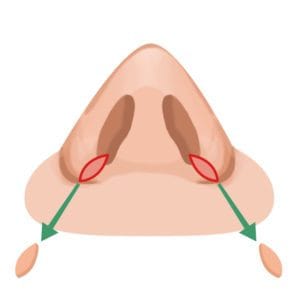
Depending on the cause of prominent nostrils, it may be difficult to achieve the desired results using non-surgical methods alone. In such cases, an option to consider is alar reduction (nostril reduction) through an incision.
The reasons why the nostrils appear large vary from person to person.
There isn't just one reason why people feel their nostrils are large.
For example, some people have thick outer walls of the nostrils, while others have nostrils that protrude sideways; some have a wide base (basal width) between the left and right nostrils, and others have nostrils that appear wide from side to side. Furthermore, in some cases, the issue isn’t limited to the alar base itself; the shape and height of the nasal tip, as well as its balance with the nose as a whole, can make the alar base appear more prominent.
Therefore, it’s not necessarily true that “if you’re self-conscious about your nostrils, you should just have a nostril reduction.” First, it’s important to determine why your nostrils appear large and choose a method that addresses the underlying cause.
What Is Alar Reduction (Nasal Wing Reduction)? A Method for Reshaping the Nostrils Through an Incision
Alar reduction (nose wing reduction) is a procedure that involves removing a portion of the alar (nose wing) to adjust the width and projection of the nose wings, as well as the size of the nostrils. Unlike methods that use sutures to pull the left and right sides of the nostrils closer together, this procedure involves removing excess skin and soft tissue to adjust the shape. As a result, it may be a viable option for addressing issues such as wide or thick nostrils, which are difficult to treat with non-surgical methods.
At Bianca Clinic, we select the appropriate technique—such as the internal or external approach—based on the shape and width of the nostrils. Depending on the specific condition, we may also combine multiple surgical techniques. Of course, since these procedures involve incisions, it’s important to consider downtime factors such as scarring and swelling. Neither the non-surgical method nor the surgical method is inherently superior; it is important to choose the method best suited to the desired results and the condition of your nose.
If you're concerned about the width of the base or the size of your nostrils, consider the "internal approach."
The internal approach is a method that involves removing excess skin and tissue from inside the nostrils to narrow the width of the alar base from the inside. It is primarily considered when the basal width—the distance between the bases of the left and right alar bases—is wide, or when the patient is concerned about the size of their nostrils. Another characteristic of this procedure is that the incision is made inside the nostrils.
We determine suitability based on an examination of the width of the nostrils and the shape of the nostrils.
If you're concerned about the outer part of your nostrils protruding, consider the "lateral approach."
The lateral rhinoplasty technique involves removing excess skin and tissue from the outer sides of the nostrils to correct lateral protrusion. It is considered for cases where the nostrils are round and protrude outward, or when the patient is concerned about a wide, “spread-out” appearance, often referred to as a “spread-out nose.”
An incision is made along the groove where the nostrils meet the cheeks, and the area is sutured while reshaping it. Depending on the condition of the nostrils, adjustments may be made using only the internal approach, only the external approach, or a combination of both.
▷View the BIANCA CLINIC page on alar reduction (nose wing reduction)
Don't Just Focus on the Nostrils | BIANCA CLINIC Values the Overall Balance of the Nose
When it comes to alar reduction, my priority isn’t simply to make the nostrils smaller. I consider the balance between the tip of the nose, the nostrils, the bridge of the nose, and the face as a whole to create a design that suits each individual.
Case Studies from BIANCA CLINIC, Including Alar Reduction (Nasal Wing Reduction)
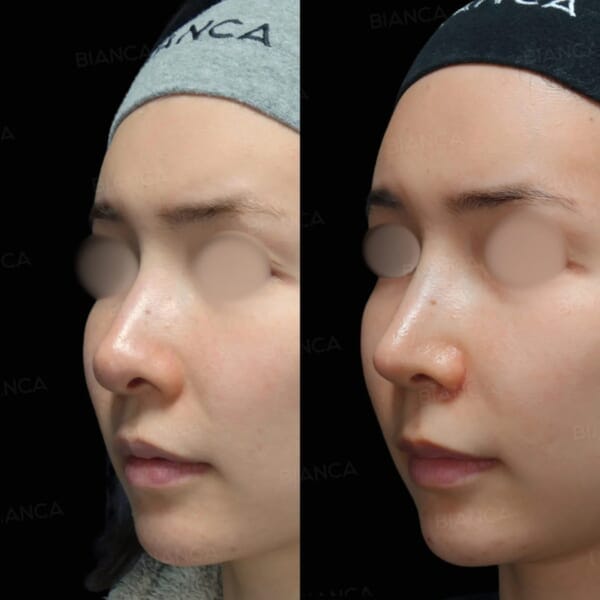
[Procedures] Alar Reduction (Nasal Wing Reduction), Septum Extension, Nasal Tip Reduction/Rhinoplasty (Correction of a "Round Nose"), Revision Surgery from Another Clinic (Nasal Tip Correction and Implant Adjustment)
[Image Caption] Left: Before treatment; Right: One month after treatment
[Costs] Alar Reduction: 550,000 yen; Septum Extension Surgery (septal cartilage + auricular cartilage + autologous cartilage): 770,000 yen;
Nasal Tip Reduction: 173,300 yen when performed in conjunction with septal extension; revision fee for work performed at another clinic (nasal tip revision and implant modification): 330,000 yen
[Side Effects and Risks] Nasal Septum Lengthening: Scarring, Reversal of Results, Asymmetry, Infection, etc.
Nasal Wing Reduction (Alar Reduction): Deviations in the nasal bridge or tip, scarring, relapse, infections, etc.
Nasal Tip Reduction/Rhinoplasty (Correction of a "Round Nose"): Swelling, bruising, pain, scarring, relapse, asymmetry, infection, etc.
*The information provided reflects the menu and prices at the time of the treatment. As the current offerings and fees may have changed, please contact us for details.
This is a case that combines alar reduction with septal extension and tip reduction. Although this case involves multiple procedures, the treatment takes into account not only the width of the nostrils but also the height and orientation of the nasal tip, as well as its relationship to the nostrils.
Even if you’re concerned about the appearance of your nostrils, a nostril reduction isn’t necessarily the only option. I place great importance on evaluating the harmony of the entire nose—and indeed the entire face—before determining the treatment that’s best for each individual.
Be Careful Not to Remove Too Much Tissue During Nostril Reduction Surgery | Smaller Isn't Always Better
When it comes to alar reduction, we sometimes hear patients say they want their nostrils “as small as possible.” However, a larger amount of tissue removed isn’t necessarily better.
If the nostrils are made too small, the natural roundness of the nostrils may be lost, resulting in an unnatural appearance, or the nostrils may appear elongated vertically, like electrical outlets, which could negatively affect the overall balance of the nose. Additionally, the transition between the nostrils and the cheeks may appear unnatural (taking on a comma-like shape).
Since it is not easy to restore tissue that has already been removed to its original state, it is important to carefully determine “where and to what extent to adjust” rather than simply deciding “how much to remove.”
What I value most in rhinoplasty is aiming for “maximum results with minimal intervention.” I strive to address only the necessary areas to the necessary extent, while making the most of the patient’s natural nose shape and facial features.
Using 3D simulations to determine which nose shape suits you best
At Bianca Clinic, when developing a treatment plan for rhinoplasty,VECTRA® 3D Simulation SystemWe also make use of it.
By using 3D images, it is possible to align the patient’s desired look with the doctor’s proposed design while checking the balance with the eyes, mouth, and facial contours—rather than viewing the nose in isolation.
Although there may be some differences between the simulation and the actual result, it serves as a way to discuss “which areas you’re concerned about” and “how much of a change you’d like to see.”
Please feel free to mention during your consultation if you’d like to “make your nostrils smaller without surgery.” Based on the condition of your nose and your preferences, we’ll work together to find the best approach for you.
Frequently Asked Questions About Non-Surgical Nose Wing Reduction
We answer common questions about non-surgical nose wing reduction, including its longevity, downtime, and how it differs from the surgical method.
Q. Is it really possible to reduce the size of the nostrils without surgery?
There is a method that uses medical sutures and other materials to alter the appearance of the nostrils without making any incisions. However, this differs from alar reduction—which involves removing skin and tissue—in terms of its mechanism, suitability, and the results it can achieve.
Q. Can non-surgical nostril reduction reverse?
With thread-based methods, there is a possibility that the results may revert over time. Since the duration of results varies depending on the treatment method and individual differences, be sure to consult your doctor beforehand.
Q. How long is the downtime for a non-surgical nose wing reduction?
Even with non-surgical methods, swelling, bruising, redness, and pain may occur. The severity and duration of these symptoms vary depending on the procedure and individual differences.
Q. Can I make my nostrils smaller with just injections?
There is a method that uses botulinum toxin to target the muscle movements associated with the width of the nostrils. However, this procedure does not involve removing tissue from the nostrils themselves to reduce their size.
Q. Are the scars from a surgical alar reduction noticeable?
At Bianca Clinic, we make an incision inside the nostrils for the internal approach and along the groove of the alar base for the external approach, then suture the incision with minimal scarring in mind. While scarring varies from person to person, scars tend to become less noticeable over time.
Q. What happens if too much tissue is removed during a nose wing reduction?
Depending on the amount of tissue removed, the shape of the nostrils and their balance with the tip of the nose may be affected. Therefore, it is important to determine the amount of tissue to be removed while considering not only the nostrils but also the balance with the entire nose and the face as a whole.
When it comes to alar reduction, don’t just focus on “non-surgical” options—choose the method that’s right for you.
There are also non-surgical methods for reducing the size of the nostrils, such as those using threads or injections. However, since these differ from surgical alar reduction (nostril reduction) in terms of how they work and the extent of results they can achieve, you should not base your decision solely on whether the procedure is surgical or non-surgical. Instead, choose the method that best addresses the cause of your concern and aligns with the changes you hope to achieve.
At Bianca Clinic, we propose personalized treatment plans while taking into account the balance of the entire nose and the face as a whole. If you’re thinking, “I’d prefer to have my nose reshaped without surgery, if possible,” or “Which method is right for me?”, please start by scheduling a consultation.
▷Schedule a consultation at Bianca Clinic
▷Read other blog posts by Yu Yagasugi