column (e.g. in newspaper)
2026.10.31
What Types of Sagging Does HIFU Treat? An Explanation of Its Effects, Who It’s Suitable For, and Who It’s Not Suitable For

As a plastic surgeon, he has experienced many cases and has developed precise techniques and a deep anatomical understanding. Currently, combining his knowledge of plastic surgery with the latest technology, he provides a wide range of cosmetic treatments for skin, contouring, sagging, and other concerns of aging. He has also shared the responsibility of writing Japan's first textbook on gynecological cosmetic surgery, "Basic Techniques of Gynecological Cosmetic and Plastic Surgery. From her experience as an idol during medical school, she realized that "natural beauty" goes beyond the will to choose how you want to be, and she focuses on supporting her patients to "love yourself more every day". We are English-speaking and value counseling that is easy to talk to.
HIFU is a cosmetic procedure designed to tighten the skin from deep within to address mild to moderate sagging in areas such as the cheeks and jawline.
However, for people with little fat in their cheeks or excess skin, a different method may be more appropriate, so it is important to carefully determine the treatment area and depth.
"You just need to apply HIFU deeply to the areas where sagging is a concern." Actually, it's not quite that simple. Even on the same face, there may be fat under the chin, while the cheeks may be thin.
Doctors at BIANCA CLINIC explain everything from the expected results of HIFU to who is a good candidate for the treatment and how to prevent sunken cheeks.
What is HIFU?
HIFU stands for “High-Intensity Focused Ultrasound,” a procedure that concentrates ultrasound energy on a targeted area beneath the skin. It works by utilizing the contraction of tissues heated by the ultrasound and the subsequent changes in collagen to achieve skin tightening.

It is characterized by its ability to target subcutaneous tissue without incisions. It is also a good option for those who are beginning to notice sagging in their facial contours.
However, this is a medical procedure that involves the use of heat.
In addition to a sensation that feels like it’s reverberating through the bone during treatment, redness and swelling may occur afterward. Anatomical knowledge is also essential to prevent burns and nerve damage.
BIANCA's HIFU Treatment PageBut we go into more detail there.
Depth at Which HIFU Acts
A key feature of HIFU is that you can select not only the treatment site but also the “depth” at which the heat is concentrated. The treatment objective varies depending on the target layer—such as the skin, fat, or fascia.
| Examples of Penetration Depth | Primary Target Audience and Objectives |
|---|---|
| About 1.5 mm | Near the dermis. Improves skin firmness and tightens the superficial layers |
| Approximately 3.0 mm | Deep dermis to the subcutaneous fat layer. Tightening of the cheeks and other areas. |
| About 4.5 mm | Tightening of deep tissues, including those near the SMAS (superficial muscular aponeurotic system) |
*The penetration depth is a general guideline. The actual depth of penetration varies depending on the device, the treatment area, and individual differences.
The SMAS is a fascial tissue that extends around the facial muscles and is one of the structures that support the face. This does not mean that “anyone can reach the SMAS with a 4.5mm needle.”
There are also differences in the treatment methods. Dot mode concentrates heat into small dots, while linear mode delivers heat in a linear pattern and is used to target fat layers, such as those under the chin. The mode and depth are selected based on the treatment goal.
Benefits You Can Expect from HIFU
The primary goal of HIFU is to tighten sagging skin on the cheeks and around the jawline and to define a blurred facial contour. When the treatment targets fat layers, it may also be used to reduce volume under the chin.
A paper summarizing 16 clinical studies published in 2023 reported skin-tightening effects on the face using micro-focused ultrasound (MFU), which is related to HIFU. [1] Since the equipment and settings varied from study to study, the results cannot be generalized to all HIFU treatments.
Even for those whose jawline appears less defined in profile, the treatment approach differs depending on whether the issue is sagging skin or excess fat. For more details,Sagging of the Facial Contours and Treatments by CausePlease also refer to this.
Some people notice a tightening effect early on, while others see changes over a period ranging from a few weeks to two or three months. Please note that, unlike surgery to remove excess skin, there are limits to the extent of improvement that can be achieved.
Who Is a Good Candidate for HIFU?
If your cheeks appear to have sagged more than before, or if your jawline no longer looks as defined in photos, and you’re concerned about these changes and want to achieve a more lifted appearance without surgery, HIFU is an option for you.
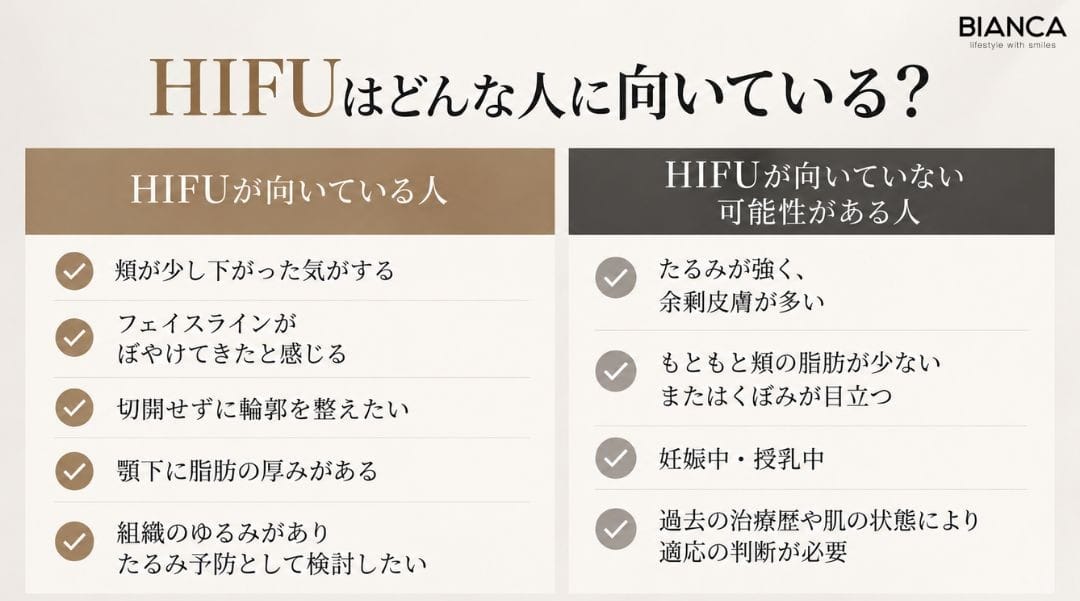
This is primarily intended for mild to moderate looseness.
For people whose facial contours are obscured by fat under the chin, Linear Mode may be an option. However, it is not intended to reduce fat throughout the entire face, as there is fat on the cheeks that you may want to preserve.
There’s no need to decide based solely on age, thinking, “I’m in my 40s, so it’s time for HIFU.” The key factors to consider are whether your skin still has elasticity and how much the underlying tissue moves. For more details,Treatments for Sagging Skin in Your 40sBut it's also covered there.
People for Whom HIFU May Not Be Suitable
In cases of severe sagging with significant excess skin, HIFU alone may not be sufficient to achieve the desired contour. This is because tightening the skin and removing excess skin require different approaches.
In cases where excess skin is a concern, thread lifts and surgical facelifts are also options.
In addition, for people who naturally have less fullness in their cheeks, there may be certain areas where it’s best to avoid treatment. To prevent sunken areas from appearing even thinner, we’ll assess the overall fullness of the face.
We ask that women who are pregnant or breastfeeding refrain from receiving treatments at our clinic. Medical conditions, skin inflammation, and your history of previous treatments are also factors we consider when determining your eligibility for treatment.
Precautions for People Prone to Sunken Cheeks
The concern with HIFU regarding sunken cheeks is that the heat from the treatment may reach the subcutaneous fat. People with hollows under their cheekbones should be especially careful.
It’s important to note that this isn’t limited to linear mode, which targets the fat layer. With dot mode as well, you need to pay attention to the depth and treatment area.
For example, there are cases where the cheeks appear slim when viewed from the front, but the area under the chin looks fuller when viewed from the side. Just because you want to reduce the fullness under the chin doesn’t mean you should treat the cheeks under the same conditions. You need to distinguish between the areas you want to tighten and the areas where you want to preserve the roundness.
What happens if you get too many HIFU treatments?
If treatments are scheduled too closely together or if excessive heat is applied, this may lead to pain, burns, or unintended changes in the tissue. This treatment does not work on the principle that the more sessions you have, the more your contours will be lifted.
You might find yourself thinking, “My cheeks looked slimmer last time, so I’ll go a little harder this time.”
However, your current fat levels and the degree of sagging may not be the same as they were last time. If you undergo repeated treatments on the thinner areas of your cheeks, it’s possible that the hollows may become more noticeable.
At our clinic, we generally recommend continuing treatment once every 3 to 6 months for the standard dot mode and approximately once every 6 months for the linear mode.
Differences from Borneuma
While HIFU focuses ultrasound energy at a specific depth,volnemaThis treatment uses radiofrequency (RF) heat to transfer heat from the skin to the subcutaneous tissue. The way the heat spreads differs.
For example, consider someone who is concerned not only about a loss of skin firmness but also about excess fat under the chin. Rather than choosing based on the name of just one device, it’s important to first identify what is causing the facial contours to appear blurred. In some cases, a combination of both approaches may be used.
For information on pain, downtime, and which areas are suitable or unsuitable for the procedure,Comparison Article on Volnuma and HIFUPlease see.
Things to Check When Undergoing HIFU Treatment at BIANCA
At our clinic, we don’t just ask, “Which areas do you want to slim down?” We also work with you to identify areas where your facial contours are blurred and the natural fullness you’d like to preserve.
For example, even if there is a step-like difference in height next to the mouth, some people have thinner skin on the upper part of their cheeks. In such cases, the treatment plan must be adjusted accordingly.
It’s also essential to determine whether the area under the chin is primarily composed of fat or if sagging skin is more noticeable. Since the appearance varies when viewed from the front, at an angle, and in profile, we assess the condition from multiple angles.
During the consultation, we will assess skin thickness and elasticity, bone structure, fat distribution, and tissue sagging. Your history of previous procedures—such as HIFU, liposuction, or thread lifts—is also important. We will take your preferences and desired downtime into consideration.
Next, we consider the mode to be used, the depth of penetration, the angle, the output, and the areas where treatment should be avoided.
Unlike treatments that aim to "apply the energy evenly across the entire face," Bianca Clinic's HIFU treatment plan focuses on targeting the areas that need it most.
The big picture, including options other than HIFU, is as follows:The Complete Guide to Facial Sagging Treatments...is introduced here.
Frequently Asked Questions About HIFU Skin Tightening Treatments
Q. What does HIFU treat?
A. This treatment is designed to tighten the tissues in areas with mild to moderate sagging, such as the cheeks and jawline. In areas where fat deposits are prominent, such as under the chin, the Linear Mode may be considered.
Q. At what age can you get HIFU treatment?
A. There is no one-size-fits-all age at which treatment should begin. Some people in their 30s may be candidates for HIFU, while others, even as they get older, may be better suited for different methods. Minors require individual evaluation.
Q. Does HIFU cause sunken cheeks?
A. Depending on the layer or area being treated, the hollows in the cheeks may become more noticeable. We will make a determination after assessing your natural fat volume and treatment history, and taking into account the volume you wish to preserve.
Q. Does getting too many HIFU treatments make you look older?
A. If excessive treatment causes the cheeks to appear less full, it can make you look older. However, there is no set number of treatments that will cause you to look older; the treatment conditions and the condition of your face are what matter most.
Q. What is the difference between this and Volnuma?
A. HIFU focuses ultrasound waves at a specific depth, while Volnuma delivers RF heat over a wide area. The choice depends on the condition of the skin and fat.
The effectiveness of HIFU varies depending on the "depth of treatment" and the "cause of sagging."
When considering HIFU, it’s important to think about which areas you want to tighten and which areas you want to preserve fat in. The required treatment method varies depending on whether the issue is loose skin, sagging tissue, or excess fat under the chin.
At BIANCA CLINIC, we recommend treatments based on your facial features, previous treatment history, and your preferences. If you’re wondering whether HIFU is right for your sagging skin, please feel free to consult with us.
▷View a list of anti-aging treatments for sagging skin and facial lifting, along with case studies
▷Try a consultation at BIANCA CLINIC
References