column (e.g. in newspaper)
2026.10.17
The Complete Guide to Facial Sagging Treatments | A Doctor Explains the Causes, Types, and Recommended Cosmetic Procedures
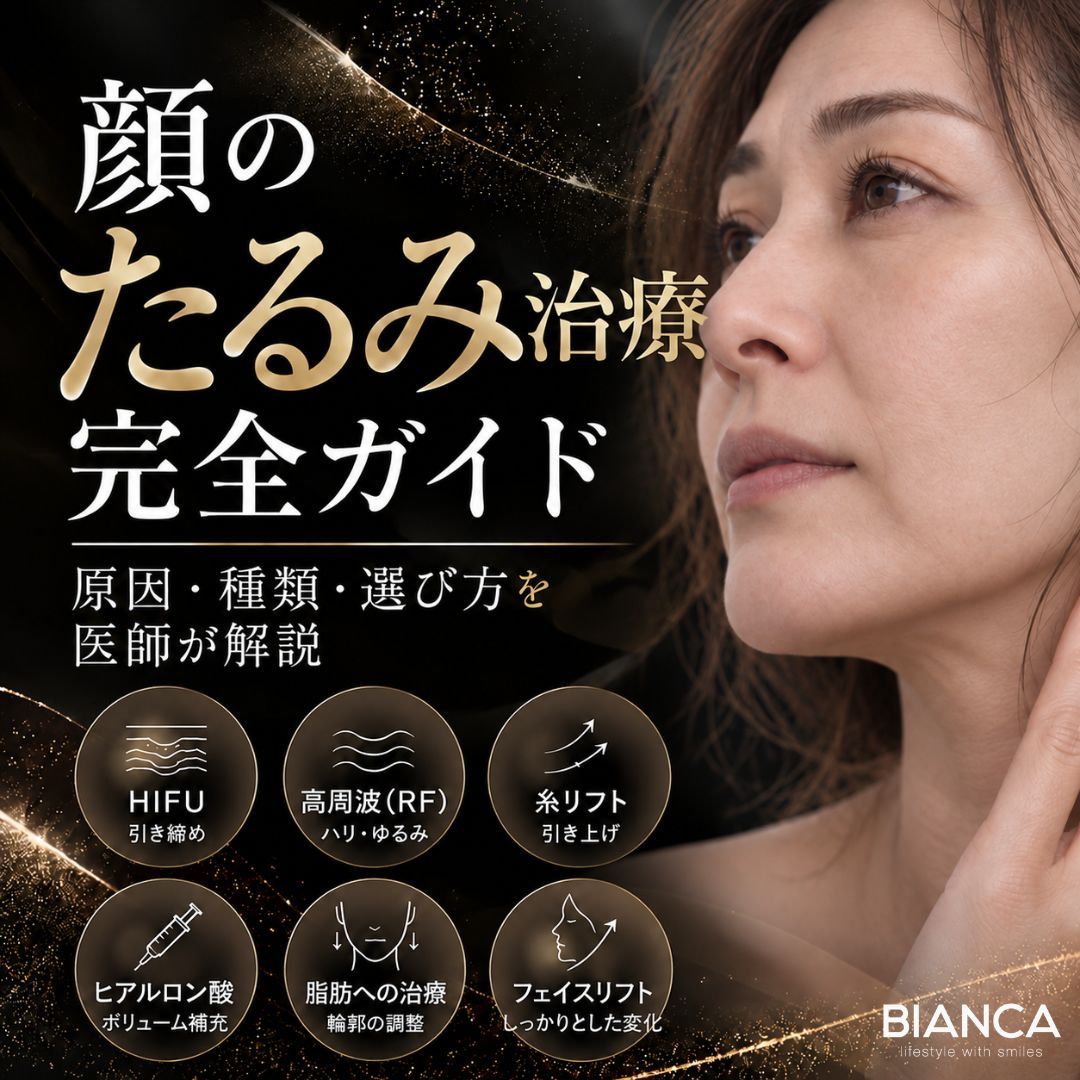
Treatments for facial sagging include HIFU (High-Intensity Focused Ultrasound), radiofrequency (RF), thread lifts, hyaluronic acid injections, and surgical facelifts.
Which cosmetic procedure is appropriate depends on skin laxity, the amount and location of fat, deep tissues—including the SMAS (superficial musculoaponeurotic system)—and changes in the skeletal structure.
The key is not to simply choose a popular procedure, but to identify the causes of sagging and the changes you hope to achieve, and then consider the treatment method that’s right for you.
What Is Facial Sagging?
Facial sagging refers to a condition in which the cheeks, mouth area, and jawline droop, or the facial contours become blurred, due to changes in the skin and subcutaneous tissue.
Although they tend to become more noticeable with age, the way they appear varies from person to person depending on factors such as bone structure, body fat, weight fluctuations, and exposure to ultraviolet rays.
Facial sagging isn't just a problem with the skin
The appearance of the face is supported by the fat, fascia, muscles, ligaments, and bones located beneath the skin.
The appropriate treatment may not be the same for sagging caused by a loss of skin elasticity as for the drooping caused by the descent of cheek tissue.
In addition, as fat in the cheeks decreases and the cheeks become sunken, the surrounding skin may appear saggy.
How does the structure of the face change with age?
As we age, changes occur in the skin’s elasticity, the distribution of facial fat, the supportive structures of the soft tissues, and the skeletal structure.
For example, different changes may occur simultaneously on the same face—such as a loss of volume in the upper cheeks and noticeable fullness around the mouth.
Rather than thinking, “I just need to tighten my entire face,” it’s important to look at the changes in each specific area.
Main Causes of Facial Sagging
Facial sagging is not caused by a single factor; rather, it results from a combination of changes in the skin, fat, SMAS, ligaments, bone structure, and muscles.
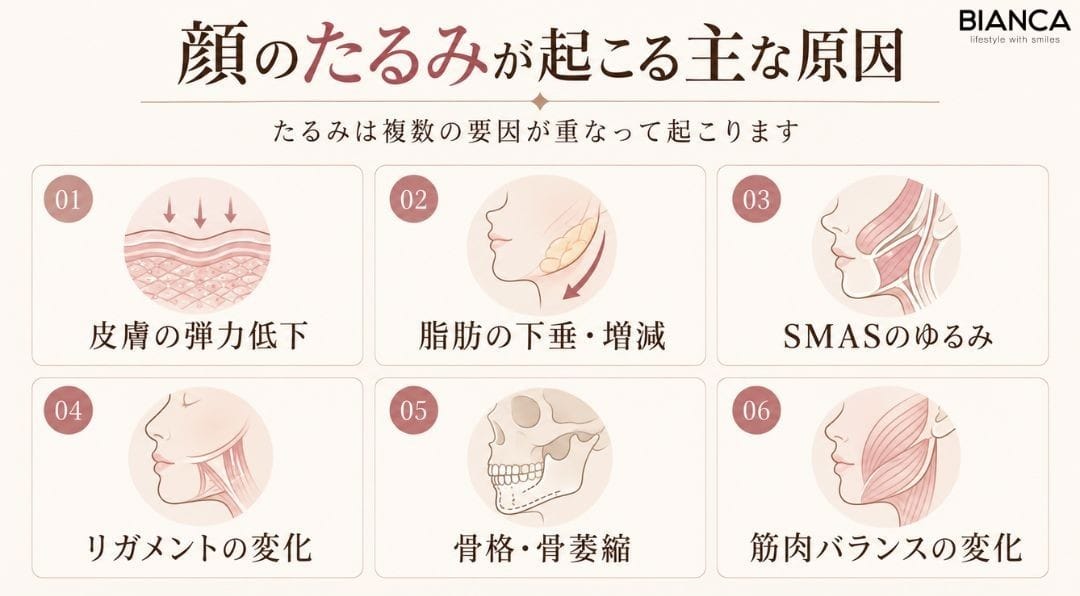
Understanding the main factors provides insight into the types of treatment available.
Loss of skin elasticity
When changes in collagen and elastin cause a loss of skin firmness, fine lines and sagging skin become more noticeable.
It's not just aging; photoaging caused by UV rays also plays a role.
If your goal is to tighten the skin, treatments such as RF are an option; however, if there is a significant amount of excess skin, it may be difficult to achieve sufficient results with radiation therapy alone.
Fat Sagging and Fluctuations
As fat shifts downward, increases in certain areas, or decreases in others, it can lead to sunken cheeks and sagging around the mouth.
If there is a lot of fat under the chin, treatment targeting the fat should be considered; conversely, for faces with little fat, it is necessary to decide how to preserve volume.
Losing fat doesn't necessarily make you look younger.
SMAS Loosening
SMAS is a fascial tissue associated with facial expression muscles and other structures, and it forms part of the framework that supports the skin and fat.
As we age, changes in deep tissues—including the SMAS—and surrounding supportive tissues can lead to sagging cheeks and a loss of definition along the jawline.
Treatments that take these changes in deep tissues into account include HIFU and surgical facelifts.
Changes in Ligaments
Ligaments are supportive structures that connect the soft tissues of the face to deeper layers, and their positional relationship with the surrounding fat and bone structure affects the contours of the cheeks and mouth area.
Changes in vision due to aging are complex and do not result from a simple mechanism in which the ligaments uniformly stretch.
Skeletal System and Osteoatrophy
The structure and support of the skeletal framework—including the cheekbones and the area around the jaw—also change with age.
As a result, indentations and unevenness in the contours may become noticeable.
In cases where a lack of bone structure or volume is a factor, injectable treatments may be considered in addition to contouring procedures.
Changes in Muscle Balance
The activity of the facial muscles and the platysma muscle in the neck affects the appearance of wrinkles and the jawline.
While Botox injections may be appropriate for reducing muscle tension, they are not a treatment that addresses the sagging of fat or excess skin itself.
What are the different types of treatments for facial sagging?
There are various types of cosmetic procedures designed to improve facial sagging and lift the face.
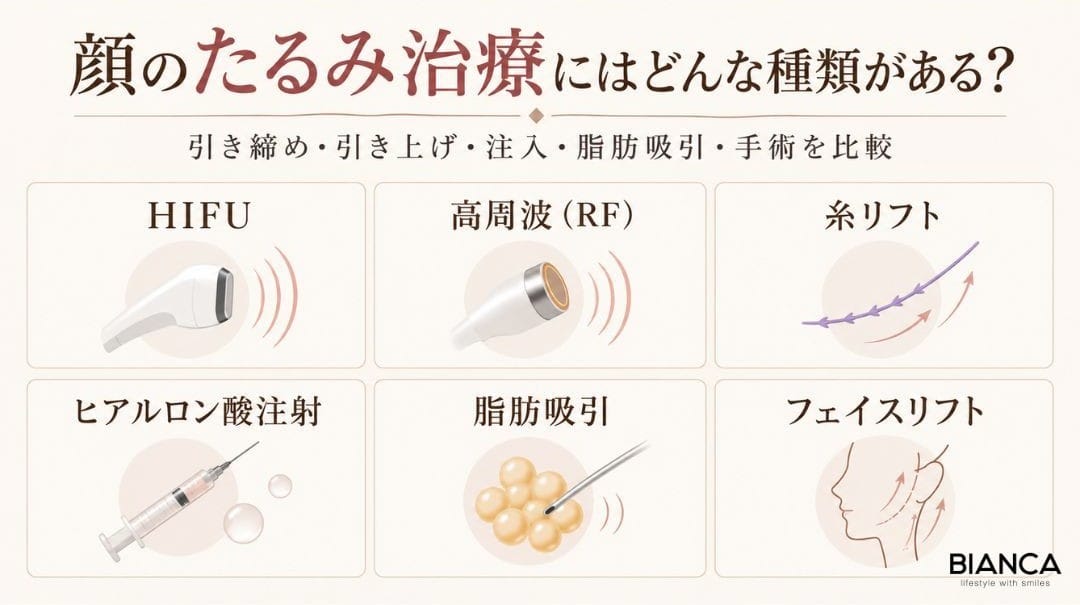
The most common procedures include thermal tightening, lifting sagging tissue, volume restoration, fat-reduction treatments, and surgical facelifts.
Since each treatment has different objectives and places varying degrees of strain on the body, we select the appropriate approach based on your preferences—whether you prefer a non-invasive treatment or want to experience noticeable results.
HIFU (High-Intensity Focused Ultrasound)
HIFU is a method that uses high-intensity focused ultrasound to deliver heat to a targeted depth, with the goal of tightening the tissue.
At Bianca Clinic, we use the “UltraCell Zi” and adjust the treatment depth, angle, and energy level according to the condition of the patient’s face.
While the treatment is primarily intended for mild to moderate sagging, caution is required when treating areas with little fat.
High-Frequency RF (e.g., Volnuma)
RF is a treatment that aims to tighten the skin and subcutaneous tissue through the thermal effects of radiofrequency.
In addition to Volnuma, which targets loss of skin firmness and sagging facial contours, Bianca Clinic also offers Mofius 8 Burst—which uses micro-needles to deliver heat at multiple depths—and Embrace RF, which targets subcutaneous tissue from the inside.
One of the hallmarks of our clinic is our wide range of RF treatments with different characteristics, allowing us to recommend the most appropriate treatment based on the degree of sagging and your desired results.
Thread Lift
A thread lift is a procedure in which medical-grade threads are inserted under the skin to lift sagging tissue in areas such as the cheeks and jawline.
At Bianca Clinic, we offer several types of treatments, including our original BIANCA LIFT, as well as the Artemis Lift and the Tes Lift.
We combine different types and numbers of threads, as well as insertion techniques, based on the degree and location of sagging and the desired results, to achieve a lift tailored to each individual.
hyaluronic acid injection
Hyaluronic acid injections are a treatment designed to restore volume lost due to aging, such as sunken cheeks and hollows.
Although this treatment does not directly lift the tissues, it can sometimes reduce the appearance of sagging by altering the facial contours.
Since there are risks such as unnatural swelling caused by overfilling and, in rare cases, vascular occlusion, it is essential to determine the appropriate injection volume and site.
Botox injection
Botox is a treatment that temporarily modulates muscle function.
This is considered in cases where tension in the platysma muscle affects the appearance of the facial contours.
However, since this method does not directly improve loss of skin elasticity or sagging fat, its applications are limited.
Approaches to Fat
If you have excess fat under the chin or on the cheeks, resulting in a blurred facial contour, options such as liposuction or fat-dissolving injections may be worth considering.
On the other hand, excessive fat reduction may accentuate hollows and unevenness.
To determine whether fat reduction is necessary, an evaluation that takes into account excess skin and bone structure is required.
Surgical Facelift
In cases of significant sagging of excess skin or tissue, we aim to improve the condition through surgical treatments such as an SMAS facelift.
Unlike laser treatments or thread lifts, this procedure directly lifts the skin and deep tissues, so it can be expected to provide greater improvement for sagging skin.
However, since there are risks associated with the procedure—such as scarring, swelling, infection, and nerve damage—it is important to carefully weigh the benefits against the physical toll on the body.
The appropriate treatment varies depending on the cause of sagging.
The best cosmetic procedures for facial sagging depend on the cause and the degree of sagging.
It is important to choose a treatment method based on the primary causes, such as sagging skin, excess fat, tissue ptosis, and lack of volume.
| Main cause | Distinctive Features | Treatment Options Under Consideration |
| Sagging skin | Loss of Firmness and Fine Lines | RF and HIFU |
| Deep Tissue Relaxation | Mild to moderate sagging of the facial contours | HIFU |
| Tissue Prolapse | Sagging around the cheeks and mouth | Thread Lift / Facelift |
| Low volume | Sunken Cheeks and Hollows | Hyaluronic Acid and Fat Injections |
| High in fat | Double Chin and Facial Fullness | Liposuction and Fat-Dissolving Injections |
| There is a lot of excess skin | Severe sagging | Surgical Facelift |
This serves as a guideline for treatment selection; in reality, multiple causes often overlap.
Even for the same concern—such as “I’m worried about my jawline”—one person may be a good candidate for a skin-tightening treatment, while another may be better suited for a treatment that lifts the underlying tissue.
During a medical examination, it is important to assess the overall balance of the face.
Do treatments for sagging skin vary by age?
While age can serve as a guide when considering treatment, it is not the sole factor in determining the course of treatment.
Depending on skin condition, body fat, and previous treatment history, the available options may vary even among people of the same age group.
30s
Even in your 30s, you may start to notice a loss of skin firmness and slight sagging of the facial contours.
We may consider treatments such as HIFU or RF as needed, but if sagging isn't noticeable, there's no need to rush into treatment.
Basic skincare, such as protection against UV rays, is also important.
in their 40s
Your 40s are a time when changes in the distribution and volume of fat often occur alongside a loss of skin elasticity.
We select the appropriate treatment—such as skin tightening, thread lifts, or injectable treatments—based on the underlying cause.
50s and older
For people in their 50s and older, a combination of excess skin, sagging tissue, and loss of volume may become increasingly noticeable.
In some cases, light therapy may be appropriate, while in others, a surgical facelift may be considered; the most suitable treatment depends on the degree and condition of the sagging.
We don't decide whether to perform surgery based on age alone; instead, we consider the balance between the desired changes and the associated burden.
Sagging Skin Treatments by Body Area
Facial sagging manifests differently depending on the area—such as a loss of definition along the jawline, jowls, sagging cheeks, and loose skin under the chin or on the neck.
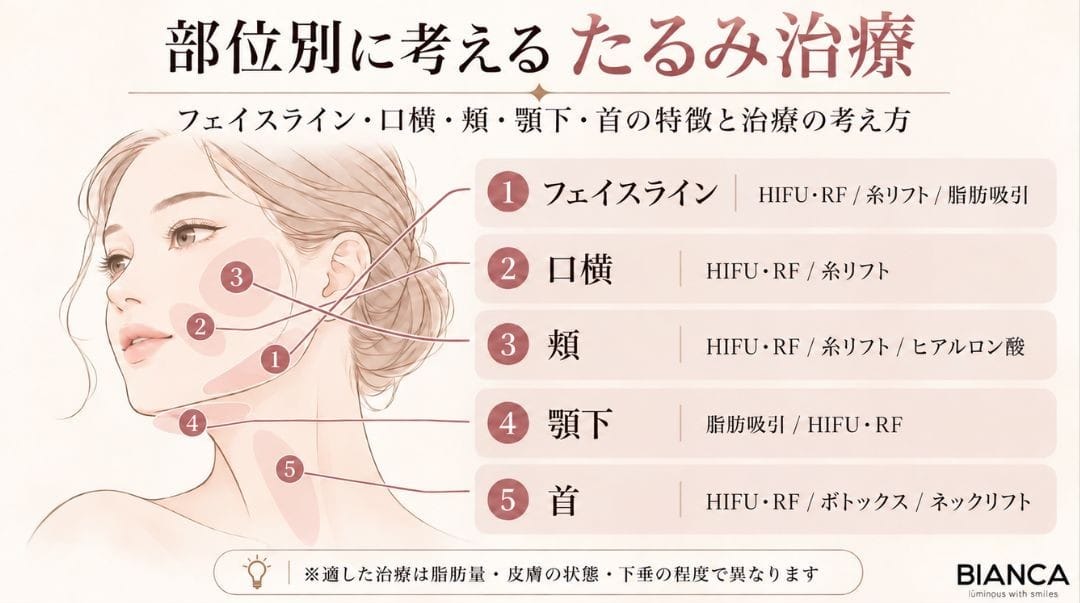
What factors contribute to issues in each area, and what cosmetic procedures can help improve them?
Let's take a closer look at the characteristics of each area and the corresponding treatment methods.
Face line
A sagging jawline is caused by factors such as loose skin, sagging cheeks, and fat under the chin.
We offer treatments tailored to the specific cause, such as skin tightening using HIFU or radiofrequency (RF), lifting procedures using thread lifts, and liposuction.
Beside the mouth
The "ponyo" at the sides of the mouth is caused by a combination of factors, including fat in the cheeks, sagging tissue, and loose skin.
While treatments such as HIFU, RF, and thread lifts can help improve the appearance, there are cases where simply removing fat is not enough to achieve satisfactory results.
頬
Sagging cheeks result from a combination of factors, including a loss of skin elasticity, the sagging or reduction of fat, and changes in the skeletal structure and supporting tissues.
We will consider treatments tailored to your specific condition, such as HIFU or radiofrequency (RF) for sagging skin, thread lifts for tissue ptosis, and hyaluronic acid injections for loss of volume.
If you have sunken cheeks, you should be careful not to over-tighten the skin or lose too much fat.
under the chin
A double chin and sagging under the chin are influenced by factors such as the amount of fat, skin elasticity, and bone structure.
If fat is the main concern, treatments targeting fat are an option; if sagging skin is the main concern, skin-tightening treatments are an option.
Since both factors may be involved, it is difficult to determine the cause based solely on appearance.
首
Sagging of the neck is caused not only by loose skin but also by the platysma muscle and excess skin.
Depending on the condition, we will consider treatment options such as light therapy, Botox injections, and neck lifts.
Evaluating the area, including the transition between the face and neck, leads to a natural-looking result.
How do you decide when to use HIFU and when to use RF?
HIFU is a treatment that focuses ultrasound waves at a targeted depth, while RF delivers radiofrequency heat to the skin and subcutaneous tissue.
If your priority is deep tissue tightening, HIFU is the recommended option; for skin firmness and sagging, RF is a good choice.
However, since which option is more suitable depends on your body fat percentage and skin condition, it’s important to assess your situation carefully.
Is it common to combine multiple treatments for sagging skin?
If there are multiple causes of sagging, we may combine light therapy, injectable treatments, and thread lifts.
For example, because HIFU and Voluma differ in the type of energy they use and how they deliver heat, using them together makes it possible to target multiple layers.
However, combining treatments does not necessarily lead to better results, and in some cases, a single treatment may be sufficient; therefore, it is important to make a judgment based on the specific condition of the sagging skin.
Does the treatment vary depending on the amount of fat in the face?
The amount of fat in the face plays a major role in determining the choice of treatment for sagging skin.
While excess fat can cause the face to appear puffy, a lack of fat can accentuate sunken cheeks and hollows.
Fat-reduction treatments are not suitable for everyone.
If you're particularly concerned about sunken cheeks, you need to distinguish between the areas you want to tighten and those where you want to preserve volume.
How to Avoid Regrets When Treating Sagging Skin
To avoid regrets, it is important to understand not only the effectiveness of treatments for sagging skin but also their limitations, side effects, and complications.
For example, with light-based treatments, you need to be careful about burns and unwanted fat loss; with thread lifts, you need to watch out for tightness and unevenness; and with hyaluronic acid injections, you need to be cautious of over-injection and vascular occlusion.
Surgery also carries risks such as scarring, infection, and nerve damage.
Since you may not always achieve the desired results, be sure to confirm the treatment’s suitability, downtime, cost, and whether follow-up treatments will be necessary before undergoing the procedure.
How does BIANCA determine the treatment method?
At Bianca Clinic, we conduct a comprehensive evaluation not only of the areas where you are concerned about sagging but also of the overall balance of your face and age-related changes, and we propose treatments tailored to each individual.
At BIANCA CLINIC, in addition to non-invasive treatments such as HIFU and Voluma, we offer a wide range of procedures, including thread lifts, hyaluronic acid injections, liposuction, and surgical facelifts.
Depending on the cause of sagging and the patient's preferences, it is also possible to combine multiple treatments.
Check body fat, bone structure, and skin condition
In sagging skin treatments, we assess factors such as skin thickness and elasticity, the amount of fat in the cheeks and under the chin, bone structure, the presence of sunken cheeks, and the degree of tissue sagging to determine which layer needs to be addressed.
In addition, we develop a treatment plan by taking into account the areas of concern, the patient’s age, their treatment history, their desired results, and their expectations regarding downtime.
For example, with HIFU, the depth, angle, and energy level of the treatment are finely adjusted based on the amount of facial fat and the degree of sagging. We aim for natural-looking tightening while taking into account risks such as sunken cheeks.
Using Firming, Lifting, and Volume Restoration Appropriately
Even if the goal is the same—"I want a facelift"—the appropriate approach varies depending on the underlying causes, such as sagging skin, tissue ptosis, or loss of volume.
At Bianca Clinic, we tailor our treatments to the specific causes of sagging.
HIFU and radiofrequency (RF) are options for tightening the skin and tissues, while thread lifts and surgical facelifts are options for lifting sagging tissues.
In addition, we may consider treatments such as hyaluronic acid injections to address a lack of volume.
Rather than focusing on a single procedure, we prioritize achieving the natural, youthful appearance our patients desire while maintaining the overall harmony of the face.
Frequently Asked Questions About Facial Sagging Treatments
Q. What is the most effective treatment for facial sagging?
A. The most effective approach depends on the cause and severity of the sagging.
For mild sagging, HIFU or RF are options; for tissue sagging, thread lifts are recommended; and for cases with significant excess skin, a facelift is an option.
Q. At what age should you start treatment for sagging skin?
A. There is no set age at which to begin treatment for sagging skin.
Since the appearance of sagging varies from person to person, we determine the need for treatment based on the condition of the skin and fat, as well as the specific symptoms of concern, rather than age alone.
Q. Which is better, HIFU or RF?
A. HIFU is a good option for deep tissue tightening, while RF is a good option for improving skin firmness and treating sagging skin.
Which one is better depends on your body fat percentage and the treatment area.
Q. Can I get treatment for sagging skin even if my cheeks are sunken?
A. Even if you have sunken cheeks, we can explore treatment options.
However, treating areas with little fat requires careful consideration, and in some cases, a treatment to restore volume may be appropriate.
Q. How often should I get treatments for sagging skin?
A. The appropriate frequency varies depending on the type of treatment and your progress.
Treatments such as HIFU, RF, and thread lifts are not performed at regular intervals; instead, the doctor will assess your condition and make a determination.
It's important to choose a treatment for facial sagging based on its cause.
Treatments for facial sagging include HIFU, RF, thread lifts, hyaluronic acid injections, liposuction, and surgical facelifts.
The key is to identify whether the cause of sagging lies in the skin, fat, deep tissues, or the skeletal structure, and then choose the appropriate treatment method.
At BIANCA CLINIC, we offer a wide range of treatments for sagging skin and recommend procedures tailored to each individual’s condition and preferences.
We offer treatments designed to create a natural, youthful appearance while taking into account the overall balance of your face.
If you're concerned about sagging skin on your face, please feel free to contact our clinic for a consultation.
▷View a list of anti-aging treatments for sagging skin and facial lifting, along with case studies