column (e.g. in newspaper)
2026.10.12
What's the Difference Between InMode FORMA and Volnuma? A Guide to Choosing a Non-Surgical Facial Contouring Treatment

As a board-certified dermatologist and aesthetic dermatology instructor recognized by the Japanese Dermatological Association, I oversee both general dermatology and aesthetic dermatology, while also advocating for the importance of “daily skincare” to maximize the effectiveness of aesthetic medical treatments. Holding qualifications such as Advanced Cosmetic Ingredient Specialist and Hair Diagnosis Specialist, I developed the Japanese-made doctor's cosmetics brand "Skin Amure" based on knowledge and experience gained from extensive clinical cases. My expertise has been recognized, leading to appointments as an "InMode Certified Practitioner" and "ADVATx® Global KOL".

When you’re thinking, “I want to improve my skin’s firmness” or “I want to define my jawline,” InMode FORMA and Volnuma are two options to consider.
Both treatments use radiofrequency (RF), but it can be hard to tell what the difference is, right?
In fact, even among RF treatments, the way heat is delivered varies, which is a factor to consider when choosing a treatment.
In this article, BIANCA CLINIC explains the differences between FORMA and Borneuma.
We’ll share some key points to consider when deciding which treatment is right for you, including a comparison with HIFU.
What are the main differences between InMode FORMA and Volnuma?
The main differences between InMode FORMA and Volnuma are the RF electrode configuration and the range of heat penetration.
While InMode FORMA uses bipolar RF to heat primarily the dermis, Volnuma uses monopolar RF to deliver heat from the dermis to the fat layer.
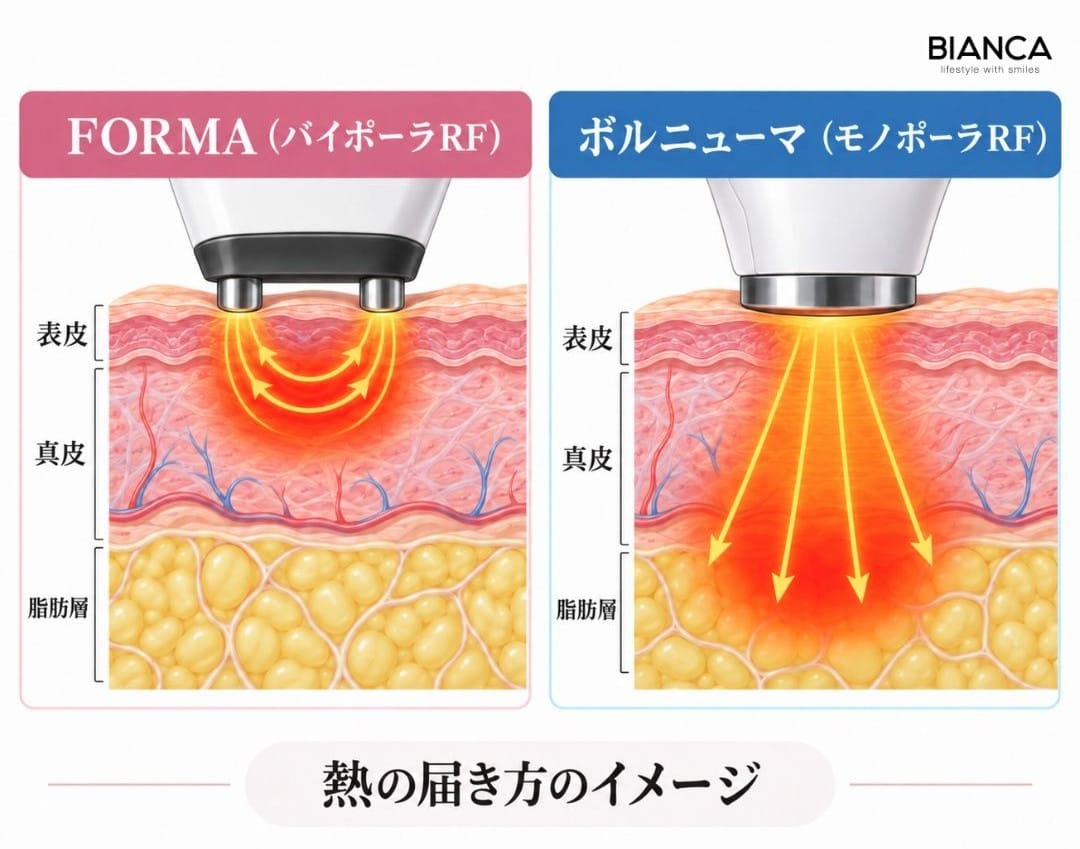
While both aim to improve skin firmness and tone, their approaches are not the same.
Furthermore, it’s not necessarily true that appliances that heat food to a greater depth are better.
The treatment options available depend on which skin tissue you want to target.
Compare the Differences Between InMode FORMA, Voluma, and HIFU
Let’s compare these three devices, including HIFU (High-Intensity Focused Ultrasound), which is known for its skin-tightening effects.
|
Comparison Items |
In Mode FORMA |
volnema |
HIFU (UltraCell Zi) |
|
Energy |
High-frequency (RF) |
High-frequency (RF) |
High-Intensity Focused Ultrasound |
|
Irradiation Method |
Bipolar RF |
Monopolar RF |
Focusing and directing ultrasound |
|
Main Scope of Application |
Center of the Dermis |
Dermis to Adipose Tissue |
The dermis, SMAS layer, etc. |
|
Changes We Can Expect |
Skin Firmness, Elasticity, and Tightening |
Skin firmness, tightening of the jawline |
Tightening of tissues, including deep tissues |
|
How to Deliver Heat |
Heat while monitoring the temperature |
Heats a wide area |
Concentrate heat at the set depth |
|
Major Downtime |
Redness, flushing, etc. |
Heat sensation, swelling, etc. |
Heat sensation, swelling, etc. |
*Results may vary from person to person, and the treatment area and downtime may also differ depending on the treatment conditions.
HIFU uses ultrasound energy, which is different from RF, and, depending on the settings, can target deep tissues such as the SMAS layer.
As you can see, even among treatments for sagging skin, there are differences in the type of energy used and how the heat is applied.
How do the high-frequency mechanisms of InMode FORMA and Volnuma differ?
Both InMode FORMA and Volnuma utilize RF-induced thermal stimulation, but the way the current flows differs.
This difference is related to the tissues being heated and the treatment plan.
FORMA | Bipolar RF that primarily heats the dermis
FORMA is a treatment that uses high-frequency current between two electrodes to heat the dermis and surrounding areas.
By monitoring the skin's surface temperature during treatment and using thermal stimulation to promote collagen restructuring, this treatment aims to improve skin firmness, elasticity, and tone.
A key feature is the ability to adjust the irradiation area and direction while maintaining temperature control.
For example, the thickness of the skin and the distribution of fat differ between the cheeks and the jawline.
Therefore, rather than warming the entire face uniformly, it is important to consider where and how to apply the heat.
For information on how FORMA works and the benefits you can expect beyond skin firming and tightening,An article explaining the features of InMode FORMABut I'll explain that in more detail.
Borneuma | Monopolar RF that delivers heat from the dermis to the fat layer
Borneuma is a treatment that uses monopolar RF to deliver heat from the dermis to the fat layer.
In addition to collagen contraction and remodeling, this treatment is also expected to tighten the fibrous tissue beneath the skin, addressing sagging in the cheeks, around the mouth, and along the jawline.
Another feature is that cartridges are available in sizes tailored to specific body parts, making it easy to treat even small areas.
It also features cooling and vibration functions, and is designed to minimize any sensation of heat or pain during treatment.
However, the perception of pain varies from person to person.
How do the expected effects of FORMA and Volnuma differ?
Both InMode FORMA and Volnuma are treatments designed to improve skin firmness and tone.
However, one factor to consider when making your choice is whether you want to “improve your skin’s texture” or “tighten up a sagging jawline.”
Of course, the results aren't completely different.
Let's talk about the characteristics of each one in a little more detail.
If you want to improve your skin's firmness and texture
"I wish my skin had a little more firmness." "I feel like the skin on my cheeks has started to sag a bit."
If the main concern in these cases is a lack of firmness in the skin itself, I would consider InMode FORMA.
InMode FORMA is a treatment that gently delivers heat primarily to the dermis.
I think its appeal lies in the fact that it helps improve skin firmness and elasticity while also addressing mild sagging.
In particular, this treatment is a good option for those who want to firm up their skin while making the most of their current facial features, rather than drastically changing their facial contours.
However, if your main concerns are enlarged pores, uneven skin texture, or rough skin, treatments other than RF may be more appropriate.
If you want to firm up the sagging skin along your jawline and around your mouth
On the other hand, if volume is concentrated in the lower cheeks or around the mouth, causing the jawline to appear blurred, Volneuma may be considered.
Since Volnuma can deliver heat from the dermis to the fat layer, it is a good option when you want to achieve not only firmness on the skin’s surface but also tightening that extends to the subcutaneous tissue.
However, what I want to emphasize here is that just because you want to tighten your jawline doesn’t mean you should apply heat indiscriminately.
The fullness of the cheeks is also an important element that shapes a person's facial features.
For people with low body fat or whose cheeks tend to look sunken, it’s important to carefully consider the treatment areas and procedures to ensure that the necessary volume is not lost.
In some cases, FORMA may be sufficient; however, if you are concerned about sagging in tissues deeper than the skin, you may want to consider HIFU.
Rather than simply making it thinner and sharper, I want to focus on shaping it naturally while maintaining the overall balance of the face.
Do InMode FORMA and Volnuma differ in terms of downtime and the number of treatments required?
Both InMode FORMA and Volnuma have relatively short downtime periods, and there is no significant difference in the typical post-treatment recovery process.
With InMode FORMA, redness or flushing may occur immediately after the treatment, but these symptoms usually subside within a few hours or by the next day.
With pneumonia, redness, a sensation of heat, and swelling may also occur; these symptoms generally subside within a few hours to a few days.
However, symptoms vary from person to person, and in rare cases, burns or other injuries may occur.
On the other hand, there is a clear difference in the frequency of treatments.
- In Mode FORMA: We recommend continuing treatment about once every 2 to 3 weeks, for a total of 3 to 6 sessions.
- Borneuma: For the face, we recommend regular treatments every 3 to 6 months.
While InMode FORMA involves repeated treatments at relatively short intervals, Volnuma is more like a maintenance treatment performed every few months.
While the number of sessions and intervals for both are adjusted based on the condition of your skin, there is a difference in the frequency of visits.
An article summarizing the progression of downtime and how to spend itWe provide more details here.
What factors should you consider when choosing between InMode FORMA and Volnuma?
When choosing between InMode FORMA and Volnuma, you need to consider not only whether you prioritize skin firmness or facial contouring, but also the condition of your skin and fat, as well as your desired results.
Identify Your Skin Condition and Desired Changes
To put it simply, if you want to improve your skin’s firmness and texture, InMode FORMA is a good option, while if you’re looking to tighten your jawline and the areas around your mouth, Volnuma is a good choice.
However, in reality, there are quite a few people who experience both of these concerns at the same time.
In addition, there are cases where RF alone may not produce the desired results, such as when there is a significant amount of excess skin or when excess fat is the primary cause.
Therefore, rather than simply choosing based on the name of the treatment, it is important to consider an approach that suits the current condition of your skin and facial contours.
If you're wondering, "Is FORMA the right fit for my concerns?",Characteristics of People for Whom InMode FORMA Is SuitablePlease take a look at this as well.
Here, we explain in a little more detail the factors to consider when deciding whether to undergo the procedure.
At Bianca Clinic, we place great importance on tailoring FORMA treatment plans to each patient’s facial features.
When it comes to InMode FORMA, what I value most is not setting a fixed location or direction for the treatment.
Even when it comes to the same facial contour concerns, the fullness of the cheeks, the distribution of fat, and the degree of skin laxity vary from patient to patient.
That’s why Bianca Clinic has adopted “Customized FORMA,” a treatment that tailors the laser application to your facial features and specific areas of concern.
Of course, InMode FORMA isn't right for everyone.
Considering treatments such as Voluma and HIFU, which tissues should be targeted to achieve the desired results?
I keep that perspective in mind as I plan each treatment.
Frequently Asked Questions About the Differences Between InMode FORMA and Volnuma
Both InMode FORMA and Volnuma are RF treatments, but you may have questions about pain, whether they can be used together, and how they differ from other devices. Here are the answers to some common questions.
Q1. Which is more painful, InMode FORMA or Volnuma?
You may feel a sensation of heat during both procedures, but it is not possible to make a direct comparison of the intensity of the pain.
The InMode FORMA delivers treatment while monitoring temperature, and the Volnuma is equipped with cooling and vibration functions.
However, results may vary depending on the treatment area, the intensity of the treatment, and how the patient perceives it.
Q2. Can InMode FORMA and Volnuma be used together?
Since these treatments can target different depths, we may consider using them in combination depending on the condition of the skin and the treatment goals.
However, both are treatments that use RF to apply heat.
Combining these treatments does not necessarily increase their effectiveness; you must also consider the strain on the skin and the buildup of heat.
Q3. Will InMode FORMA and Volnuma reduce facial fat?
Both treatments are primarily designed to tighten the skin and tissues; reducing fat is not their main objective.
Although Volnuma delivers heat to the fat layer, this alone does not necessarily result in fat reduction; therefore, if you are concerned about the volume of fat, we will consider other approaches as well.
Q4. What is the difference between Sofwave and HIFU, and InMode FORMA and Volnuma?
The main difference lies in the energy used and how the heat is delivered.
InMode FORMA and Volnuma use RF, while SofWave and HIFU (High-Intensity Focused Ultrasound) utilize ultrasound energy.
There are also differences in the target demographics.
Q5. Does the choice between InMode FORMA and Volnuma depend on age?
We do not determine which treatment is appropriate based solely on age.
Even among people of the same age, there are individual differences in skin thickness, firmness, and fat distribution.
We'll assess your current skin condition and the changes you'd like to see.
Let's understand the differences between InMode FORMA and Volnuma and decide which treatment is right for you.
Although InMode FORMA and Volnuma both use RF technology, they differ in how heat is delivered and the tissues they target.
The important thing isn't which one is better, but rather to consider which treatment is best suited to the changes you're hoping to achieve.
At BIANCA CLINIC in Tokyo, we place great importance on designing InMode FORMA treatment plans tailored to each patient’s facial features and skin condition, while also offering a range of treatment options, including Volnuma and HIFU.
If you have any concerns about skin firmness or your facial contours, please feel free to contact us.