column (e.g. in newspaper)
2026.10.12
What Is TCA Peel? How It Works on Ice-Pick Acne Scars and Pitted Scars

As an Assistant Professor, Associate Ward Director, and Chief of Dermatopathology at the university hospital dermatology department, I deepened my expertise through academic presentations and paper publications both domestically and internationally. I have handled a wide range of treatments, from birthmark therapy in children to adult pigmentation concerns, utilizing various lasers and injection therapies, while also contributing to community healthcare. Through encountering numerous cases, I strongly felt the potential and necessity of aesthetic medicine, resolving to pursue further expertise. Building upon my solid dermatological knowledge and meticulous diagnostic skills, I value treatments that gently support each individual's skin while bringing out its inherent beauty.
"My acne has cleared up, but I'm left with tiny holes that look like they were made by a needle." "Even after undergoing treatments like laser therapy, the deep indentations haven't improved much."
Even if the surface holes of these ice-pick-type acne scars are small, tissue loss may extend deep into the skin.
TCA Cross is a treatment that precisely targets such deep craters.
In this article, Aya Hayama, a dermatologist at BIANCA CLINIC, explains how TCA peels work, the benefits you can expect, and the causes of ice-pick acne scars.
I'll also explain the differences between this and the new TCA Cross.
What kind of treatment is TCA Cross?
TCA Cross is a procedure in which TCA (trichloroacetic acid) is applied topically to atrophic scars, such as acne scars, to promote skin regeneration.
The name “CROSS” is an acronym for “Chemical Reconstruction of Skin Scars.”
TCA itself is an ingredient used in various peeling treatments, such as the “Massage Peel (Collagen Peel),” which is also offered at Bianca Clinic.
However, while a massage peel combines TCA with hydrogen peroxide and other ingredients to improve skin firmness and radiance, a TCA cross treatment applies high-concentration TCA to deep skin depressions.
Even if the same ingredients are used, the formulation of the medication, the area of application, and the purpose of the treatment differ.
The key feature of TCA peels is that, rather than exfoliating the entire face uniformly, the solution is applied specifically to the bottoms and walls of the acne scars.
We aim to improve deep indentations while taking care to avoid unnecessary irritation to the surrounding skin.
Why is TCA Cross effective for treating deep acne scars?
TCA Cross uses high-concentration TCA to chemically stimulate the interior of the indentation and promotes tissue remodeling by leveraging the subsequent wound healing process.
I’ll explain why this mechanism is particularly important for ice-pick acne scars.
Ice-pick-shaped craters indicate a loss of dermal tissue.
When acne inflammation becomes severe, it damages the collagen and elastic fibers in the dermis.
If the lost tissue is not fully repaired afterward, the skin may heal with a sunken appearance.
This is the primary mechanism by which atrophic acne scars form.
In particular, the “ice-pick” type generally refers to a narrow opening—less than 2 mm wide—with a V-shaped indentation extending into the deep layers of the dermis.
Even if they appear to be pores on the surface, there may be a continuous, elongated tissue defect beneath the surface.
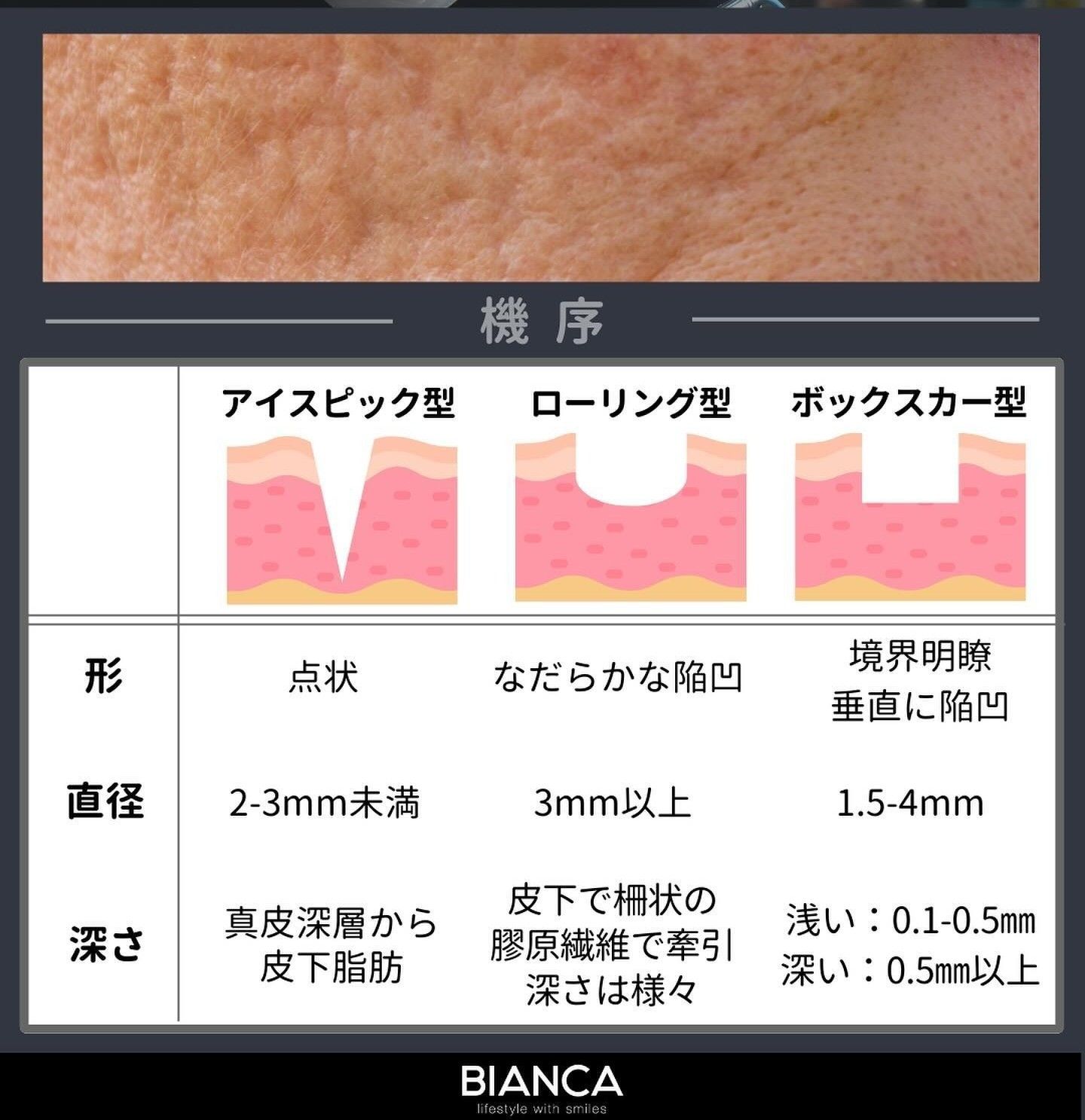
In other words, ice-pick acne scars are not simply enlarged pores, but acne scars resulting from tissue loss that extends deep into the skin.
Protein coagulation induced by TCA triggers wound healing
When high-concentration TCA comes into contact with the skin, it causes proteins to coagulate, resulting in chemical damage.
TCA Cross is a treatment that harnesses the skin's natural ability to repair damage—triggered by this reaction—to help improve acne scars.
It is believed that during the wound healing process, fibroblast activity is stimulated, leading to the production of new collagen and the reconstruction of dermal tissue.
In other words, TCA Cross is not a procedure that directly fills in depressions with hyaluronic acid or similar substances.
This method aims to reconstruct lost dermal tissue by utilizing the patient’s own wound healing response.
In fact, a study examining TCA cross treatment using 95% TCA compared skin tissue before treatment and one year later, confirming a reduction in the depth of acne scars and an increase in collagen fibers. [1]
*Research Methods*
TCA was applied topically, and a total of six treatments were administered at 6-week intervals.
However, since the study involved only three participants, it has not been proven that the same changes occur in everyone.
Nevertheless, I believe this is an interesting study that suggests changes in craters caused by TCA cross-linking may be associated with the remodeling of dermal tissue.
What benefits can be expected from TCA Cross?
With TCA Cross, you can expect it to gradually reduce the depth of deep, narrow acne scars and make unevenness on the skin's surface less noticeable.
In particular, ice-pick-type acne scars can be difficult to improve with treatments that apply uniform pressure to the skin’s surface alone.
In that regard, the TCA cloth, which allows direct access to the interior of the indentation, offers significant clinical benefits.
The effects of TCA cross have been examined in several studies.
A review published in 2021 analyzed 19 studies on TCA CROSS.
In a study that evaluated the degree of improvement in acne scars on a graded scale, improvements exceeding 25% were reported in 60–100% of patients, suggesting that the treatment may be particularly effective for ice-pick acne scars. [2]
However, since the number of participants, TCA concentration, and number of treatments vary from study to study, not all patients will experience the same results.
Assessing the condition of acne scars determines the effectiveness of treatment
I believe that TCA Cross is a treatment that can produce noticeable results when the shape of the crater is properly assessed.
The key is to check the depth and shape of the indentation and choose a treatment that suits its condition.
However, not all acne scars have the same structure.
For example, in the “rolling” type—where the skin is pulled downward by fibrous adhesions beneath the skin—TCA cross-treatment alone may not be sufficient to address the underlying cause.
Therefore, rather than performing a TCA peel simply for the sake of doing so, it is important to assess the depth and shape of the acne scars and determine what is happening beneath the skin.
Also, this treatment does not eliminate dents in a single session.
We aim for gradual improvement through multiple treatment sessions.
What is the difference between TCA Cross and New TCA Cross?
At Bianca Clinic, we offer two types of treatments: TCA Cross and New TCA Cross.
Both treatments aim to improve acne scars by utilizing the effects of TCA, but they differ in the treatment area and the method of applying the solution.
| Comparison Items | TCA Cross | New TCA Cross |
| Scope of treatment | Full face | Targeted treatment for specific craters that concern you |
| Treatment Method | Apply high-concentration TCA to the problem areas | Applying the medication using an ultra-fine needle |
| Features | Approaching Multiple Craters | Fine-tune the amount of medication and the depth of application |
The new TCA Cross allows for precise adjustment of the amount of solution and the depth of application.
With the new TCA Cross treatment, a very fine needle is used to apply the solution to each individual crater.
Since the amount of medication and the depth of application can be adjusted depending on the condition of the indentation, this method is worth considering when performing intensive treatment on particularly troublesome deep, ice-pick-like indentations.
However, the new TCA cloth shares the same basic operating principle as the conventional TCA cloth.
It doesn't use completely different ingredients or mechanisms.
Furthermore, there are not enough studies that have directly compared the new TCA cross and demonstrated that it is more effective than conventional methods.
At Bianca Clinic, we determine the best treatment method after assessing the depth and number of acne scars, as well as the condition of your skin.
What are the pros and cons of TCA cross?
The advantage of TCA peel is that it can be applied topically to deep, narrow acne scars.
On the other hand, because high-concentration acids are used, it is important to be aware of potential skin reactions and risks following the procedure.
Benefits | Precise treatment of deep indentations
One of the benefits of TCA peel is that it can target deep, ice-pick-type acne scars that are difficult to improve with surface-level treatments alone.
The action of high-concentration TCA promotes wound healing and aims to rebuild dermal tissue.
A key feature of this treatment is that it can improve the condition of craters where tissue has been lost deep inside, even if they appear to be just small holes on the surface.
Disadvantages | There is a risk of hyperpigmentation, scarring, and other complications
With TCA peels, redness, scabbing, and post-inflammatory hyperpigmentation may occur after the procedure.
Using a high concentration of TCA does not necessarily guarantee effective results; it is important to ensure the solution acts appropriately based on the condition of the skin.
Frequently Asked Questions About TCA Cross Treatments
Here are the answers to some common questions we receive from people considering TCA Cross.

Q1. Are TCA peels and chemical peels the same thing?
Although the same TCA may be used, the purpose and method of the treatment differ.
TCA Cross is a procedure in which high-concentration TCA is applied to the crater to promote tissue regeneration.
Q2. Can TCA peels help reduce the appearance of enlarged pores?
TCA peels may also help reduce the appearance of enlarged pores.
However, since the causes of enlarged pores—such as sebum secretion—and indentations caused by acne scars are different, we will assess your skin condition before determining the appropriate treatment.
Q3. Is TCA peel effective for acne scars other than those with a crater-like appearance?
It is primarily used for atrophic acne scars that are indented. For acne scars characterized mainly by redness or hyperpigmentation, we will consider a different treatment.
Q4. Can I undergo TCA peel treatment even if I have acne?
For areas with active acne or inflammation, treating the acne may take priority.
We determine whether a treatment can be performed based on the condition of your skin.
Q5. Will acne scars disappear completely with TCA peels?
This treatment does not guarantee that the marks will disappear completely.
Results vary from person to person depending on the depth and shape of the scars, and multiple treatments are needed to gradually make the indentations less noticeable.
TCA Cross is a treatment that focuses on deep crater-like structures.
In particular, with ice-pick-type lesions, even if the surface opening is small, the tissue defect may extend deep into the tissue.
Therefore, it is important to adopt an approach that targets not only the skin's surface but also the interior of the indentations.
At Bianca Clinic, we offer both TCA Cross and New TCA Cross treatments and determine the appropriate procedure based on the condition of the skin's texture.
When aiming to improve acne scars, it’s important to understand the structure of each individual scar rather than applying the same method to every indentation.
As a dermatologist, I value that perspective.
If you're concerned about deep acne scars or pitted scars, please feel free to contact BIANCA CLINIC in Tokyo for a consultation.
▶Check the details of the TCA Cross treatment
▶Please contact us via the online reservation form.