column (e.g. in newspaper)
2026.11.02
What Is Gummy Smile Surgery? A Dentist Explains the Two Methods and How to Choose Between Them

He is a specialist in the treatment of gummy smiles, one of the most sensitive areas of esthetic dentistry. He practices, lectures, researches, and writes articles in Japan and abroad. He is the only Japanese dentist who is certified as an implant specialist in both the U.S. and Europe. He uses a multifaceted approach, including surgical treatment, orthodontics, and Botox injections, to address all concerns about the mouth. He is a dentist who can help patients achieve their “desired smile.

Surgery for a gummy smile includes lip repositioning, which adjusts the movement of the upper lip, and aesthetic crown lengthening, which corrects the position of the gums. Which procedure to consider depends on the cause.
"Does gummy smile surgery involve cutting the gums?" "How is it different from the method that involves stitching the inside of the upper lip?"
Even once you start considering surgery, it can be difficult to know which method is right for your specific concerns. Even if your gums look the same, your options will vary depending on whether the main cause lies with your upper lip or your gums.
In this article, Teppei Tsukiyama, a dentist at BIANCA CLINIC, explains the differences between the two surgical procedures for treating a gummy smile and the key points to consider when deciding on a treatment.
Can a gummy smile be corrected with surgery?
Depending on the cause, surgery may be able to reduce gum exposure in cases of a gummy smile. For example, the areas that need to be adjusted differ between people whose upper lip lifts significantly when they smile and those whose gums cover a large portion of their front teeth.
However, if the underlying cause is related to the jaw structure or the alignment of the teeth, treatments other than the surgery described here may be more appropriate. The key is not to base your decision solely on how much gum is visible.
For a detailed explanation of the cause, see “Why Does a Gummy Smile Happen?"Please see [...].
What types of surgery are available for a gummy smile?
The main options are lip repositioning, which addresses the movement of the upper lip, and aesthetic crown lengthening, which adjusts the proportion of teeth and gums visible. Although both are surgical procedures, their objectives are not the same.
Lip Repositioning | Adjusting Upper Lip Movement
If your upper lip lifts significantly when you smile, revealing gums that are normally hidden, lip repositioning (upper lip mucosal resection) may be an option.
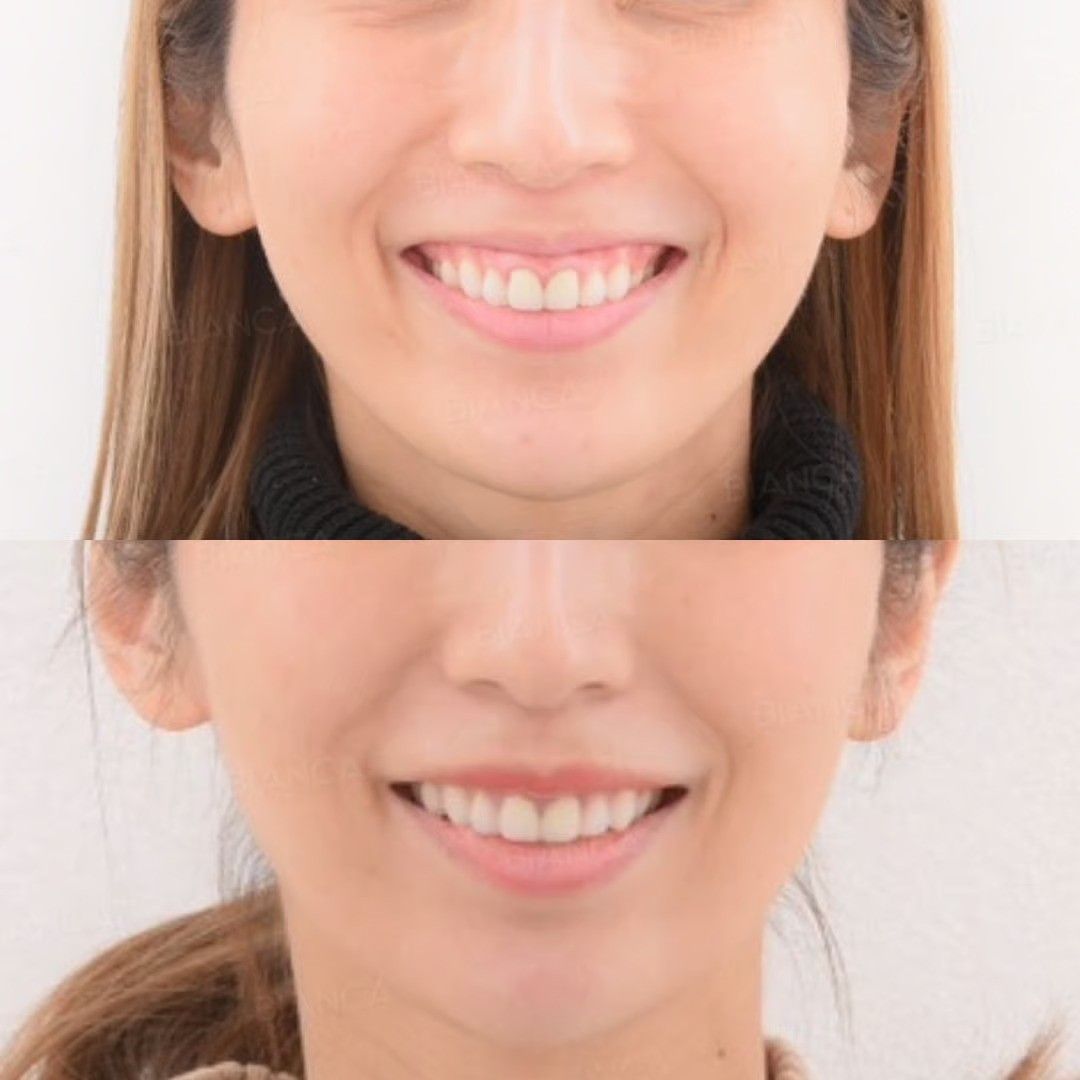
[Procedure] Lip Repositioning (Upper Lip Mucosal Resection)
[Treatment Period and Number of Sessions] Top: Before treatment; Bottom: 1 month after treatment
[Side Effects and Risks] Swelling, bruising, etc.
[Cost] 385,000 yen
*Please note that the information provided reflects the menu and prices at the time of the treatment. As the current offerings and prices may have changed, please contact us for details.
This is a surgical procedure in which a portion of the mucous membrane on the inside of the upper lip is removed and sutured to adjust the extent to which the lip can be raised. It is characterized by the fact that it addresses the position of the lip when smiling, rather than involving the removal of gum tissue. There is a possibility of postoperative relapse or a feeling of discomfort in lip movement.
For information on the surgical procedure, before-and-after photos, and fees,Lip Repositioning Treatment PageYou can check it here.
Aesthetic Crown Lengthening | Adjusting the Position of the Gums
Aesthetic crown lengthening is an option to consider when the gums cover the surface of the front teeth, making them appear short. This procedure restores balance by adjusting the position of the gums to expose more of the visible portion of the teeth.
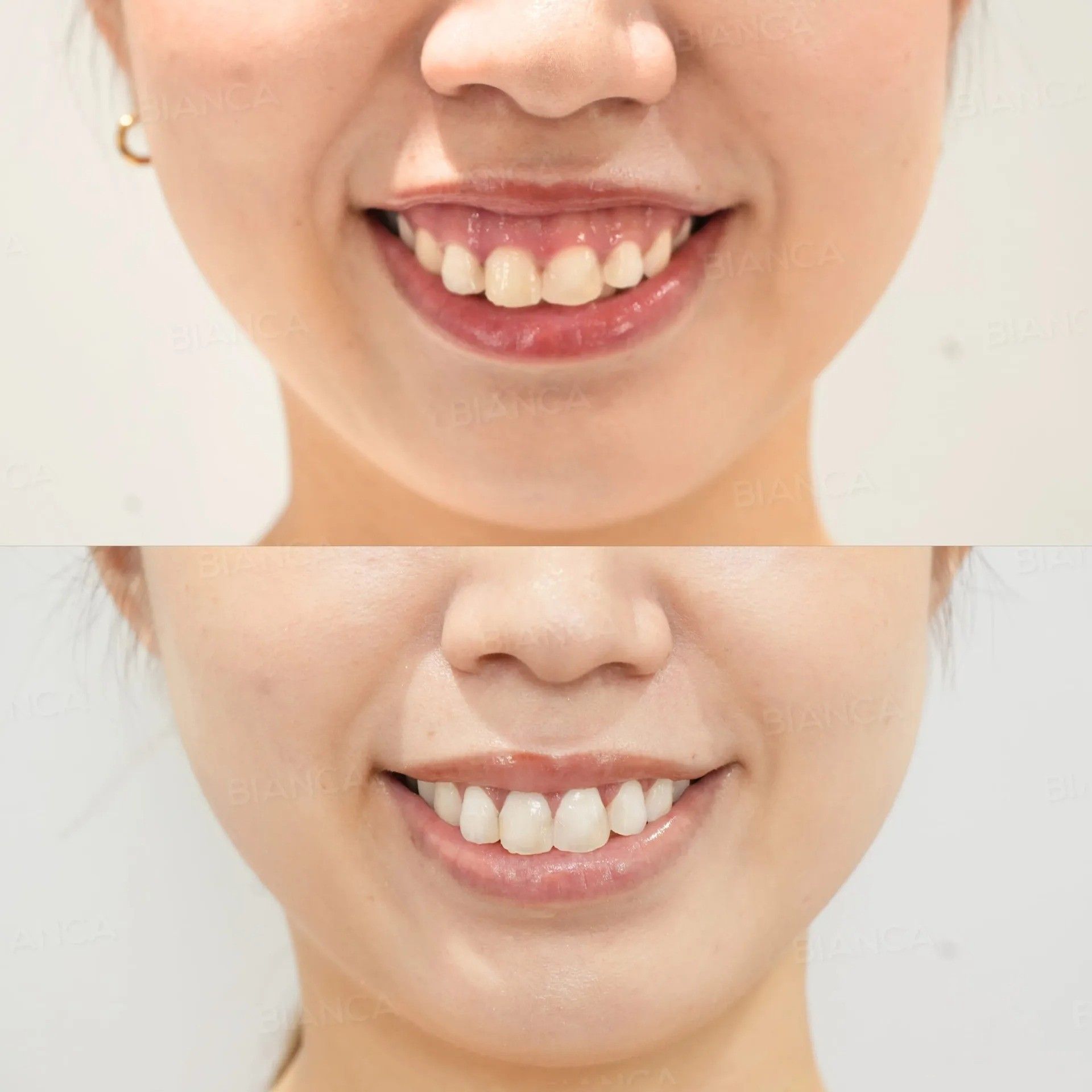
Esthetic crown lengthening
[Treatment Period and Number of Sessions] Top: Before treatment; Bottom: 1 month after treatment
[Side Effects and Risks] Infection, relapse, swelling, bleeding, pain, hypersensitivity, etc.
[Cost] 385,000 yen
*Please note that the information provided reflects the menu and prices at the time of the treatment. As the current offerings and prices may have changed, please contact us for details.
Depending on the position of the bone supporting the teeth, it may be necessary to adjust not only the gums but also the bone. To preserve the health of the periodontal tissues, careful judgment is required when determining the extent of the resection.
For more information.Procedure Page for Aesthetic Crown LengtheningPlease see.
What is the difference between lip repositioning and aesthetic crown lengthening?
The main difference between the two procedures is the approach taken to address the cause of the prominent gums.
| Comparison Items | Lip Repositioning | Esthetic crown lengthening |
|---|---|---|
| Target Areas | The mucous membrane on the inside of the upper lip | Gums and, if necessary, the surrounding bone |
| Main Purpose | Limit the extent to which the upper lip rises | Adjust the visible portion of the teeth |
| Conditions Under Consideration | The upper lip moves a lot | The gums cover a large portion of the teeth. |
| Estimated Surgery Duration | About 40 to 45 minutes | About 30 to 60 minutes |
| Key Risks | Swelling, pain, bleeding, infection, relapse, etc. | Swelling, bleeding, sensitivity, infection, etc. |
*Please note that surgery duration and postoperative recovery vary from person to person.
What if the problem stems from both the upper lip and the gums?
In addition to the gums covering the teeth, if you have a lot of movement in your upper lip, adjusting only one of these factors may not produce the desired results.
Although both procedures may be combined as needed, this is not a prerequisite. It is important to understand what each procedure changes.
Are there cases where surgery for a gummy smile isn't recommended?
If the position of the front teeth or the bite is the main cause, you may want to consider orthodontic treatment.
In cases where skeletal issues are significant, a specialized evaluation—such as for orthognathic surgery—may be necessary. Additionally, if there is inflammation in the gums, restoring oral health should be the top priority.
If the issue is caused by the muscles of the upper lip, Botox injections—which do not require an incision—are also an option.
The effects and duration areAn article explaining Botox injections for a gummy smileWe provide more details here.
What are the risks and chances of relapse associated with gummy smile surgery?
Surgical procedures may result in swelling, pain, bleeding, or infection. Furthermore, even with methods designed to produce long-term results, there is no guarantee that the results will be permanent.
Is there a chance the results will revert after surgery?
While lip repositioning can produce long-lasting results with a single procedure, the changes may gradually reverse after more than three years.
Even with aesthetic crown lengthening surgery, there are cases where the gum line recedes by about 20 to 30 percent over a period of approximately 10 years. Results vary from person to person, and there is no guarantee that the effects will last.
What about swelling and pain after surgery?
Lip repositioning may cause swelling or pain around the upper lip, while aesthetic crown lengthening may cause gum swelling, bleeding, or temporary tooth sensitivity.
Since post-operative care varies depending on the type of surgery, please consult with us in advance if you have work or important plans coming up.
Bianca Clinic's Approach to Gummy Smile Surgery
When performing gummy smile surgery, I focus more on how the mouth looks when the patient smiles than on exactly how many millimeters of gum tissue to remove.
For example, some people have gums that are usually hidden, but when they smile, their upper lip lifts significantly. In this case, simply adjusting the position of the gums may not do much to change the appearance that concerns them.
On the other hand, if your front teeth appear short, we’ll first focus on the balance between your teeth and gums.
At Bianca Clinic, we offer both lip repositioning—which adjusts the movement of the upper lip—and aesthetic crown lengthening—which corrects the position of the gums.
That said, it’s not as simple as just choosing one or the other.
What is the cause, and what kind of results are you hoping to achieve? I discuss these points with my patients before deciding on a treatment plan.
The key is to make adjustments to the areas that concern you while maintaining a natural appearance. If you’re unsure about undergoing surgery for a gummy smile, please let us know your preferences during your consultation.
Frequently Asked Questions About Surgery for a Gummy Smile
We’ll answer questions from people who are considering surgery to address their concerns about a gummy smile.
Q1. Can a gummy smile be completely corrected with surgery?
While surgery tailored to the specific cause may reduce gum exposure in some cases, there is no guarantee that the results will meet your expectations or that the effects will be long-lasting.
Q2. Will lip repositioning make it harder to smile?
To adjust the range of motion of the upper lip, you may experience a feeling of tightness or find it difficult to smile after surgery. We will develop a surgical plan to minimize these effects.
It is important to confirm these details before surgery, including how they might affect facial expressions.
Q3. Will surgery to correct a gummy smile leave scars on my face?
Since both procedures involve making an incision inside the mouth, there are usually no visible scars on the surface of the skin on the face. However, a wound will form inside the mouth, and changes may occur as it heals.
Q4. Can I have both surgeries at the same time?
They can be used together. However, this is not necessary for everyone.
We make our determination based on the condition of your gums and upper lip, as well as the changes you'd like to see.
Q5. Can I return to my original condition after surgery?
It is difficult to completely restore the excised tissue to its original state, and there are limitations on revision surgery, particularly in lip repositioning. It is important to make your decision only after you are fully satisfied with the information provided.
When undergoing surgery for a gummy smile, it is important to choose a method that addresses the underlying cause.
Surgery for a gummy smile serves different purposes depending on whether it involves adjusting the position of the gums or modifying the movement of the upper lip.
For those who are concerned about their upper lip lifting significantly when they smile, lip repositioning may be an option.
At BIANCA CLINIC, we evaluate the necessary treatments based on the overall balance of your mouth and the changes you desire.
▶Lip Repositioning: Case Studies and Treatment Details
▶Case Studies and Procedure Details for Aesthetic Crown Lengthening