column (e.g. in newspaper)
2026.10.18
What Works for Facial Sagging in Your 40s? Recommended Cosmetic Procedures and How to Choose the Right Treatment

Treatments for facial sagging in people in their 40s include non-invasive procedures such as HIFU (High-Intensity Focused Ultrasound) and Volnuma, as well as thread lifts and hyaluronic acid injections.
However, the most appropriate treatment is not determined by age alone.
It is important to identify the causes, such as loss of skin elasticity, sagging of cheek fat, and changes in bone structure or volume.
We’ll explain the changes that commonly occur in your 40s and how to choose cosmetic procedures that achieve a natural-looking result.
Why does facial sagging become more noticeable in your 40s?
Sagging in one’s 40s becomes more noticeable not only due to a loss of skin elasticity but also because of changes in factors such as fat and bone structure.
Even if you feel that “my jawline has become less defined recently” or “my nasolabial folds have deepened,” there isn’t necessarily just one cause.
First, let's take a look at what kind of changes are taking place.
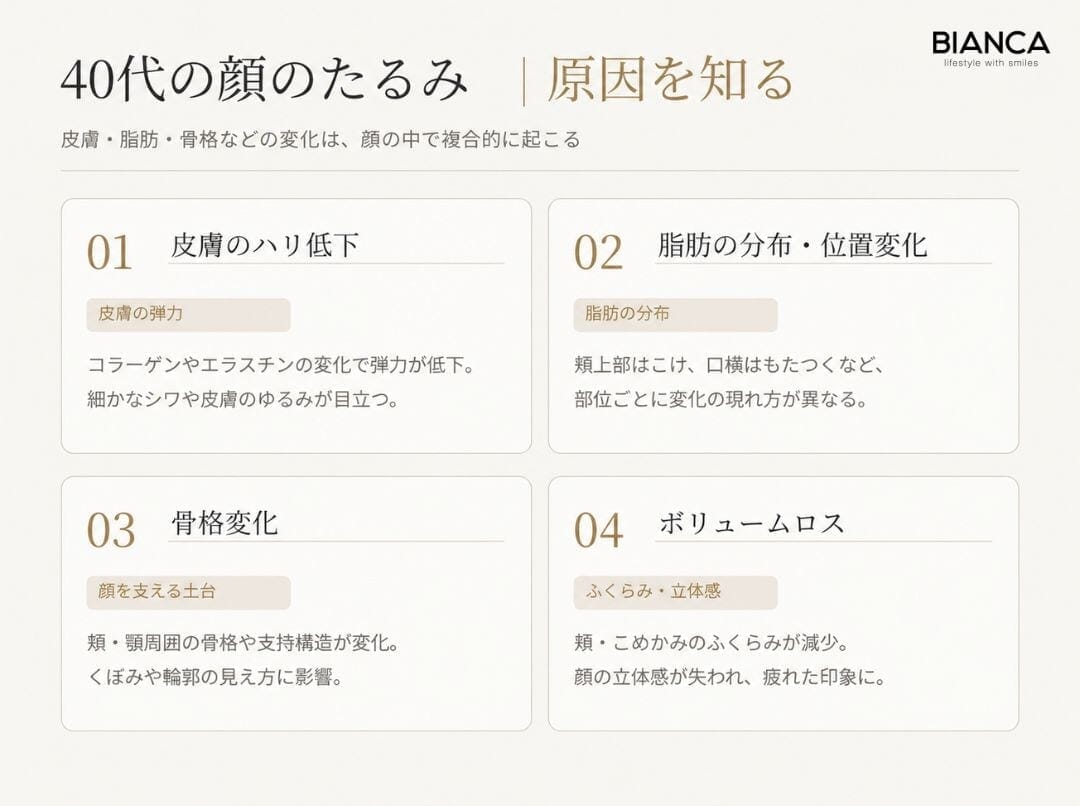
Loss of skin firmness
Collagen and elastin, which support the skin's firmness, undergo changes due to aging and exposure to ultraviolet rays.
As elasticity decreases, the skin on the cheeks begins to sag, and you may start to notice sagging around the mouth and along the jawline.
While dry skin can make fine lines more noticeable, moisturizing alone cannot lift deep-seated sagging.
If sagging skin is the main concern, we will consider treatments designed to tighten the skin.
Changes in Fat Distribution
Facial fat is distributed across multiple compartments known as fat compartments.
Because the changes associated with aging vary from one area to another, the entire face does not become plump or thin out evenly.
Even if you’ve gained weight since your younger days, the area around your mouth and jawline may become saggy, while the upper cheeks and temples may appear sunken.
It is important to assess not only the amount of fat, but also its distribution and location, as well as changes in the tissues that support it.
Skeletal Changes
The skeletal structure serves as the foundation that supports the skin and fat of the face.
As we age, changes in the shape of the bones around the jaw and cheeks can affect the structures that support the skin and fat, which may lead to noticeable hollows in the cheeks and sagging of the facial contours.
A person’s natural facial contours and the size of their jaw are also factors that influence the appearance of sagging.
In cases where skeletal structure plays a significant role, it may be difficult to achieve the desired results with tightening treatments alone.
Volume Loss
Volume loss refers to the loss of facial fullness and dimensionality that occurs with aging.
In particular, in the upper cheeks and temples, hollows can form due to fat loss, which can make a person look tired or older.
If the issue is caused by a lack of volume, a tightening treatment alone may not be enough to achieve sufficient improvement.
If necessary, we will consider methods to restore lost volume, such as hyaluronic acid injections.
In your 40s, it’s essential to focus not only on toning but also on maintaining a sculpted appearance.
Concerns About Sagging Skin Common in Your 40s
In your 40s, sagging skin tends to appear particularly along the jawline, around the mouth, in the nasolabial folds, and on the cheeks.
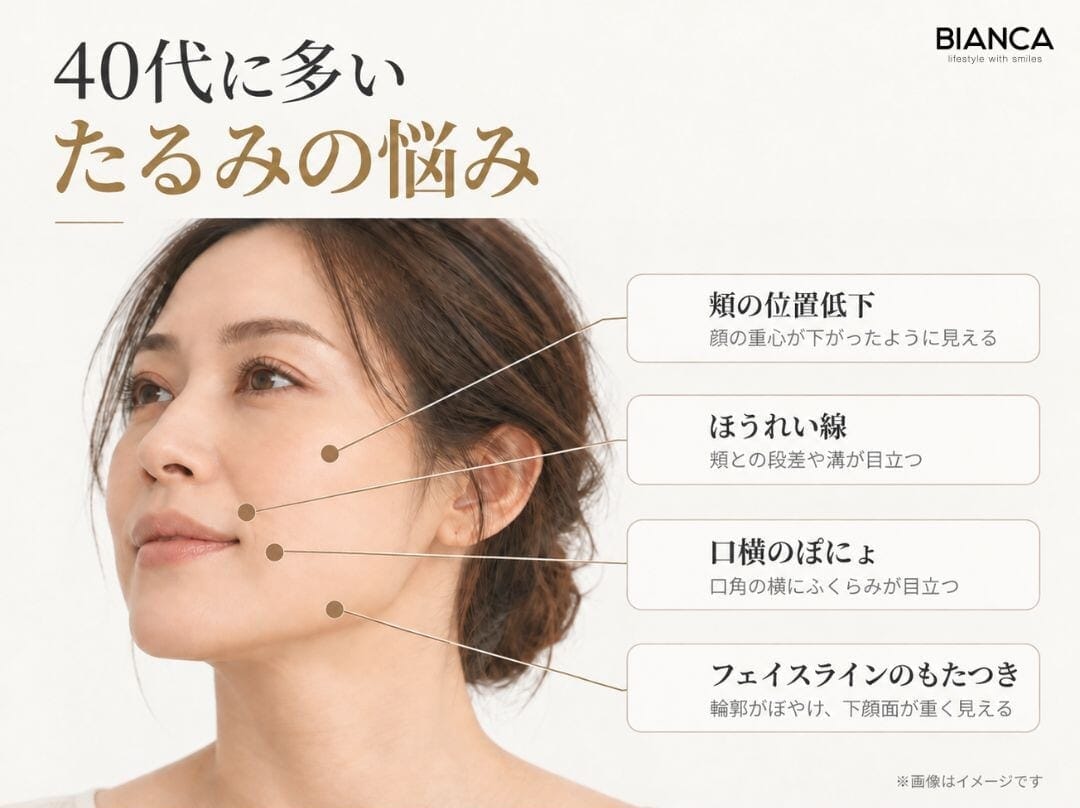
Some people begin to notice changes in the appearance of their face, such as “My face has become more square than it used to be” or “The corners of my mouth have drooped, making me look grumpy.”
Even if the affected area is the same, the causes can vary, so it’s important to determine not only “which area is causing concern” but also “why it looks that way.”
Let's take a look at the sagging concerns common among people in their 40s and their characteristics.
Facial line leaning
The jawline, which used to be well-defined, may become blurred, making the lower half of the face appear square.
In particular, when sagging is noticeable from the sides of the mouth down to the jawline, it results in what is commonly known as a “bulldog face.”
Even if it doesn't seem like much of a problem when viewed from the front, some people notice changes in their facial contours when they see a side-view photo.
Several factors contribute to this sagging, including loose skin, sagging cheek fat, and fat under the chin.
The chubby cheek next to my mouth
"Ponyo" refers to the puffy bulge that forms next to the corners of the mouth, making the mouth area look heavy.
As you enter your 40s, fat and sagging around the mouth—which you may not have noticed before—can start to become more noticeable.
When marionette lines—which run from the corners of the mouth down toward the jaw—are prominent, the mouth area can appear droopy, giving the impression that you’re in a bad mood.
The "ponyo" around the mouth is caused by factors such as cheek fat, sagging tissue, and loose skin.
In some cases, it is not simply a matter of increased fat, but rather changes in tissue position due to aging that are having an effect.
nasolabial folds
Many people feel that their nasolabial folds have become deeper than before or that the lines are noticeable even when they aren’t smiling.
Nasolabial folds are natural creases, but in your 40s, changes in the volume and position of your cheeks can make them appear more pronounced than before.
In particular, when a step forms between the fullness of the cheeks and the nasolabial folds, it can cast a shadow on the lower half of the face, giving the impression of fatigue.
Because this is influenced not only by a loss of skin elasticity but also by skeletal structure, fat distribution, and natural facial features, the degree to which it is noticeable varies from person to person.
Sagging Cheeks
As the fullness in the upper cheeks that was present in one’s youth begins to sag, it can make it appear as though the face’s center of gravity has shifted downward.
In particular, when the “Gorgon lines”—which run diagonally from under the eyes to the cheeks—are prominent, they can cast shadows on the cheeks, sometimes making you look tired.
The Gorgon Line is related to a lack of volume in the cheeks and the structures that support the skin and fat.
In addition, when volume accumulates around the sides of the mouth due to sagging cheeks, the lower half of the face can appear heavy.
Since the sagging of the cheeks and the hollowing of the cheeks can sometimes occur simultaneously, the condition cannot always be explained by a single cause.
Cosmetic Procedures to Consider for Sagging Skin in Your 40s
The main treatments for facial sagging in people in their 40s include HIFU, Voluma, thread lifts, and hyaluronic acid injections.
Each specializes in different types of concerns, and sometimes they are combined.
First, let’s review the basic functions of each treatment for sagging skin.
| treatment | Main Purpose | Status Under Review |
|---|---|---|
| HIFU | Tightens the tissue at the targeted depth | Mild to moderate sagging of the cheeks and jawline |
| volnema | Tightens the skin and subcutaneous tissue using high-frequency waves | Loss of skin firmness and sagging skin |
| Thread Lift | Physically lift the sagging tissue | Sagging of the cheeks and jawline |
| hyaluronic acid injection | Make Up for Lost Volume | Sunken Cheeks, Hollows, and Loss of Facial Contour |
*Results may vary from person to person. If there is a significant amount of excess skin, we may consider a surgical facelift or other options.
HIFU (High-Intensity Focused Ultrasound)
HIFUThis treatment uses high-intensity focused ultrasound to deliver heat to tissue at a targeted depth.
This procedure is considered when the goal is to tighten deep layers of tissue, and it can be performed without making an incision in the skin.
We assess the degree of sagging and the balance of the face, and adjust the depth, angle, and energy of the laser treatment for each specific area.
However, for patients with sunken cheeks, the treatment plan must be designed with the potential effects on fat in mind.
volnema
volnemaThis treatment aims to tighten the skin and subcutaneous tissue using the thermal effects of radiofrequency (RF).
This treatment is recommended for those concerned about a lack of firmness or mild to moderate skin laxity.
Thread Lift
A thread lift is a procedure in which medical-grade threads are inserted under the skin to lift sagging tissue in the cheeks and along the jawline.
At Bianca Clinic,The Original BIANCA LIFTWe carry products such as BIANCA LIFT W, Artemis Lift, and Tesu Lift, among others.
The type and number of threads, as well as the direction in which they are inserted, are determined based on the degree of sagging and the desired outcome.
In cases where there is a significant amount of excess skin, for example, it may be difficult to achieve sufficient improvement with sutures alone.
hyaluronic acid injection
hyaluronic acid injectionThis procedure is designed to restore volume to areas that lack it, such as sunken cheeks or hollows.
Although this procedure does not involve directly lifting the skin or tissue, it can help soften the appearance of aging by enhancing the facial contours.
At Bianca Clinic, we adjust the formulation and injection volume based on the patient’s cheek hollows, facial structure, and desired results.
On the other hand, you need to be careful to avoid unnatural bulges caused by using too much.
Which is better for people in their 40s: HIFU or Volnuma?
Even for people in their 40s, HIFU is a good option if the focus is on tightening deep tissues, while Volnuma is a good choice for improving skin firmness and addressing sagging skin.
However, you can't make a decision based solely on age, such as "If you're in your 40s, choose this one."
The appropriate treatment areas and methods vary depending on body fat, skin thickness, and whether or not there is hollowing of the cheeks.
For example, the key considerations differ between someone whose main concern is sagging along the jawline and someone who is concerned about thin cheeks and a lack of firmness.
It's important to distinguish between the areas you want to tone and the areas where you want to maintain volume.
Things to Watch Out For in Your 40s If You Have Sunken Cheeks
For people in their 40s with sunken cheeks, sagging treatments that focus on reducing fat may not always be the best option.
If you have little volume in your cheeks, depending on how you contour them, sunken areas or unevenness in your facial contours may become noticeable.
With HIFU in particular, it is important to carefully set the treatment depth, target area, and output level.
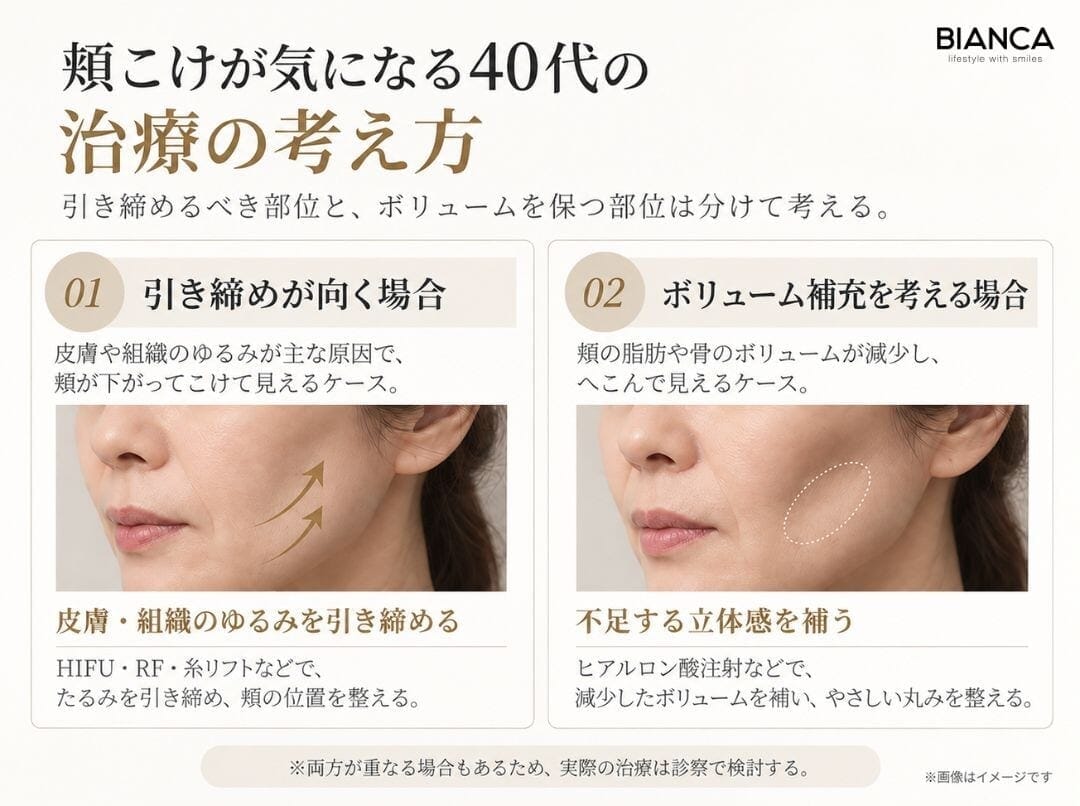
If you are concerned about sunken cheeks, we assess the area that is sunken and the area that is sagging separately.
This is because treatments designed to tighten sagging skin and those designed to restore lost volume have different objectives.
Is it too early to get a thread lift in my 40s?
It’s not necessarily too early to get a thread lift in your 40s.
Whether a thread lift is appropriate is determined not by age, but by the degree of sagging in the cheeks and jawline, as well as the condition of the skin and fat.
If there is a specific area of the body you wish to lift, it may be a candidate for a skin tightening treatment.
On the other hand, if the primary concern is loss of skin firmness, light-based treatments may be appropriate; if the cheeks are significantly sunken, we may consider injection treatments first.
Adding more thread doesn't necessarily guarantee the ideal result.
It is important to aim for a natural look, taking into account the direction of the lift and the three-dimensional contours of the face.
Key Points for Assessing Sagging Skin in People in Their 40s Using BIANCA
At Bianca Clinic, we offer recommendations that take into account not only the areas you're concerned about but also the overall balance of your face and the changes that come with age.
This is because sagging in one’s 40s is often characterized by a combination of loose skin, sagging fat, and a loss of volume.
Evaluate the skin, fat, and skeletal structure separately
At Bianca Clinic, we identify the causes of sagging in each specific area of the face and conduct a comprehensive evaluation of the condition of the skin, fat, bone structure, and supporting tissues.
For example, sagging around the mouth is caused by loose skin and tissue drooping, while hollows in the cheeks and temples are caused by a loss of fat.
In addition, even within the same area, multiple causes may overlap, so it is not possible to make a determination based on a single factor alone.
During the examination, we assess skin thickness, elasticity, fat content, bone structure, and the degree of tissue sagging.
We develop a treatment plan that takes into account your past treatment history, your desired results, and downtime, while considering the overall balance of your face.
Use "Tightening," "Lifting," and "Replenishing" appropriately
HIFU and radiofrequency (RF) are options for tightening the skin and tissues, while thread lifts are an option for lifting sagging tissues.
For a lack of volume in the cheeks, hyaluronic acid injections may be considered, and for severe sagging, a surgical approach may be considered.
At our clinic, we do not limit ourselves to a single treatment method; instead, we combine multiple treatments as needed to achieve the best possible results for each individual.
For an overview of sagging skin treatments and how to choose one based on the cause,The Complete Guide to Facial Sagging TreatmentsBut you can check it yourself.
Frequently Asked Questions About Sagging Skin Treatments for People in Their 40s
Q. What works best for sagging skin in your 40s?
A. The most appropriate treatment for sagging skin in your 40s depends on the cause and severity.
For sagging skin, we consider treatments such as HIFU and RF; for tissue ptosis, thread lifts; and for loss of volume, hyaluronic acid injections.
Q. For people in their 40s, which is better: HIFU or Voluma?
A. HIFU is a good option for deep tissue tightening, while Volnuma is a good option for improving skin firmness and treating sagging skin.
Since factors such as body fat and whether or not someone has sunken cheeks also play a role, you can't judge who looks better or worse based on age alone.
Q. Is it too early to get a thread lift in my 40s?
A. It’s not necessarily too early to get a thread lift in your 40s.
This procedure may be an option if you're concerned about sagging cheeks or a sagging jawline, but if skin laxity is your main concern, a different treatment may be more appropriate.
Q. How often should I get treatments for sagging skin in my 40s?
A. The appropriate interval between treatments varies depending on the treatment method and the patient's progress.
We don’t perform HIFU, RF, and thread lifts at the same frequency; instead, we make that decision based on how the effects are manifesting and the condition of your skin.
Q. Can I get HIFU treatment even if my cheeks are sunken?
A. Even if you have sunken cheeks, HIFU may still be a suitable treatment option.
However, if the hollows in your cheeks are caused by a loss of fat, HIFU cannot correct them.
It is important to evaluate sagging and loss of volume separately and choose the appropriate treatment.
For facial sagging in your 40s, choose a treatment tailored to the cause
Sagging in one’s 40s is caused not only by loose skin but also by the location and amount of fat, bone structure, and the three-dimensional contours of the cheeks.
It is important to choose a treatment that addresses the underlying cause from options such as HIFU, Voluma, thread lifts, and hyaluronic acid injections.
At BIANCA CLINIC, we offer treatments tailored to each patient’s individual condition and preferences, with the goal of achieving a natural look.
If you’re in your 40s and have started to notice changes in your jawline or around your mouth, please feel free to consult with us.
▷View a list of anti-aging treatments for sagging skin and facial lifting, along with case studies