column (e.g. in newspaper)
2026.10.04
What Is Ham-Eye Correction? How Eyelid Skin Resection Works and What You Need to Know

As a board-certified plastic surgeon by the Japanese Society of Plastic and Reconstructive Surgery, he has been engaged in a wide variety of periocular surgeries at university hospitals. Based on his solid anatomical knowledge and suturing skills, he is in charge of a wide range of surgeries around the eyes including sub-brow incisions and blepharoplasty incisions, as well as hyaluronic acid injections, Botox injections, and thread lifts. We also accept insurance coverage for droopy eyelids and inner eyelashes. We value natural and elegant results, and are known for our attentive counseling that attends to the patient's feelings.
"My eyes look heavy even though I got double eyelids," or "I like my current double eyelid crease, but I'm concerned about the skin covering my eyelashes."
When correcting a "ham-like" appearance, we take both your preferences and the underlying causes of the bulge into consideration.
Even if they look similar, that doesn't necessarily mean the required corrections are the same.
In this article, Yumi Hattori, a board-certified plastic surgeon at BIANCA CLINIC and a member of the Japanese Society of Plastic and Reconstructive Surgery, explains the principles behind correcting “ham eyes” and discusses one of the treatment methods: upper eyelid skin excision.
What Is "Ham Eye Correction"? A procedure that reshapes the eye area based on the cause of puffiness
"Ham-eye correction" is a surgical procedure that reshapes the eye area based on the cause of the double eyelid bulge.
The term “ham-eye correction” does not refer to a single, specific surgical procedure.
There are ways to adjust the overhang of the skin and to reevaluate the position of the double eyelid and how deeply it sits.
What exactly is “ham eye” in the first place?
"Ham-me" is a colloquial term for a condition in which the area between the double eyelid line and the eyelashes appears plump and raised.
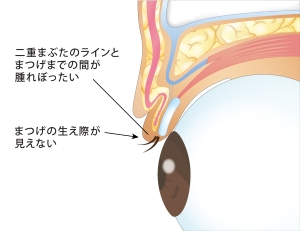
It is called this because the double line cuts into the surface, creating a bulge below it, which resembles a ham tied with string.
This is not a medical diagnosis.
The swelling may hide the lash line or make the crease in double eyelids more noticeable.
However, having a wide double eyelid alone does not necessarily mean you have "ham eyes"; the thickness of the skin and muscles, as well as the depth of the double eyelid, also affect how they appear.
Superficial Skin Resection Above the Eyelashes Using the Ham-Type Technique
At Bianca Clinic, we perform “epicanthoplasty (correction of epicanthus)” as one of the procedures to correct epicanthus.
This procedure involves removing excess skin near the lash line to correct drooping and bulging.
This can also be an option for those who say, “I want to keep my current double eyelid line, but I’m concerned about the puffiness near my lashes.”
However, even if something looks similarly swollen, there isn't necessarily just one cause.
If the position of the double eyelid, excessive creasing, or tissue adhesions are factors, it may be necessary to adjust the fixation in addition to excising the skin.
Therefore, during the consultation, we will discuss the best correction method while confirming the cause of the swelling and the shape of the double eyelid the patient wishes to maintain.
Why is it important to identify the cause when correcting a "ham eye"?
The fullness of the lower eyelids is influenced not only by the thickness of the skin and fat but also by the width of the double eyelid crease and the depth of the crease.
Therefore, after identifying the cause of the bulge, we consider whether to adjust the skin or revise the position and fixation of the double eyelid.
Why does the swelling stand out after double eyelid surgery?
Double eyelids are formed by the connection between the skin of the eyelid and the deep tissues that work to open the eye.
When you open your eyes, the skin is pulled inward, creating a crease.
Even in double eyelid surgery, this connection is created by securing the sutures and tissue.
For people who naturally have thick eyelid skin or orbicularis oculi muscles (the muscles around the eyes), the bulge near the eyelashes may be more noticeable.
In cases like this, even though the patient underwent double eyelid surgery hoping to achieve a beautiful eye area, they may feel that “their eyelids actually look puffier.”
This is because drawing the double line high up can create more space between the line and the eyelashes, which may emphasize the natural thickness of the lashes.
Post-procedure adhesions can also contribute to double eyelid creases.
In some cases, "adhesions" may be a factor in the indentation that occurs after double eyelid surgery.
Adhesions refer to the sticking together of tissues.
This connection is necessary to maintain the double crease, but depending on where it’s attached and how firmly, the double line may cut deeply into the skin, making the bulge underneath more noticeable.
In such cases, we will consider methods for separating the adhered tissues and adjusting the double fixation.
However, if it’s been only a short time since the procedure, the swelling might be making your eyes look like ham eyes.
Even if you find yourself wondering, “Will it end up looking like this?” that doesn’t necessarily mean you need to make changes right away.
First, have the medical facility where you received the treatment check how the swelling is subsiding and whether there are any changes in the swelling.
How is drooping eyelids corrected with an upper eyelid skin excision?
An upper eyelid skin excision is a procedure in which an incision is made near the lash line to remove excess skin.

If excess skin is the main cause, you can consider a correction procedure that makes use of your existing double eyelid crease.
Smooth the skin on the side of the double line closest to the eyelashes
"Eyelashes" refer to the hairs on the eyelids. In an upper eyelid skin excision, an incision is made along the eyelash line, and the excess skin above it is removed.
Rather than creating a new double line, this treatment focuses on addressing the overlap and bulging near the lash line.
In some cases, it is possible to make adjustments without significantly altering the double eyelid line itself; however, if the amount of skin covering the eyelid changes, the appearance of the double eyelid will also change.
It is important that you share both your desire to “keep your current double eyelid line” and “the look you’re aiming for.”
When it comes to skin, more isn't necessarily better.
If too much skin is removed, it may become difficult to close your eyes.
In revision surgery, in particular, it is essential to confirm how much skin was removed during the previous procedure and how much remains now.
Whether or not tissues other than the skin are treated also depends on the cause and the treatment method.
The bulge in the hamstrings isn't caused solely by excess fat.
Since the position of the double eyelid or how deeply it is creased can sometimes be a factor, it’s important to consider a correction method tailored to the underlying cause rather than simply removing the bulging area.
What are the pros and cons of ham-eye correction?
By making adjustments tailored to the specific cause, you can correct bulges and indentations.
However, the scope of treatment varies depending on the procedure, and there are risks associated with scarring, asymmetry, and the ability to open and close the eyes.
Changes You Can Expect from Upper Eyelid Skin Resection
An upper eyelid skin excision procedure corrects excess or overhanging skin along the lash line.
You can also expect to see a change where the hairline becomes more visible as the skin covering the eyelashes thins.
The main benefits are as follows:
- Allows for direct adjustment of excess skin or folds along the lash line
- Depending on the situation, we may be able to consider making adjustments without significantly altering the existing double lines.
- Since the incision is made close to the eyelashes, the scar is less noticeable.
Risks of Upper Eyelid Skin Excision
On the other hand, there are the following limitations and risks.
- If the main causes are the position of the double eyelid or deep adhesions, this procedure alone may not be sufficient to address the issue.
- The way scars heal varies from person to person.
- Swelling, bruising, infection, discomfort in the eyelids, and asymmetry may occur.
- There is a risk of incomplete eyelid closure (inability to fully close the eyes) and dry eye, among other conditions.
Even if it is only a minor adjustment, this procedure involves an incision.
Let’s take a look at what kind of changes we can expect, as well as the areas where improvement may be difficult and any potential risks.
Frequently Asked Questions About Ham Eye Correction
We’ll answer your questions about correcting “ham eyes,” such as whether it’s possible to preserve the double eyelid line or if fat removal alone is sufficient.

Q. Does "ham-eye correction" mean the same thing as "upper eyelid skin excision"?
A. They are not the same. "Ham-eye correction" is a general term for procedures that correct the bulge between the double eyelid crease and the eyelashes, and upper eyelid skin excision is one such method.
In some cases, it may be necessary to adjust the overhang of the skin, while in others, it may be necessary to reassess the position of the double eyelid, its fixation, or any adhesions.
Q. Is it possible to correct "ham eyes" while keeping my current double eyelids?
A. If excess or overhanging skin near the eyelashes is the main cause, we can consider a correction procedure that preserves your existing double eyelid crease through an upper eyelid skin excision.
However, since the appearance of your double eyelids may change as the amount of skin covering them decreases, we’ll work with you to determine your desired outcome by discussing “which aspects of your current double eyelids you’d like to preserve” and “which areas of fullness concern you.”
Q. Can't the "ham-shaped" correction be done just by removing fat?
A. Fat removal alone may not be sufficient.
Factors such as the thickness of the skin and orbicularis oculi muscle, the height of the double eyelid, and fixation or adhesions may also play a role.
If you remove fat without first determining whether it is the cause, the bulge that concerns you may not necessarily improve; therefore, it is important to identify the cause first.
Q. Can I consider ham-eye correction even if I haven't had double eyelid surgery?
A. Even if you haven't had double eyelid surgery, you are welcome to consult with us.
This is because, depending on the natural thickness of the eyelids and the degree of skin sagging, the eyes may appear droopy.
During the consultation, we’ll examine the overhanging skin and eyelid movement, and work with you to determine how to address any areas of concern, including through upper eyelid skin excision.
Q. Can I get eyelid correction surgery even immediately after double eyelid surgery?
A. Shortly after surgery, swelling may cause the eyes to look like "ham eyes."
Rather than deciding on a correction right away, it’s important to monitor the time elapsed since the procedure and any changes in the swelling.
Please consult with the medical facility where you received treatment to determine whether a correction is necessary and when to discuss it.
When correcting "ham eyes," consider the double eyelid you want to keep and the puffiness you're concerned about separately.
When undergoing eyelid surgery, it’s important to choose a method that addresses the cause of the puffiness and to communicate which parts of your current eye area you’d like to preserve.
Eyelid skin excision is one option for correcting skin overhang or bulging on the side of the eyelashes.
If the position of the double eyelid or adhesions are a factor, a different approach may be necessary.
When consulting with BIANCA CLINIC, please let us know your preferences, such as “I’d like to reduce the bulge on the lash line” or “I’d like to keep my current double eyelid crease.”
Let's discuss the parts you're concerned about and the parts you want to keep, and work together to figure out how to make the revisions.
▶ Procedure Page for Eyelid Skin Resection (Hamm Eye Correction)