column (e.g. in newspaper)
2026.10.05
What Is the Difference Between Jarnavax and Opioid Pain Relievers? A Comparison of Mechanisms of Action and Addiction Potential

He is also a leader outside of the clinic, serving as president of Creation Labo, producer of cutting edge, and board member of the Japanese Society of Cosmetic Internal Medicine. She is also active as a leader outside the clinic, serving as the president of Creation Labo, producer of Cutting Edge, and board member of the Japanese Society of Aesthetic Internal Medicine. She aims to go beyond satisfaction to inspiration. He is a game changer in the world of aesthetic medicine, proposing Lifestyle Beauty that transcends the boundaries of aesthetic medicine.
Although both Jarnavax and opioid analgesics are medications used to relieve pain, they work differently. Jarnavax is a non-opioid analgesic that targets the NaV1.8 channel in peripheral sensory neurons.
Although both Jarnavax and opioid analgesics are medications used to relieve pain, they work differently. Jarnavax is a non-opioid analgesic that targets the NaV1.8 channel in peripheral sensory neurons.
Some of you may be wondering, “Isn’t Jarnavax an opioid?” “Is it addictive?” “How is it different from traditional pain relievers?”
JOURNAVX™ is a medication that received approval from the U.S. FDA in January 2025 as a non-opioid analgesic for the treatment of moderate-to-severe acute pain in adults. [1]
At BIANCA CLINIC, we believe that understanding where and how medications work is essential when considering how to manage pain in aesthetic medicine.
In this article, we will explain the mechanisms of action, addictive potential, and principles of pain relief for Jarnavax and opioid analgesics, based on an understanding of how pain is transmitted.
The Difference Between Jarnavax and Opioid Pain Relievers
The main difference between Journalax and opioid pain relievers lies in the sites they target and the mechanisms by which they relieve pain.
| Comparison Items | Journalax | Opioid pain relievers |
| Primary targets | NaV1.8 in peripheral sensory neurons | Opioid receptors* in the brain, spinal cord, and other areas |
| How to Manage Pain | Suppresses the transmission of pain signals from the periphery to the spinal cord and brain | Suppressing pain signal transmission and perception |
| Classification as a Controlled Substance in the United States | Not specified | Morphine, oxycodone, hydrocodone, and similar substances are subject to regulation. |
| About Dependence and Abuse | The FDA review found no evidence of concerns regarding abuse or physical dependence. | There are risks such as dependence, abuse, and overdose |
*Opioid receptors are found not only in the brain and spinal cord but also in the peripheral nervous system.
Jarnavax acts on the NaV1.8 channel in peripheral sensory neurons. Opioid analgesics, on the other hand, act on opioid receptors found in the brain, spinal cord, and periphery.
This does not mean that “because it is a non-opioid, it is always safe” or that “it is superior to opioids.” Since their mechanisms of action and risks differ, the choice must be made based on the severity of the pain, the treatment plan, and the patient’s condition.
How is pain transmitted to the brain in the first place?
Information generated by stimulation of the skin or tissues is transmitted from the peripheral nerves to the spinal cord and then to the brain, where it is perceived as “pain.”
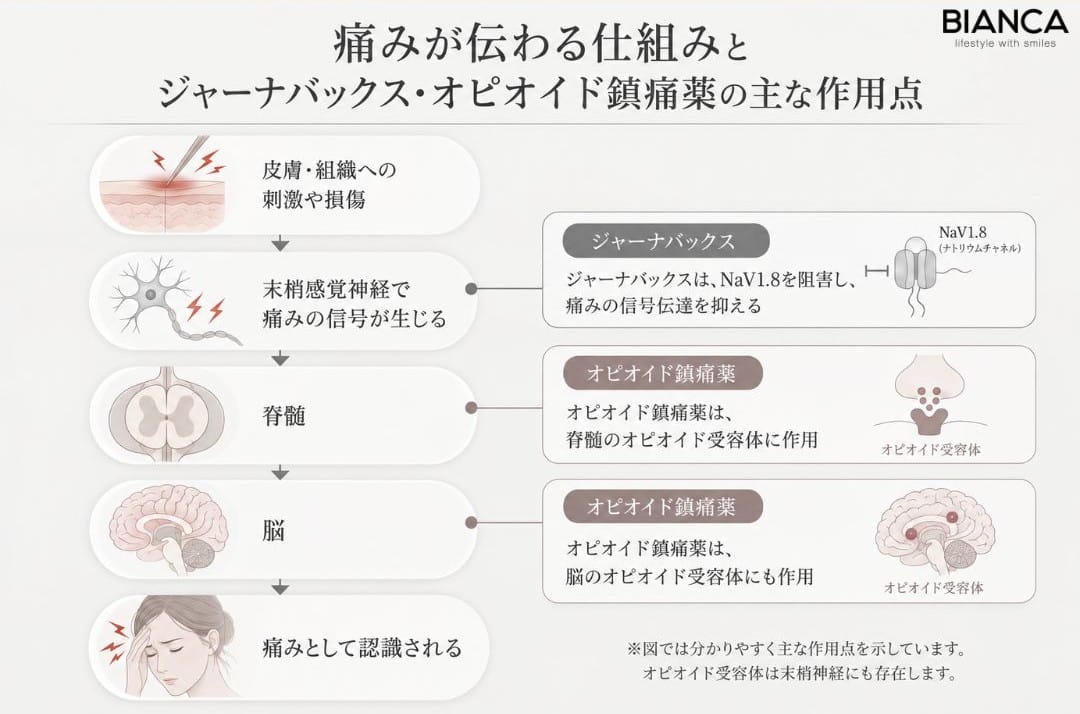
As such, Journalax and opioid analgesics act on the pain transmission pathways through different mechanisms.
How do the mechanisms of action of Journalax and opioid analgesics differ?
While Journalax targets NaV1.8 in peripheral sensory neurons, opioid analgesics suppress pain through opioid receptors.
Jarnavax inhibits NaV1.8 in peripheral nerves.
The generic name for Jarnabax is suzetrigine, which selectively inhibits the voltage-gated sodium channel NaV1.8.
NaV1.8 is found in peripheral sensory nerves that transmit pain and serves as one of the key “pathways” through which nerves transmit electrical signals. By inhibiting the function of NaV1.8, Jarnavax suppresses the transmission of pain signals from the peripheral nerves to the spinal cord and on to the brain.
For more information on the features of Journalax itself, see the related article “What Is JOURNAVX™? An Explanation of This Non-Opioid Analgesic Gaining Attention in Aesthetic Medicine Pain Management" explains this in detail.
Opioids act on opioid receptors.
Opioid analgesics act on opioid receptors found in the brain, spinal cord, and peripheral nerves.
They exert an analgesic effect by suppressing the transmission of pain signals from the spinal cord to the brain and by reducing the perception of pain in the brain. Opioid receptors are also present in peripheral nerves.
In other words, the key difference is that while Jarnavax targets a specific channel called NaV1.8 in peripheral nerves, opioid analgesics regulate pain transmission and perception through opioid receptors.
How Do the Risks of Dependence and Abuse Differ Between Journalax and Opioid Pain Relievers?
There are also differences in how Journalax and opioid analgesics are classified in terms of dependence and abuse.
Jarnavax is not classified as a controlled substance in the United States.
During the FDA's approval review, JarnaVax was assessed as posing no risk of abuse or physical dependence, and it was not classified as a controlled substance in the United States. [2]
Controlled substances are drugs that are subject to special regulation in the United States due to the potential for abuse or dependence.
However, the fact that a substance is “not a controlled substance” does not mean it is “free of side effects or risks.” Furthermore, since approval in the United States is limited to moderate-to-severe acute pain in adults, it cannot be uniformly concluded that there is no risk of dependence even with long-term use. [2]
Opioids carry risks such as dependence and abuse.
Opioid analgesics are medications used for the management of moderate to severe pain; they are sometimes used to treat acute pain, such as that experienced after surgery or following a trauma.
On the other hand, prescription opioids carry risks such as dependence, abuse, and overdose. The CDC* also states that prescription opioids pose serious risks, including dependence and overdose. [3]
With continued opioid use, “tolerance” may develop, making it harder for the same dose to produce the desired effect. If you suddenly stop taking the medication after your body has become accustomed to it, you may experience withdrawal symptoms such as anxiety, sweating, and nausea. Furthermore, it can become difficult to control your own use of the medication, which may lead to a situation where you seek it more than necessary.
Rather than simply thinking, “I should avoid it because it’s an opioid,” it is important to use it after carefully weighing the necessary pain relief against the risks.
*CDC…Centers for Disease Control and Prevention (U.S. Centers for Disease Control and Prevention). It is a U.S. government agency responsible for public health.
Is There a Difference in Pain Relief Between Journalax and Opioid Pain Relievers?
It is not possible to compare the effectiveness of Journalax and opioid analgesics using a single measure such as “which is stronger.”
In clinical trials, it has also been compared with opioid-containing analgesics.
In the Phase 3 clinical trials used to support FDA approval of Jarnavax, the two primary trials evaluating efficacy compared Jarnavax, a placebo*, and a hydrocodone-acetaminophen combination for the treatment of acute pain following abdominoplasty and bunion surgery. [1][4]
Hydrocodone is an opioid analgesic that is used in combination with acetaminophen.
Jarnabax demonstrated analgesic efficacy compared to placebo in the primary endpoint. However, these results do not support the conclusion that “Jarnabax is more potent than opioids” or that “it can completely replace opioids.”
Subsequently, a Phase 4 trial focused on cosmetic and reconstructive surgery has also examined pain management strategies that combine multiple analgesic methods, including Jarnavax. In a trial involving 99 participants, it was reported that 90.9% did not use rescue opioids until the end of the treatment period. [5]
However, this study did not directly compare Jarnavax alone with other treatments. Therefore, it is not possible to conclude that “using Jarnavax eliminates the need for opioids.”
*Placebo… A medication that contains no active ingredients and serves as a control to evaluate the effects of the investigational drug itself.
Don't choose pain relievers based solely on their "strength"
When treating pain, we take into account the cause and severity of the pain, the details of the treatment or surgery, the patient’s medical history, and any other medications being taken.
In addition, rather than relying on a single medication, we sometimes manage pain by combining analgesics and anesthetic methods that act on different sites or through different mechanisms. For example, we combine acetaminophen, NSAIDs, and local anesthetics depending on the patient and the procedure being performed.
It is important to choose the appropriate method based on the level of pain relief needed and the risks associated with each option.
How Do You Differentiate Between Jarnavax and Opioid Pain Relievers?
The decision on whether to use Journalax or opioid pain relievers depends on factors such as the severity and cause of the pain, the type of procedure or surgery, and the patient’s condition.
In cosmetic medicine, pain is often managed by combining multiple methods—such as topical anesthesia, local anesthesia, and intravenous anesthesia—in addition to oral pain relievers. Overseas, research is being conducted on pain management strategies for cosmetic and reconstructive surgery that involve the preoperative use of Jervax in combination with other pain relief methods.
Therefore, it is not simply a matter of choosing between Jarnavax and opioid analgesics. The choice should be made based on the level of pain relief required and the nature of the procedure.
It is important not to assume across the board that “using Jarnavax eliminates the need for intravenous anesthesia” or that “Jarnavax is always the preferred alternative to opioids.”
At Bianca Clinic, we evaluate the necessary pain management options while taking into account the specifics of your treatment and your condition. If you have any concerns about pain, please let us know during your consultation.
Important Points to Keep in Mind When Using Journalax
Although Jarnavax is a non-opioid pain reliever, it is not free of side effects or drug interactions.
According to the U.S. FDA’s package insert, side effects reported with relatively high frequency include pruritus (itching), muscle spasms, elevated CK (creatine kinase) levels, and rash. Additionally, there are interactions with certain medications, and patients are advised to avoid foods and beverages containing grapefruit. [4]
Although Jarnavax is approved in the United States, it is not approved as a drug in Japan. You should inform your doctor of your medical history and any medications you are currently taking, and consider using this medication only after a proper medical evaluation.
Frequently Asked Questions

Q. Is Jarnavax an opioid?
A. No. Jarnavax is a non-opioid analgesic that targets NaV1.8. Its mechanism of action differs from that of opioid analgesics, which target opioid receptors.
Q. Is Journalax a narcotic?
A. Jarnavax is not a narcotic. It is a non-opioid analgesic and is not classified as a controlled substance in the United States. It differs from opioid analgesics such as morphine and oxycodone in terms of its mechanism of action and regulatory status.
Q. Is there a risk of dependency with JournalBax?
A. During the FDA’s approval review, no concerns regarding abuse or physical dependence on JarnaVax were identified. [2] However, this does not mean that the potential for dependence can be ruled out for all methods of use.
Q. How do Journalax and intravenous anesthesia differ?
A. Jarnavax is an oral pain reliever that suppresses the transmission of pain signals; it is not a medication primarily intended to induce sleep.
On the other hand, intravenous anesthesia is a method of administering anesthetics and sedatives through a vein to regulate the level of consciousness. The two are not simply interchangeable; the appropriate method is selected based on the required level of sedation and analgesia.
Q. Is Jarnavax an NSAID?
A. Jarnavax is not an NSAID. While NSAIDs primarily inhibit COX to suppress the production of substances involved in inflammation and pain, Jarnavax targets NaV1.8, so its mechanism of action is different.
Jurnabax and opioids work differently to relieve pain
Jarnavax is a non-opioid analgesic that selectively inhibits NaV1.8 in peripheral sensory neurons to suppress pain signal transmission. In contrast, opioid analgesics act on opioid receptors to regulate pain transmission and perception.
The FDA review found no evidence of abuse or physical dependence associated with Jarnavax, and it is not classified as a controlled substance in the United States. However, the fact that it is a non-opioid does not mean it is free of side effects or risks.
Pain management in cosmetic medicine varies depending on the procedure and the patient's condition. At BIANCA CLINIC, you can consult with us in advance about any concerns you may have, including anxiety about pain.
If you have any concerns about pain during or after the procedure, please discuss them with your doctor during your consultation.
References
[1] U.S. Food and Drug Administration, “Drug Trials Snapshots: JOURNAVX”
[2] U.S. Food and Drug Administration: “Integrated Review: JOURNAVX (suzetrigine)”
[3] Centers for Disease Control and Prevention, “About Prescription Opioids”
[4] U.S. Food and Drug Administration, “JOURNAVX Prescribing Information”
[Medication to Be Used] JOURNAVX™ (oral)
[Cost] 9,900 yen per tablet
[Risks, Side Effects, etc.] Itchiness, muscle cramps, elevated CK (creatine kinase) levels, and rashes may occur. Additionally, there are interactions with certain medications, and concomitant use with potent CYP3A inhibitors is contraindicated. While taking this medication, you must avoid foods and beverages containing grapefruit. Patients with severe liver dysfunction should avoid using this medication.
【Important Notes Regarding Unapproved Medicines】
・JOURNAVX™ (generic name: suzetrigine), which is used in this procedure, is an unapproved drug that has not received regulatory approval in Japan.
・In the United States, it received FDA approval in January 2025 as a non-opioid analgesic for the treatment of moderate-to-severe acute pain in adults.
・The pharmaceuticals used in this treatment are imported through the personal import process under a physician’s supervision. For details, please refer to the Ministry of Health, Labor and Welfare’s “Information on Pharmaceuticals and Other Products Requiring Caution in Personal Imports.”
https://www.yakubutsu.mhlw.go.jp/individualimport/purchase/index.html
・There are no approved drugs in Japan with the same active ingredient and the same indication.
・Since this product has not been approved in Japan, its safety and efficacy may not have been sufficiently confirmed in Japan.
・In the unlikely event that serious side effects occur, you may not be eligible for the national relief program (the Pharmaceutical Side Effect Victim Relief Program).