column (e.g. in newspaper)
2026.11.11
Who Is a Good Candidate for Lip Repositioning? A Dentist Explains Who Is Suitable for Gummy Smile Correction

He is a specialist in the treatment of gummy smiles, one of the most sensitive areas of esthetic dentistry. He practices, lectures, researches, and writes articles in Japan and abroad. He is the only Japanese dentist who is certified as an implant specialist in both the U.S. and Europe. He uses a multifaceted approach, including surgical treatment, orthodontics, and Botox injections, to address all concerns about the mouth. He is a dentist who can help patients achieve their “desired smile.

Lip repositioning is recommended for people whose gums are visible when their upper lip lifts significantly. However, since the position of the teeth and gums, as well as the patient’s bone structure, also play a role, a dental examination is necessary to determine suitability.
"My gums show when I smile—would lip repositioning be right for me?" "I'd like to explore options other than Botox injections."
We sometimes receive inquiries like this from people who want to correct their gummy smile.
However, even if the gums are visible in the same way, the underlying causes can vary from person to person. To determine whether lip repositioning is appropriate, it is necessary to consider not only the movement of the upper lip but also the condition of the teeth and gums.
In this article, BIANCA CLINIC will explain the characteristics of people who are good candidates for lip repositioning and the key factors we consider during consultations.
Who is lip repositioning suitable for?
For people whose upper lip lifts high when they smile, exposing more of their gums, lip repositioning (upper lip mucosal resection) may be an option.
This procedure involves removing and suturing a portion of the mucous membrane on the inside of the upper lip to adjust the range of upward movement of the lip, with the goal of correcting a gummy smile.
To learn how lip repositioning adjusts the movement of the upper lip, as well as how the procedure works and the expected results,An article providing a detailed explanation of the characteristics of lip repositioningWe introduce it here.
When it comes to lip repositioning, you cannot determine whether the procedure is appropriate based solely on the number of millimeters of gum tissue that is visible.
This is because other factors—such as the teeth, gums, and the bone structure of the upper jaw—may also be involved.
So, in what kinds of situations—whether you have concerns or specific wishes—might this be an option?
Indications for Lip Repositioning Based on Concerns and Desires
People often consider lip repositioning because they want to improve the appearance of their mouth when they laugh heartily, or because they’re looking for alternatives to Botox injections.
What kind of results you’re looking for is also an important factor to consider when choosing a treatment.
When I smile, my upper lip lifts high, making my gums stand out.
Normally, it doesn't bother me that much, but when I laugh really hard, my upper gums look really wide.
If that sounds like you, it may be related to the muscles that lift your upper lip.
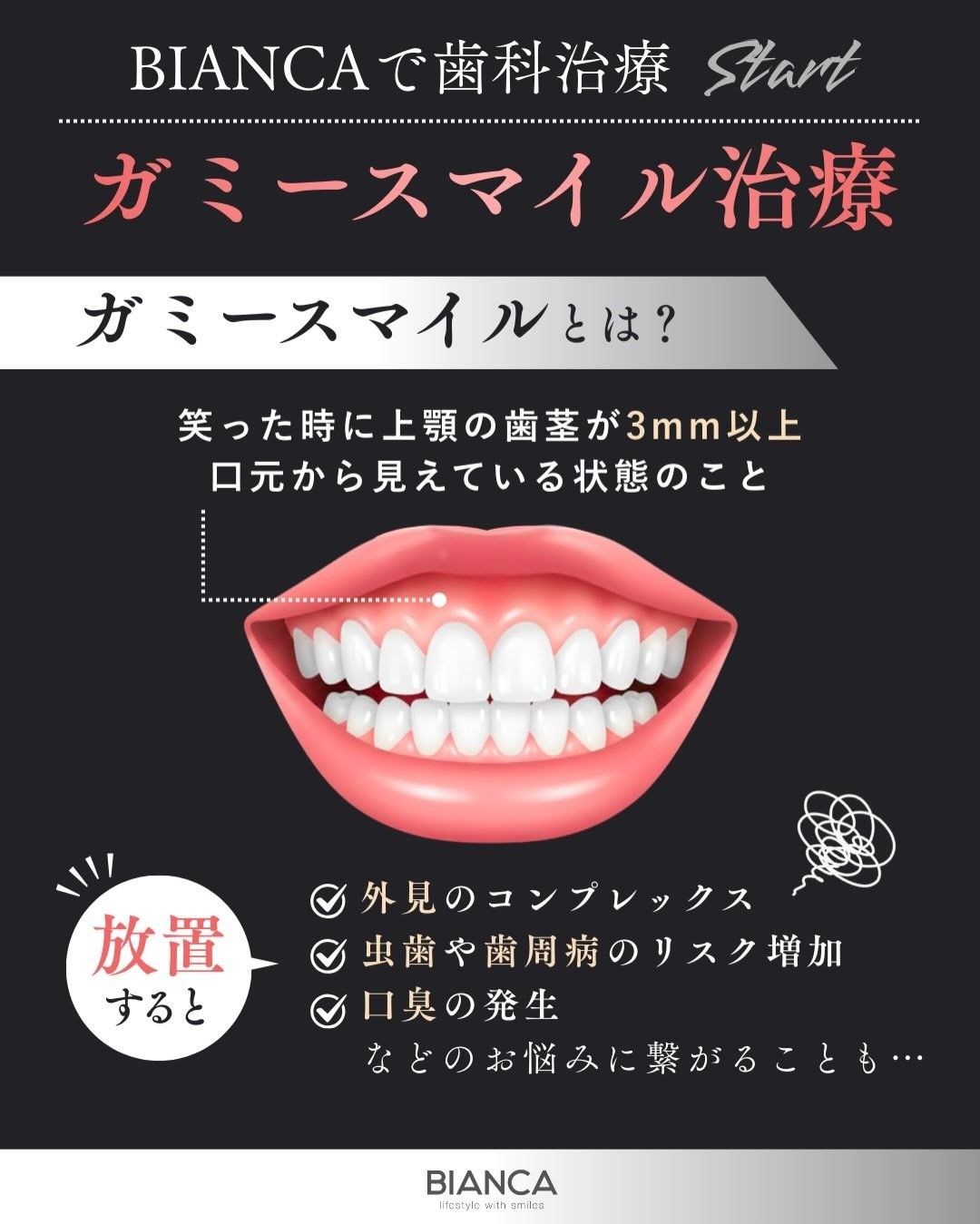
Lip repositioning is a procedure that directly addresses the range of motion of the upper lip. Therefore, if lip movement is the primary cause of a gummy smile, this is one option to consider.
I'd like to explore options other than repeated Botox injections.
Botox injections for a gummy smile work by suppressing the activity of the muscles that lift the upper lip, thereby adjusting how high the lips rise when you smile.
While adjustments can be made without surgery, regular treatments are necessary to maintain the results.
In contrast, lip repositioning is a procedure that surgically adjusts the range of motion of the upper lip to achieve long-term results.
For those who would prefer a surgical approach over repeated injections, this could be one option to consider.
Of course, surgical procedures carry risks such as swelling, pain, infection, and relapse, and it is difficult to restore the removed tissue to its original state. It is important to consider not only the desired long-term results but also the physical toll of the procedure.
Cases Where Lip Repositioning May Not Be Appropriate
A gummy smile can be caused by a variety of factors—including not only the movement of the upper lip but also the teeth, gums, and facial structure. For this reason, lip repositioning is not suitable for everyone.
If you'd like to learn more about the characteristics and treatment options for a gummy smile,An article explaining the causes of a gummy smile and treatment optionsPlease also refer to this.
When misaligned teeth or skeletal issues are the main causes
If the problem is caused by the position of the upper front teeth or the bite, orthodontic treatment may be considered as a solution.
Furthermore, in cases where the upper jawbone is significantly developed in the vertical direction, simply restricting the movement of the upper lip may not be sufficient to achieve adequate improvement.
In fact, studies on lip repositioning indicate that when skeletal factors play a significant role, the decision to perform the procedure must be made with caution.[1]。
When the gums cover a large portion of the teeth
For people whose front teeth appear short, the main cause may be the position of the gums, rather than the movement of the upper lip.
In such cases, we consider “aesthetic crown lengthening,” a procedure that adjusts the position of the gums to modify the amount of tooth that is visible.
In addition, if there is inflammation caused by periodontal disease or other conditions, it is necessary to restore the health of the gums first.
To determine which treatment is right for you,An Article Explaining the Surgical Methods and Differences for a Gummy SmilePlease also refer to this.
What does BIANCA check to determine suitability?
When considering the indications for lip repositioning, I place great importance on distinguishing between the cause of the visible gums and the changes the patient desires.
Even for the same "gummy smile," the treatment you choose will vary depending on the condition of your mouth.
How the movement of the upper lip changes between a resting state and when smiling
During the examination, we observe how the upper lip moves when the patient is relaxed and when they smile.
What matters isn't just how much of the gums are visible. It's also about where the upper lip starts to lift and how high it goes. By observing this, we can assess how much lip movement contributes to a gummy smile.
In addition, pay attention to the movement of your upper lip from side to side.
Since smiles don't always move symmetrically on both sides, there are times when only one side lifts significantly.
Since lip repositioning involves adjusting the range of motion of the upper lip, it is essential to understand these characteristics of movement.
Assess whether additional treatment is needed based on the condition of the teeth and gums
During an examination, it is also important not to determine the cause of a gummy smile based solely on the movement of the upper lip.
We examine not only the visible portion of the teeth and the position of the gums, but also the health of the bone and periodontal tissues that support the teeth. Since some issues cannot be detected by visual inspection alone, Bianca Clinic also performs X-ray examinations and intraoral examinations.
So the question is: Can we achieve the desired results by focusing solely on the upper lip?
If we determine that adjustments to the gum line are also necessary, we may consider combining this procedure with aesthetic crown lengthening. However, combining multiple procedures is not a prerequisite. We believe that identifying the necessary treatment is key to achieving a natural-looking smile.
To what extent should the movement of the upper lip be adjusted?
Some patients ask, “I’d like to hide my gums as much as possible.”
However, I don't believe that simply showing less gum is the only way to achieve a natural smile.
This is because severely restricting the movement of the upper lip can affect the expression on your face and the appearance of your lips when you smile.
It’s important to preserve not only the balance between the teeth and gums but also the natural characteristics of your smile.
"Which parts do you want to change, and to what extent?"
At Bianca Clinic, we place great importance on listening to our patients’ wishes while clearly explaining the changes they can expect from treatment and its limitations.
Frequently Asked Questions About Who Is a Good Candidate for Lip Repositioning
Here are answers to some common questions patients may have about treatment eligibility.
Q1. Can I undergo lip repositioning even if I have only a mild gummy smile?
Even in cases of a mild gummy smile, if the movement of the upper lip is the primary cause, treatment may be an option.
Q2. Is this treatment suitable even if Botox injections didn't produce sufficient results?
Yes. Just because you didn't see sufficient results from Botox injections doesn't necessarily mean that lip repositioning isn't right for you.
Results vary depending on the injection site, the amount injected, and the cause of the gummy smile. It is important to first determine why the desired results were not achieved.
Q3. Can the procedure be performed even if there is asymmetry in the movement of the upper lip?
Even if there is asymmetry, there are cases where treatment may still be an option.
However, since the treatment varies depending on the cause and severity of the differences between the left and right sides, it is not always possible to achieve perfect symmetry.
Q4. Can people with thin upper lips undergo lip repositioning?
Even if you have a thin upper lip, lip repositioning may be an option for you.
However, suitability is not determined by lip thickness alone. We assess the movement of the upper lip, the condition of the inner mucosa, and the amount of gum exposure to determine whether the procedure can be performed safely.
Q5. Do you ever combine lip repositioning with aesthetic crown lengthening?
If both the movement of the upper lip and the position of the gums contribute to a gummy smile, we may consider a combination of treatments.
However, two treatments are not always necessary. We will determine the appropriate course of action based on the cause and the changes you wish to achieve.
First, consult your dentist to see if lip repositioning is right for you.
If the movement of your upper lip is what causes your gums to show when you smile, lip repositioning is one option worth considering.
However, the reasons why gums are visible vary from person to person.
It is important not to base treatment decisions solely on the amount of gum exposure, but to also assess the movement of the upper lip and the condition of the periodontal tissues.
At BIANCA CLINIC, we evaluate the condition of your smile from a dentist’s perspective and explore the best approach to help you achieve the smile you desire.
If you're wondering whether lip repositioning is right for you, please schedule a consultation to discuss your options.
▶Lip Repositioning: Treatment Details and Before-and-After Photos
▶Schedule a Consultation at Bianca Clinic
References