column (e.g. in newspaper)
2026.11.08
What Is Lip Repositioning? An Explanation of How Gummy Smile Treatment Works and Its Benefits

He is a specialist in the treatment of gummy smiles, one of the most sensitive areas of esthetic dentistry. He practices, lectures, researches, and writes articles in Japan and abroad. He is the only Japanese dentist who is certified as an implant specialist in both the U.S. and Europe. He uses a multifaceted approach, including surgical treatment, orthodontics, and Botox injections, to address all concerns about the mouth. He is a dentist who can help patients achieve their “desired smile.

Lip repositioning is a procedure that involves removing a portion of the mucous membrane on the underside of the lips and suturing it to limit the extent to which the upper lip lifts, with the goal of correcting a gummy smile.
"When I smile, my upper lip lifts a lot, revealing my gums." "Where do they make the incision during gummy smile surgery?"
Just from the name “lip repositioning,” it may be difficult to imagine what the procedure entails. The key to understanding the procedure lies in the manipulation of the upper lip toward the inside and its relationship to the movement of the lips when smiling.
In this article, BIANCA CLINIC will explain how the procedure works, the innovative techniques reported in the literature, and the limitations of its effectiveness.
What is lip repositioning, and which areas does the procedure target?
Lip repositioning is a surgical procedure in which a strip of mucosa from the inner surface of the upper lip is excised, and the upper and lower edges of the excised area are sutured together. It is also known as upper lip mucosal excision.
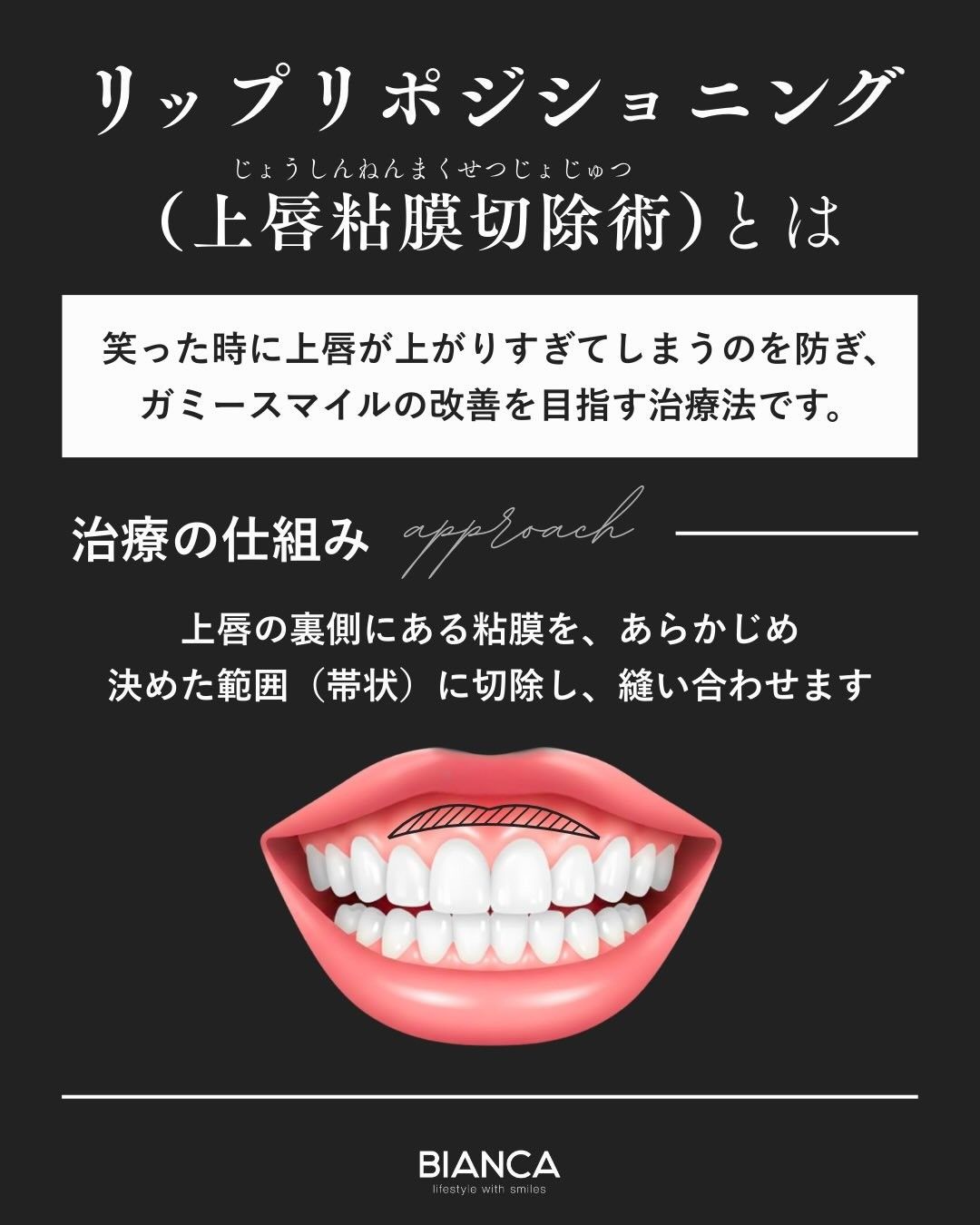
The treatment is performed on the mucous membrane between the upper lip and the gums.
If you lift your upper lip, you'll see a fold that extends from the inside of your lip to the gumline on your upper jaw. The space between your lip and your gumline is called the "oral vestibule."
In the standard procedure, the mucosa in this area is excised in a band-like fashion and sutured to make the oral vestibule shallower. This procedure is performed to limit the upward movement of the upper lip.
The procedure involves removing a portion of the mucosa on the inside of the upper lip. It differs from “aesthetic crown lengthening”—a procedure that reshapes the gum tissue around the teeth to expose more of the tooth—in terms of the area treated and the objective of the procedure.
Why does removing mucosa make it harder to lift the upper lip?
When we smile, the muscles that lift the upper lip are activated. In lip repositioning surgery, the mucous membrane on the inner surface of the upper lip is excised and sutured to reduce the range of upward movement of the lip, thereby aiming to minimize gum exposure.
Some of you might be thinking, “If muscle function is involved, does that mean you always have to cut the muscle?”
The original surgical technique does not involve cutting any muscles. While there are methods that incorporate muscle manipulation, this is not a procedure performed in all lip repositioning surgeries.
What are some surgical techniques used in lip repositioning?
In addition to the basic procedure of excising and suturing the mucosa, there are also surgical techniques that incorporate innovative approaches to fixation and the handling of the muscles that lift the upper lip.
The following is an overview of common surgical procedures to help you better understand the treatment.
Developing Innovative Methods for Suturing and Fixation
In addition to suturing the mucosa together, there is a method that involves suturing the tissue to the "periosteum," the membrane that covers the bone, to secure it in place. This technique is designed to stabilize the tissue and ensure its proper position after surgery.
It is believed that securing the implant to the periosteum helps reduce gum exposure when smiling compared to conventional methods. [2]
Add treatment targeting the muscles that lift the upper lip
There is also a method that combines this procedure with a “muscle incision,” in which a portion of the muscle is severed to reduce the force that pulls the upper lip upward.
Research reports indicate that adding muscle treatment to the procedure—rather than relying solely on mucosal excision and suturing—resulted in more stable improvements in excessive gum exposure, also known as a “gummy smile.” [1]
The key point here is that a procedure does not necessarily become suitable for everyone simply because it involves fixation or additional treatment. Don’t base your decision solely on the name of the procedure; be sure to confirm exactly which tissues will be treated, the purpose of the procedure, and the associated risks.
What are the expected benefits and limitations of lip repositioning?
With a "gummy smile," where the upper lip lifts significantly when you smile, limiting the range of motion of the upper lip can help reduce the amount of gum tissue visible. However, this procedure does not alter the position of the teeth or the underlying bone structure.
Adjust the portion visible from the lips without reducing the gum tissue
In lip repositioning, rather than reducing the amount of gum tissue itself, we adjust the portion that is hidden by the upper lip. The choice of treatment depends on whether the prominence of the gums is due to the movement of the upper lip or whether other factors are involved.
In cases where the gums cover a large portion of the teeth or where skeletal factors play a significant role, this procedure alone may not produce the desired results.
If you'd like to learn about the causes and treatment options from a broader perspective,What Is a "Gummy Smile"? A Dentist Explains the Causes, Characteristics, and Treatment OptionsPlease take a look at this as well.
At Bianca Clinic, we may consider combining aesthetic crown lengthening with orthodontic treatment. Understanding what changes occur with each procedure on its own—and what additional procedures would be needed to complement them—will help you better understand the treatment plan.
It’s not necessarily true that “once you have surgery, there’s no going back.”
Lip repositioning is not a procedure that guarantees permanent results. There is a possibility of “relapse,” in which the reduction in gum exposure achieved after surgery may increase over time.
While some studies report that improvements were sustained, others indicate that gum exposure returned to pre-treatment levels within a few months, suggesting that outcomes are not uniform. [2,3]
If you are concerned about the results reverting, please discuss this with us during your consultation. We will assess the movement of your upper lip, the condition of your gums, and the changes you’d like to see, and then propose a treatment plan tailored to your needs.
What are the benefits and precautions of lip repositioning?
While it is possible to surgically alter the movement of the upper lip, because the procedure involves an incision, it is essential to understand the recovery period and associated risks.
Advantages | Scratches are not visible on the surface
One of the key features of this procedure is that it is performed on the inside of the upper lip, allowing access without making any incisions on the skin of the face. However, since the procedure does result in a wound inside the mouth, “hard to see from the outside” does not mean “no wound.”
At Bianca Clinic, we use topical and local anesthesia to excise and suture the mucous membrane on the inside of the upper lip. The sutures used are generally absorbable, so there is no need to have them removed.
Precautions | There is a risk of swelling, pain, infection, and other complications
After the procedure, swelling, bleeding, and pain may occur, and you should be cautious about the risk of infection or relapse. There is also a risk of tightness in the upper lip or changes in sensation.
Since this procedure involves adjusting the movement of your smile, be sure to confirm in advance not only how much of your gums will be exposed but also what changes in movement or sensation may occur after the procedure.
Frequently Asked Questions About Lip Repositioning
Here are answers to questions that people looking for treatments for a gummy smile often have.
Q1. Is this a procedure that corrects a gummy smile simply by “stitching”?
Basic lip repositioning is a procedure in which a portion of the mucous membrane on the inside of the upper lip is excised and sutured.
Because it involves the removal of mucous membrane, it differs from methods that simply use sutures to secure the tissue.
Q2. Do you cut through muscle as well?
It is not mandatory. There are methods that do not involve muscle manipulation, as well as methods that combine muscle incision and other techniques.
The specific procedures performed will depend on your condition and preferences, so please consult your doctor.
Q3. Will my tooth need to be drilled?
This procedure involves excising and suturing the mucous membrane on the inside of the upper lip; grinding down the teeth is not part of the basic procedure.
If you are undergoing other dental procedures, such as orthodontic treatment, you will need to review the details of each procedure separately.
Q4. Can backsliding be prevented by adjusting the fixation method?
While it may be possible to improve stability through immobilization or suturing techniques, it cannot be guaranteed that relapse will be prevented.
Q5. Why are lip repositioning and crown lengthening performed together?
This is because, when both the movement of the upper lip and the extent to which the gums cover the teeth are involved, the treatment addresses each of these factors separately.
Not all patients need to take this medication in combination with other treatments.
Improving a gummy smile starts with understanding how the procedure works
When considering lip repositioning, it is important not only to determine “how many millimeters of gum tissue will be hidden,” but also to understand which part of the upper lip will be treated and the purpose of the procedure.
Let's consider the surgical technique and the question of whether the results will be sustained as separate issues.
At BIANCA CLINIC, our dentists perform lip repositioning. We can also recommend additional procedures performed by plastic surgeons from a cosmetic perspective.
Please consult with us about what you can expect regarding your gummy smile and share the smile you’d like to have.
▶Lip Repositioning (Upper Lip Mucosal Resection): Cases, Fees, and Procedure Details
▶BiSchedule a Counseling Appointment at Anka Clinic
References