column (e.g. in newspaper)
2026.09.15
Gut Health and Delayed-Onset Food Allergy Testing

Through holistic cosmetic medicine, we bring out your confidence and support your inner beauty. Let us pursue longevity and live a healthy and youthful life together. Our goal is to move you beyond satisfaction. We aim to be a place that makes you smile when you visit BIANCA. We aim to be such a place.
Hello! I'm Y, a nurse. 🌷
Some days are starting to feel cooler, and I can really sense that fall is here—how is everyone holding up?
“I feel sluggish even though I’m getting enough sleep,” “My chronic skin problems haven’t improved even after changing my skincare routine,” “I experience severe fatigue and gastrointestinal discomfort after meals”—are you struggling with chronic, unexplained health issues like these?
In this post, I’d like to introduce delayed food allergies—something I’d highly recommend looking into if you’re feeling like your body or skin isn’t quite right, even if it’s not serious enough to warrant a trip to the doctor. 💉
I was also surprised by the results—thinking, “That thing I love so much and eat every day…”—so I’d like to share my experience as well!
Even if a standard test shows "no abnormalities," there are cases where a "delayed-type food allergy (IgG antibody reaction)" to foods consumed on a daily basis may be a factor.
1. The Difference Between Immediate-Type (IgE) and Delayed-Type (IgG) Reactions🍎
Food allergies can be broadly divided into two types.
・Immediate-type Allergy (IgE Antibodies)
Symptoms appear within a few minutes to 2 hours after eating. Clear and acute symptoms, such as hives, anaphylaxis, and difficulty breathing, develop. The IgE antibodies are the primary type measured in allergy tests covered by health insurance (such as MAST and VIEW39).
・Delayed-type Allergy (IgG Antibodies)
Symptoms appear gradually over a period ranging from a few hours to several days (or, in some cases, several weeks) after eating. Because the onset is delayed, it is extremely difficult to identify the specific food that caused the reaction; this condition is characterized by a wide range of symptoms, including chronic fatigue, skin problems, headaches, and digestive disturbances.
2. Why are “favorite foods that you eat often” a cause?
Delayed-type food allergies tend to develop most often in response to foods that are consumed frequently on a daily basis (such as eggs, dairy products, wheat, and certain types of nuts).
It has been suggested that when undigested protein passes through the barrier function of the intestinal mucosa (as in leaky gut syndrome, for example), the immune system reacts, leading to a risk of systemic chronic inflammation.
3. My Results After Trying It Out 🥚
Our testing method involves a blood draw. 💉 With just a small amount of blood, we can screen for 219 different markers.
The graph below shows the results in descending order of the highest values.
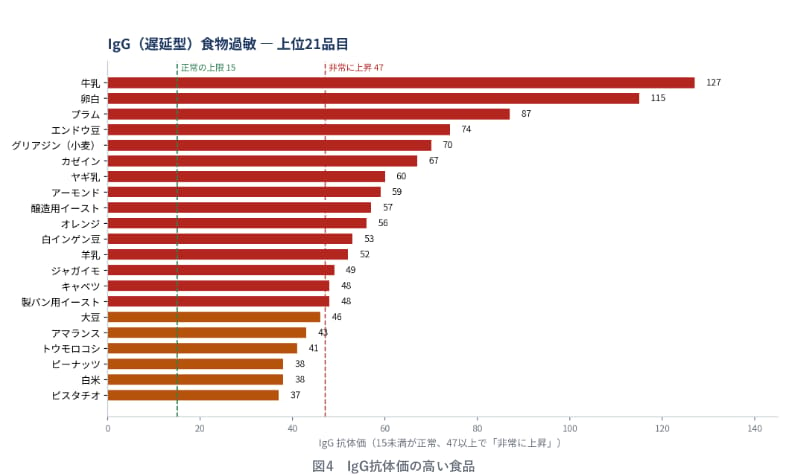
In descending order, the values are as follows: milk 127, egg whites 115, plums 87, peas 74, gliadin (wheat protein) 70, and casein 67.
Ever since I became an adult, drinking milk seemed to upset my stomach, so I switched to soy milk. I was able to confirm this once again through the results.
Also, since I ate egg whites every day—and they were one of my favorite foods—I was shocked to see such high numbers 😨
Casein, which is found in wheat and yogurt, also triggered a reaction—these were foods I ate regularly.
From Dr. Maeda, our hospital’s internal medicine specialist:It doesn't mean you can never eat it for the rest of your life, but...They suggested that I eat these foods less frequently—not every day—and that I make sure to cook eggs thoroughly before eating them.
Ever since I started rethinking my diet, I feel like I don't get the recurring breakouts I used to, and my fatigue seems to have improved too ✨
4. IgG Antibody Testing and Our Approach at Our Clinic
Our clinic offers a test (self-pay service) that comprehensively measures IgG antibody levels for a wide range of food items using only a small blood sample.
Test Items: Everyday food items (meat, fish, grains, vegetables, dairy products, etc.)
Cost: 69,300 yen (tax included) / Results available in approximately 2–3 weeks
[Important] Regarding the Interpretation of Test Results
The purpose of an IgG antibody test is not to “eliminate a food for life simply because the test result is positive.” Instead, foods that test positive should be managed by adjusting the frequency of consumption over a certain period (through restriction and food rotation), and the test results should be used as a guide to improve gut health.
✨Recommended for people like this✨
- ・People who have been feeling a bit off for a while
- ・People who feel that their physical condition or skin condition changes depending on what they eat
- ・People who have not shown any abnormalities in standard allergy tests
- ・People who experience persistent skin irritation or swelling
- ・People who find it hard to notice a difference even after receiving beauty treatments
- ・For those who want to learn about the relationship between diet and beauty
Summary
Your daily diet may be a hidden factor behind your chronic health issues!
If you are experiencing unexplained physical discomfort or skin problems, please feel free to contact our clinic for a consultation.
📍BIANCA Ginza Branch
1-8-19 Ginza, Chuo-ku, Tokyo ONE GINZA, 12th Floor
🚃 1-minute walk from Tokyo Metro Ginza-itchome Station
⏰10:00 AM to 7:00 PM
☎️050-3196-4834