column (e.g. in newspaper)
2026.10.14
What Is Scar Correction? An Explanation of Surgical Methods, Effects, and Pros and Cons

Specialist in midface and scar revision. While being involved in scar treatment, blepharoplasty, and skin cancer surgery as a plastic surgeon, I have also trained as a cosmetic surgeon. His emphasis is to provide aging care based on the harmony of the entire face, not just localized areas. We use hyaluronic acid and fat to restore the natural fullness and roundness of the face while reusing as much fat as possible to counteract the loss of volume that occurs with aging. We also focus on scar revision to make scars as inconspicuous as possible.
I still worry about old injuries and surgical scars, even after all these years.
Even if you think it can’t be cured, there are cases where surgery can make it less noticeable.
However, it’s not as simple as just removing the scar and resewing it to make it look good again.
The surgical method varies depending on the location of the scar and the condition of the skin.
In this article, Yuichiro Uotani, a board-certified plastic surgeon with the Japanese Society of Plastic and Reconstructive Surgery at BIANCA CLINIC, discusses the surgical techniques used in scar revision and the results you can expect.
What kind of procedure is scar revision?
Surgical scar revision aims to improve the appearance of scars and reduce tightness by excising the remaining scar tissue or repositioning the surrounding skin.
These include scars from injuries, post-surgical scars, and burn scars. Some are wide, while others cause the skin to be indented or pull on the surrounding tissue.
The first thing I want to tell our patients is that even with surgery, scars cannot be completely removed.
If you remove a scar, a new incision line will form in its place. How can you make that new scar less noticeable?
This is the basic concept behind surgical scar revision.
Skin wrinkles and tension also affect how noticeable scars are.
It's not necessarily true that the larger a scar is, the more noticeable it is.
For example, scars that run along skin wrinkles tend to blend in with the surrounding skin, whereas scars that run across wrinkles tend to be more noticeable.
Another factor to consider is the force exerted on the skin.
In areas where the skin is pulled tightly, even if the incision is carefully re-sutured to be as narrow as possible, the scar may widen as the wound heals.
This is why you can’t decide whether to have surgery based solely on the length or width of the scar.
What are the different surgical options for scar revision?
There are various surgical procedures for scar revision, including simple excision, segmental excision, Z-plasty, and W-plasty.
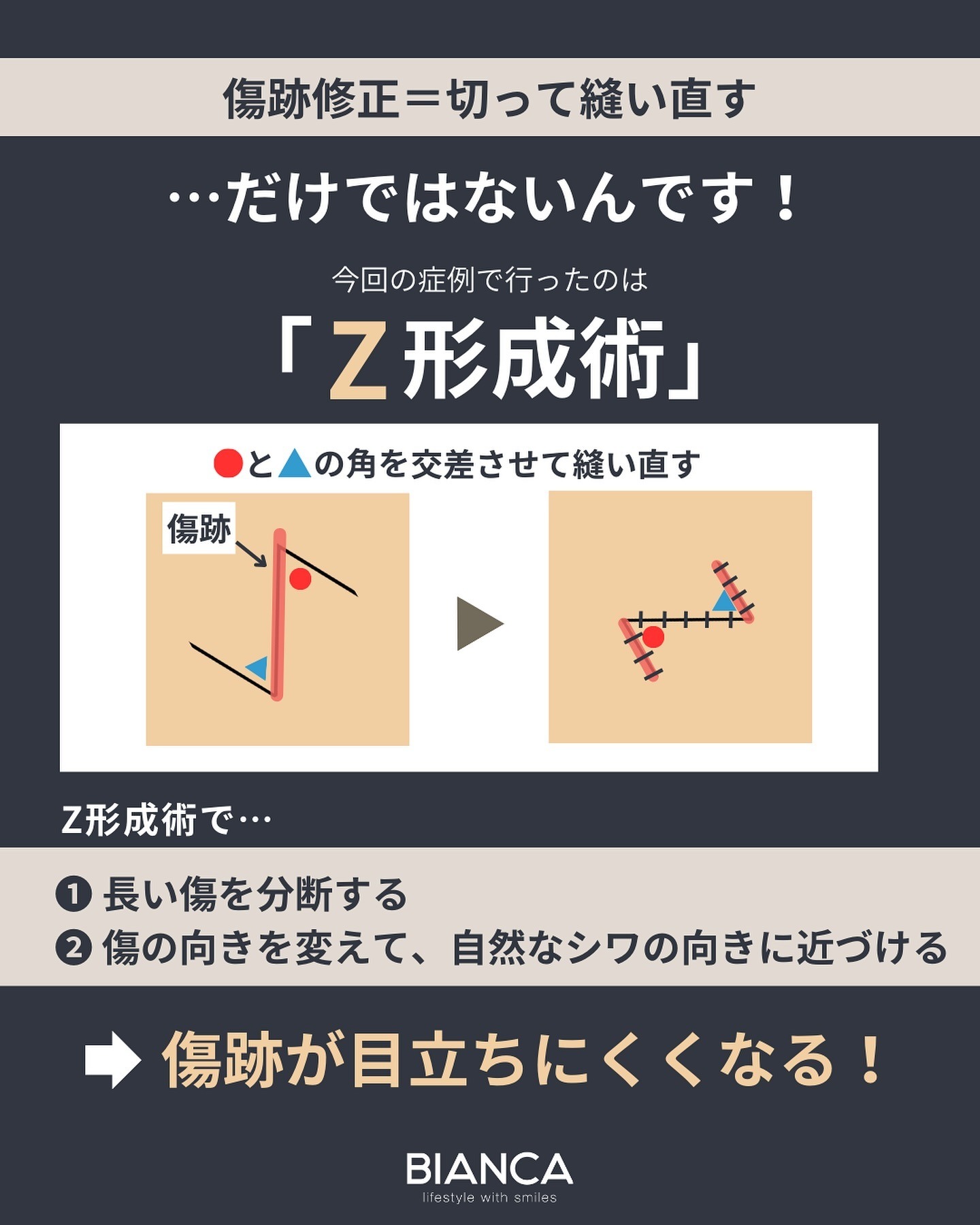
The choice of surgical procedure depends on factors such as the width and direction of the scar, the amount of excess skin in the surrounding area, and whether there is any tightness.
Here, we'll introduce the main methods.
Simple Excision | Removing the Scar and Resewing It Tightly
Simple excision is a procedure in which the lesion is removed to leave a long, narrow oval-shaped scar, and the surrounding skin is sutured together.
It is used for linear scars that have widened, among other things.
The key to this surgery lies in the technique used when suturing the tissues together.
If you only suture the surface of the skin, it puts strain on the wound.
For this reason, we suture from the deeper layers to support the wound and distribute the tension on the surface as much as possible.
However, not every scar can be resutured with fine stitches.
If you force the skin to contract when there isn’t enough slack in the surrounding skin, the scar may widen again or the shape of the surrounding area may change. We’ll determine how much tissue can be removed by assessing the condition of the skin.
Staged Resection | Gradually Reducing the Size of a Large Scar
If the scar is extensive and difficult to remove in a single procedure, the surgery may be divided into multiple sessions.
This is a segmental resection.
During the first surgery, we will remove the resectable portion, and the remaining scar will be corrected in a subsequent surgery once the skin has settled.
While this approach avoids the need to apply excessive force all at once, it does require multiple surgeries and recovery periods.
Z-Plasty | Changing the Direction of the Scar to Reduce Contracture
In a Z-plasty, a Z-shaped incision is made around the scar, and the triangular sections of skin are swapped.
This method is useful when you want to change the direction of a scar or relieve skin tightness.
For example, when scars around the mouth or eyes have contracted, causing the skin to tighten and making it difficult to move.
This condition is called “scar contracture,” and tension can sometimes be relieved through a Z-plasty.
It is also used to break up linear scars and reorient them in a direction that blends more easily with the surrounding wrinkles.
Since a new incision line is added, the total length of the scar may end up being longer than before, but the goal is not simply to make it shorter.
W-Plasty | Transforming a Straight Scar into a Zigzag Pattern
A W-plasty is a surgical technique in which a straight scar is excised and sutured to form a fine zigzag pattern.
Why go to the trouble of making it zigzag?
If the direction of a linear scar differs from that of the wrinkles in the surrounding skin, it may stand out more as a single line.
Therefore, by making subtle changes in direction to prevent the line from being recognized as a straight line, we aim to blend it seamlessly into the surrounding skin.
Of course, just because you make it zigzag doesn't necessarily mean it will become less noticeable.
Taking into account the possibility of additional incision lines, we determine suitability based on the location of the scars and the condition of the skin.
What results can be expected from surgical scar revision?
The changes that can be achieved through surgery aren't limited to making scars thinner.
The goals vary depending on the condition of the scar, such as smoothing out indentations or unevenness, or relaxing tight skin.
Smoothing out wide scratches, dents, and uneven surfaces
In some cases, a wide scar can be reduced to a thin line by excising the scar tissue and re-suturing the area.
However, the situation is slightly different with indented scars. This is because tissue in the deeper layers of the skin may have adhered to one another, causing the surface to be pulled inward.
In such cases, simply removing the superficial scar may not be sufficient; it may also be necessary to release adhesions and adjust the deep tissues.
Change the direction of the scar to make it less noticeable
Scars that run in a direction different from the skin's natural wrinkles may blend in more easily with the surrounding skin if their orientation is changed.
Shortening the scar does not necessarily lead to a good outcome.
The placement of the new incision line is also a key factor in the final result.
Improve skin tightness
When a scar hardens and contracts, it can pull on the surrounding skin, making it difficult to move.
For this type of scar contracture, procedures such as a Z-plasty can be used to relieve skin tension.
In addition to improving the appearance, another goal of surgery is to alleviate tightness and stiffness.
Are there other ways to correct scars besides surgery?
Just because you're concerned about the scar doesn't necessarily mean you need to have it removed.
If redness is prominent, a laser that targets blood vessels may be an option, while a fractional laser may be used to treat surface irregularities.
For raised scars, treatment options such as steroid injections, topical medications, or tape may be considered. In particular, keloids and hypertrophic scars may recur or worsen following surgery, so careful consideration is necessary.
Are you concerned about the color, or do you want to adjust the shape? The best approach depends on which one it is.
What are the pros and cons of scar revision?
While surgical procedures allow for direct adjustment of the shape of a scar and the surrounding tissue, they also result in a new scar.
It’s important to understand the extent to which you can aim for change, as well as the associated risks.
Benefits | You can choose the correction method based on the condition of the scar
One advantage of surgical procedures is that they can sometimes address not only the surface of the skin but also deep adhesions and contractures.
While some scars can be corrected with a simple excision, there are also cases where a Z-plasty or W-plasty is more appropriate.
When I consider surgery, what’s important to me is not to focus solely on the scars I already have.
We check how much excess skin there is in the surrounding area and determine the direction in which force will be applied after surgery.
In scar revision, it is essential to anticipate what will happen after the excision.
Disadvantages | New scars may remain and could become noticeable again
After surgery, you may experience redness, swelling, bruising, or pain.
You should also be mindful of infection, hyperpigmentation, wound separation, and raised scars.
Swelling, redness, and bruising typically last about 1 to 2 weeks, and sutures are usually removed after about 1 week.
However, it may take several months or more for the redness and firmness of the scar to subside.
Furthermore, depending on skin tension and individual constitution, it cannot be ruled out that the scar may widen again after correction.
We explain not only the changes you can expect from the surgery but also these limitations in advance.
Frequently Asked Questions About Scar Correction
Here are answers to some common questions we receive from patients regarding scar revision.
Q. 傷痕修正で傷痕は完全に消えますか?
A. 完全に消すことはできません。外科手術では新たな傷痕が残りますが、その形や方向を整え、目立ちにくくすることを目指します。
Q. 何年も前の傷痕でも修正できますか?
A. 古い傷痕でも手術できる場合があります。傷痕の範囲や周囲の皮膚の状態を確認したうえで判断します。
Q. Z形成術とW形成術はどちらが良いですか?
A. 目的によって異なります。Z形成術は傷痕の方向転換やひきつれの改善、W形成術は直線状の傷痕を目立ちにくくするために用いられます。
Q. 傷痕修正後に再び傷痕が広がることはありますか?
A. あります。とくに皮膚に強い力がかかる部位では、再び広がる可能性があるため、術後の傷口の保護も大切です。
Q. 傷痕修正の施術を受けるタイミングは?
A. 一般的には傷痕が成熟するのを待ちます。ただし、ひきつれによって動きが制限されている場合などは、早期に対応することもあります。
A Natural Look Through Scar Correction
Scar revision is not simply a surgery to remove scars.
Where should the new incision be placed, and how should it be blended with the surrounding skin?
As a plastic surgeon, that’s something I value highly.
At BIANCA CLINIC, we assess the shape and depth of scars as well as the condition of your skin, and provide recommendations—including whether surgical correction is appropriate.
Even scars that have bothered you for years may have treatment options available.
Let's start by assessing the current situation and figuring it out together.
▶Learn More About Scar Correction Treatments
▶Please contact us via the online reservation form.